
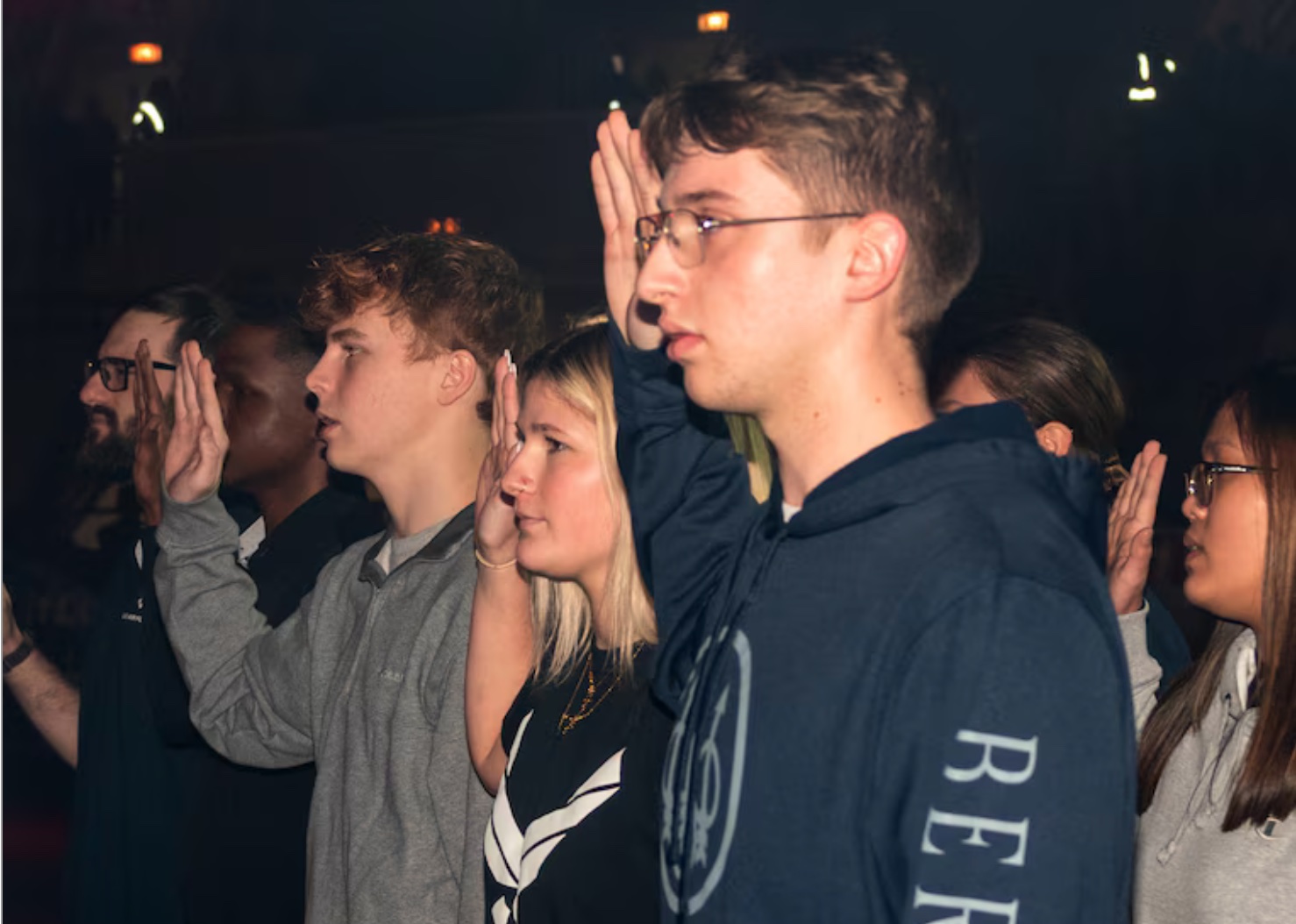
Anecdotal evidence that Americans have more confidence in the military now that Donald Trump has been elected is being supported by data.
Must Read Alaska interviewed a young man from the Mat-Su Valley this week who said that he and two of his friends enlisted in the military right after Trump was elected. The young men, right out of high school, had been waiting to see what kind of American would be commander-in-chief before they made the decision to join. The Trump win gave them confidence America would be heading in the right direction and leadership would have their backs.
The three young Alaskans may be part of a greater trend in confidence in the military growing once again, after four years of decline. Those numbers won’t be known until the military releases its next recruitment report.
Indeed, American public’s opinion of the military is turning around, according to the annual defense survey from the Ronald Reagan Presidential Foundation and Institute.

This year, confidence in the military grew from 46% last year to 51% immediately after Trump’s victory, according to the survey that went into the field immediately after the election on Nov. 5.
During the Biden Administration, the military has fallen short of its recruiting goals, although the Army improved slightly over 2023.
In 2023, for example, military recruitment it fell short by 41,000, with the Army, Navy, and Air Force all missing their targets. The Marine Corps and Space Force were the two branches that met their recruitment goals. The military started 2024 at a record low in military recruitment, and the smallest active duty force since 1940.
“Year after year, this survey shows continued, unwavering support for peace through strength,” said Roger Zakheim, Director of the Ronald Reagan Institute. “Trust and confidence in the military is rebounding after hitting a low in recent years, and Americans support increased defense spending to build a military able to deter and defeat adversaries in multiple theaters.”
The latest survey details American opinions on international engagement.
Fifty-seven percent of those surveyed, including 61% of Trump voters, believe the United States should be more engaged and take the lead on the world stage, a 15-point increase from last year, the institute found.
Other key takeaways from the Ronald Reagan Defense Institute survey include:
- A supermajority of Americans wants the United States to spend more on national defense. Seventy-nine percent of respondents want the United States to spend more on the military, including nearly nine out of ten (89%) Trump voters.
- Trust in the U.S. military is rebounding, with 51% of respondents reporting a great deal of confidence, up 5% from last year.
- This number is still nearly 20 points lower than in 2018, when 70% of respondents reported high confidence in the
military, during the Trump Administration. - A majority of respondents (61%) believe the United States military should be large enough to win two simultaneous wars at once.
- Half of Americans (49%) believe China poses the greatest threat to the United States, and 25% believe Russia poses
the greatest threat. Only 52% of respondents think the U.S. military would win a war against China, while 64% believe the United States would win a war against Russia. - Americans still favor sending military aid to Ukraine but want a negotiated end to the war. Fifty-five percent of Americans believe the United States should send weapons to Ukraine, a slight decline from recent years. There are major partisan
differences on this issue, with 74% of Harris voters supporting sending aid and only 42% of Trump voters. - A bipartisan majority (59%) supports Ukraine negotiating for peace, even if it requires conceding some territory to Russia.
- In the Middle East, freeing American hostages is a top priority.
- A majority (61%) wants freeing Americans held hostage by Hamas to be a top priority in the Middle East.
- A majority (54%) also supports the United States providing military aid to Israel, including 67% of Trump voters and 46% of Harris voters.
The survey was conducted Nov. 8-14 by Beach Research and Shaw & Company Research. The sample size was 2,510, including 1,008 telephone interviews and 1,502 online surveys. The Institute conducts a similar survey after every election to gauge public opinion on matters of national security.
There are still major hurdles to rebuilding the military. One of them is that only 23% of young people between the ages of 17 and 24 qualify physically, in part because a growing number of young people are sedentary, obese, and have associated health issues that make them unable to meet the physical fitness requirements.
Additionally, the population in general is shrinking and there are fewer young people than in the past, due to smaller families. Many young people now don’t know anyone in their immediate family who has served, which decreases their exposure to military life.
Dig deeper into the survey results at this Ronald Reagan Foundation and Institute link.
According to the Army recent recruitment report for 2024, the branch met its regular Army recruitment goal for 2024, but missed badly in its recruitment for the Army Reserve:
Regular Army (RA): 55,150 (100.27% of 55,000 goal)
Army Reserve (AR): 10,669 (72.8% of 14,650 goal)
Special Operations Recruiting BN: 3,735 (77% of 4,851 mission)
Warrant Officers: 1,610 (99.5% of 1,618 mission)
Medical Mission: 1,376 (100.7% of 1,367 mission)
Chaplains: 286 (105.9% of 270 mission)
Demographics
Male: RA 81.9% AR 66.5[JR1] [JR2] %
Female: RA 18.1% AR 33.5%
Caucasian: RA 40.5% AR 28.8%
African American: RA 25.8% AR 28.6%
Hispanic: RA 26.1% AR 32.1%
Asian/Pacific Islander: RA 6.6% AR 9.9%
Native American: RA 1.0% AR 0.6%


