
The State’s 2021 budget continues the vision of an administration that seeks to grow the private sector economy in Alaska, and wants to ensure government has a smaller, more sustainable footprint.
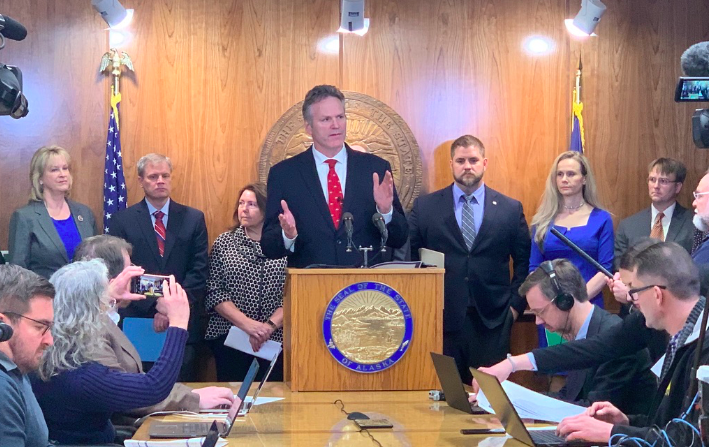
Gov. Mike Dunleavy appeared as a confident budget hawk during his press conference on Wednesday, where he was flanked by nearly his entire cabinet.
He gave brief remarks, answered some questions, before he empowered his commissioners to answer questions that related to their specific budgets, while he left for other meetings. Last year, commissioners were less involved in the actual crafting of their departmental budgets.
Dunleavy said he wants the State’s budget to be truthful and transparent, and that he is expressing the fiscal discipline that he was elected to do, following the priorities of public safety, education, and economic development — commitments he made when he ran for office.
[Budget documents are at this link]
He also vowed to continue discussions with the public and listen to Alaskans this winter as the budget is being debated in Juneau by the Legislature.
The 2021 fiscal year’s budget relies on a large portion of the Constitutional Budget Reserve to balance, but the spending itself is flat.
That came as a surprise to some political reporters, who had been predicting in their advance stories this week that the governor would continue his larger proposed budget cuts from last year.
The budget provides more for more State Troopers, more funds for courts, prosecutors, and the Department of Corrections, and it fully funds Education, as well as the statutory Permanent Fund dividend at the amount to be determined later (but thought to be about $3,000).
Dunleavy said the formula for calculating the dividend has been in statute for decades, and that he intends to follow that statute, saying the PFD does more for Alaska families than any single line item.
Dunleavy has deviated from past governors by proposing the state’s operating budget, capital budget, Mental Health budget and supplemental budget all at once. Some of the highlights:
- Capital budget: $1.3 billion with the State’s portion at $143 million.
- Operating budget: $4.39 billion.
- Supplemental budget: $270 million.
- Fully funds Court system.
- Funds three new prosecutors.
- Funds 15 new Alaska State Trooper positions.
- Increases funding for Corrections by 17.4 percent.
- Increases Pioneer Home spending by 18.3 percent.
- Provides $43 million for homelessness programs.
- Draws on the Constitutional Budget Reserve: $1.5 billion, leaving $540 million in that account.
- Draws from the Earnings Reserve Account according to SB 26 in the amount of $3.1 billion, $2.1 billion of which would pay for the full Permanent Fund dividend.
In order to accommodate the built-in growth drivers, such as set Medicaid formulas and union contracts, Dunleavy had to find cuts elsewhere. Commissioner of Administration Kelly Tshibaka said many of those will be found with travel reductions and efficiencies, with the end goal of looking for savings that also meet the mission of the departments.
If in Year One, Dunleavy showed Alaskans what a balanced budget looks like, with serious reductions in some program favorited by some Alaskans such as ferries, Pioneer Homes, and Senior Benefits, in Year Two, he is showing what a budget looks like when it’s holding steady.
His balanced budget was not accepted by the Legislature last year, which added back most of his cuts, but also didn’t override his vetoes for other spending.
This year, the Legislature will have to decide if it wants to take $1.5 billion from the Constitutional Budget Reserve, and then go into next year with not enough money to do a repeat of that. The result will likely be that the Democrat-led House and the Senate will once again take half of the statutory PFD and use it to pay for government services this year, and preserve more of the Constitutional Budget Reserve than is being proposed by the governor.
The budget is not sustainable at this point, which underscores the importance of the cuts he was able to make last year. Tough choices are clearly ahead.
Dunleavy also indicated he’ll be offering legislation to strengthen reading and algebra outcomes in the public schools, and will be looking at the 55 percent of the budget that is tied to formulas, giving budget writers little room to work with as they try to pay for everything that is mandated in statute.


