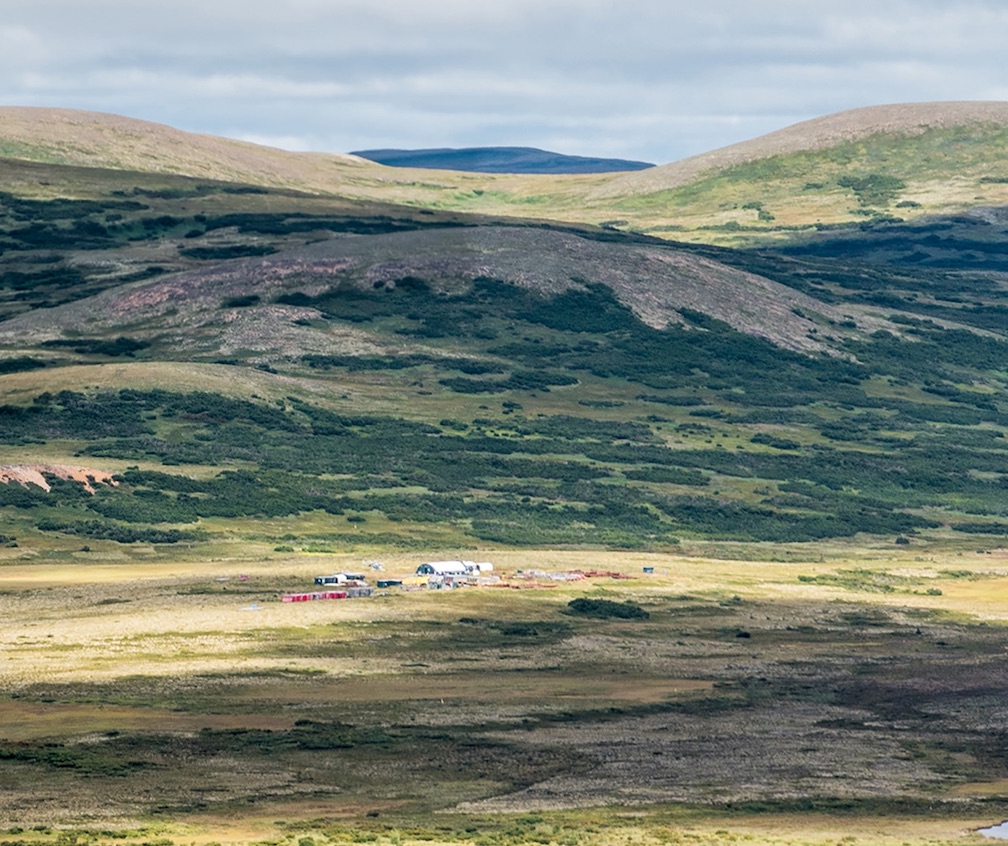
When the federal government exchanged with the State of Alaska, it didn’t really exchange it. It just took State of Alaska land and, in return, ratcheted down control of the land it supposedly gave the state.
That is the gist of a lawsuit in federal court in Washington, D.C. on Thursday against the federal government, asking for $700 billion in damages over broken contract that the state has with the feds regarding mining and resource development on state-owned land.
See related story on a separate set of lawsuits by the Pebble Partnership at this link:
Through the 1976 Cook Inlet Land Exchange, the State agreed and relinquished 700,000 acres of State land for 525,000 acres of federal land. With its newly acquired land, the U.S. was able to create Lake Clark National Park and Preserve. The state got land for mining.

The complaint, filed in the U.S. Court of Federal Claims, asks for damages for the confiscated lands, which the federal government will not allow the State to use. The EPA has tied up mining activity, which was the purpose for the land in the first place. The State estimates the value of the taken land at more than $700 billion, which will likely be among the highest sought in the Court of Federal Claims.
Last year, the state took the matter to the U.S. Supreme Court, asking the court to order the the EPA to correct its breaking of a federal permitting process.
“The Court denied that request, necessitating the filing of this action. The State also anticipates filing a separate suit in the U.S. District Court challenging EPA’s unlawful action on substantive grounds. Either of these new cases may be appealed—ultimately to the Supreme Court if necessary,” the Alaska Department of Law said.
“No other State in the union relies on its mineral riches as intensely as Alaska does. At statehood, the United States conveyed to Alaska title to the minerals in over 100 million acres of the new state’s land, with the expectation that the State would develop these mineral resources to support its economy and the wellbeing of its citizens,” said Alaska Governor Mike Dunleavy.
“The Alaska Constitution requires that the State manage its resources for the maximum benefit of its people, and reliance on our natural resources is the cornerstone of Alaska’s statehood promise. Yet, the federal government would turn these State lands—these lands conveyed to us specifically because of their mineral value—into a de facto national park. It is wrong, and Alaska will challenge it,” Dunleavy said.
“We don’t think they have the authority to do this period—to shut down 309 square miles to any possible development and any possible mine? That’s counter to everything we know regarding State sovereignty and state authority under the U.S. Constitution,” said Alaska Attorney General Treg Taylor. “But if a court finds that they do have the authority then Alaska must be compensated for the inability to use and develop its own resources, which was the foundational basis for Alaska even becoming a state.”
The land exchange in question, which also included a land swap for CIRI, Inc., an Alaska Native corporation, was “the largest land exchange in American history.”
The land exchange contract was a congressional amendment to the Alaska Native Claims Settlement Act. The exchange contract and the federal legislation ensured that the State secured its mineral rights and codified the exchange guarantee that the new lands “shall include mineral deposits” and the “[m]ineral deposits in such lands shall be subject to lease by the State as the State legislature may direct.”
“Negotiations between the State of Alaska, the United States government, and regional Alaska Native Corporation CIRI in 1976 resulted in a propitious land exchange that balanced conservation with the opportunity for responsible natural resource development in Bristol Bay,” said DNR Commissioner John Boyle. “This administration is blatantly rescinding that agreement specifically granting the people of Alaska this land with incredible mineral potential. It is a glaring injustice for the federal government to restrict the State of Alaska from performing our constitutionally-mandated duty to responsibly develop our resources for Alaskans. DNR believes that every proposed natural resource development project deserves to be evaluated through a robust, fair and science-based permitting process.”
“This seems to be the latest in an ongoing agenda by the federal government to re-write its past agreements with Alaska. It’s time to put a stop to these actions or at least pay for what they’re taking,” said Department of Fish & Game Commissioner Doug Vincent-Lang. “The game, fish, and other resources belong to Alaskans by agreement, by compact, and by citizenship.”
Decades after the exchange, as the State complaint lays out, the largest undeveloped copper deposit in the world was discovered on the lands the State received in the land exchange. Known as the Pebble Deposit, the State’s lands contain more than 57 billion pounds of copper, in addition to enormous quantities of gold, silver, and rare earth elements necessary to power developing energy sectors.
In spite of the United States’ guarantee, the EPA in January 2023 issued an unprecedented order (the “Final Determination”) that effectively prohibits any mining from occurring on these State-owned lands.
In the filing of this complaint, the State is protecting its interests as the landowner from unlawful federal actions, including being dispossessed of its right to manage its own property. The State is not endorsing any specific mining project and has not completed State-required permitting decisions for the mining company’s proposal. The State believes that a development proposal should be allowed to complete the State and federal permitting process before being arbitrarily shut down before these regulatory processes perform their functions.
That permitting work was ongoing when the U.S. Army Corps denied the company’s Section 404 permit. Before the State could appeal that decision and just as the State was prepared to resume its regulatory review, EPA prematurely vetoed any mining in an area much larger than the footprint of the proposed mine.
Read the complaint here.