Austin Barrett is now a sentenced kidnapper whose actions in 2016 led to the death of David Grunwald, the Palmer teen who was beaten and shot by a gang of four teenage boys who were on a violent wilding.
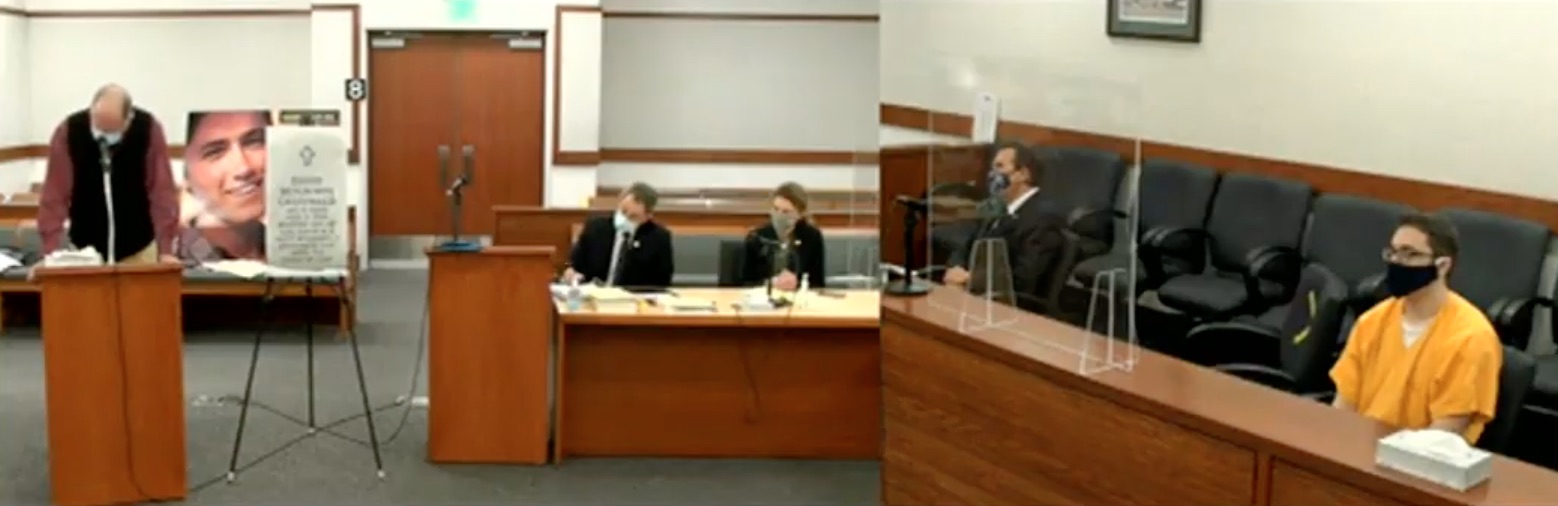
Barrett is the first of four to be sentenced, and the sentencing hearing turned bizarre today after the defense attorney got in front of the microphone and stammered his way through a theatrical presentation.
Four years after the murder of Grunwald, Barrett had earlier this year negotiated a plea bargain and was today sentenced by Palmer Judge John Heath to 64 years, with 20 suspended. He will be eligible for a parole hearing after 15 years.
Grunwald, son of Alaska Parole Board Chair Edie Grunwald and Ben Grunwald, was just 16 years old, when he had partied with a group in a camper on the evening of Nov. 13, 2016.
It was all a set up. Five youths had a plan and executed it in cold blood that November night when Grunwald was pistol-whipped in the behind Erick Almandinger’s Palmer house and then driven to a at Jim Creek on the Knik River where he was walked into the woods and shot dead.

Almandinger, Brad Renfro, Dominic Johnson, and Barrett were all arrested and ultimately convicted for the crimes.
In today’s sentencing hearing, the state prosecutor and defense attorney had come to a plea agreement to avoid a trial. The state’s attorney said that with COVID-19 delaying trials, it was better to get this plea agreement on the books, as the court system will be backed up for at least three years.
The Grunwalds both gave heartfelt testimony about how the killing of their son has impacted their life, and asked for the maximum sentence.
Defense attorney Craig Howard then gave a tense, rambling, long-winded, and self-referential defense of his client, at times blaming David Grunwald, the victim, for getting involved with a group of boys who had no moral compass.
“I’m saying this young man has a moral compass. Having said that, his moral compass was frozen for a couple of years,” Howard said.
Howard gave the “boys will be boys” defense, reminding the judge that as a teen, all he had to worry about was stealing his dad’s condoms, and that he couldn’t even buy a Playboy magazine, while today, teens are exposed to much darker elements on social media that their parents don’t know about. They were all bad kids, he said, but Austin Barrett is now remorseful and understands that he did something very bad. But it wasn’t pulling the trigger, the attorney argued.
“With murders, some homicides are one-time deal, they happen to normal, regular people. A person should be given a chance,” Howard said.
In a 45-minute presentation that sometimes seemed like he was melting down emotionally, Howard talked about how deeply this case had affected him. He said he had to throw away his slippers because they were the same brand that the 16-year-old victim wore.
With a trembling voice, incomplete sentences, and jerky motions, Howard referred to the novels, “Lord of the Flies,” and “The Oxbow Incident,” which he had re-read recently. The former book reminded him of the dystopian youth involved in the murder of Grunwald, and the latter book reminded him of how the pursuit of justice can go awry.
At another moment in his presentation, he described his own father as the original “Great Santini,” and recalled how much he had disappointed his father by not going into the military, and how he thought he dad had died prematurely because of that. He described having to resuscitate his own child once, and how hard it is to be a defense attorney. Many of his colleagues have succumbed to alcoholism, lost marriages and killed themselves, he said, because of the heavy burdens of the work they do.
“I can’t believe I’ve made it this far,” Howard said, describing the “psychic damage” he has suffered from being a defense attorney. “This picture of David Grunwald will live in my mind forever.”
Howard said, at one point, that he also went to Sunday school as a kid, and that he prefers the New Testament to the Old Testament. Later on, he said he doesn’t have the religious faith the Grunwald’s have.
“Sometimes I get it, and then I lose it,” he said.
He also refuted Edie Grunwald’s statement, saying she said he, Howard, was in “cahoots” with the defendant, “and that I am complicit in the lies. I don’t see how she can say that. She’s not omniscient. Only God is.”
Howard, who has represented a number of defendants in horrific murders in Alaska, including then-23-year-old Kirby Anthoney, who committed triple murder and rape of two children in 1987. Howard talked about a friend of his from high school who ended up being shot in Vietnam, causing Howard to wonder what his death meant.
But this case obviously got to Howard. He was a hot mess, even while coming to the defense of his young client.
“I’ve read hundreds of statements of victims and I tell you, it’s usually just black and white. Colonel Grunwald’s statement — I could not read it. I kept having to put it down. The pain just oozed through it. The grief,” he said.
But later Howard said that the Grunwalds’ statements into the court record were designed to influence the parole board in 15 years, and how he wants his own remarks to also be recorded and provided to the parole board.
He made a point of noting that Edie Grunwald is the chair of the parole board and inferred that her current position may influence future proceedings.
“The Grunwalds are victims. But the elephant in the room here is she is also the chairman of the State Parole Board,” Howard said.
After he had exhausted the courtroom, Howard ended his statement by saying he hoped the Grunwalds would permit him to visit the gravesite of their son.
“I need closure in theis case. I’m not ready for closure. If The Grunwalds don’t want me to go to his grave, I understand. I would like to know, it would go a long way for me because … I’m emotional, I would like to go to his grave and get some closure. It’s my one request,” Howard said.
Barrett, now 20, read his apology to the court. The Grunwalds had left the room for that portion of the proceedings. They didn’t want to hear it.
Then, the judge accepted the plea agreement, Barrett was fingerprinted, and led from the courtroom.
The question of who pulled the trigger has still not been resolved, as all four of the youth declared they were not the culprit. But Barrett’s case was considered the most difficult to prosecute because he did not engage in social media or texting after the murder, and the others did, leaving a damning trail behind them.