
DOJ SENDING EMERGENCY FUNDS TO SUPPORT LAW ENFORCEMENT
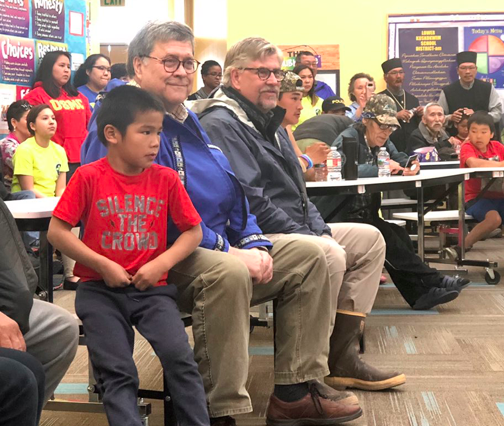
Fresh off of his trip to rural Alaska, U.S. Attorney General William P. Barr on Friday declared a law enforcement emergency under the Emergency Federal Law Enforcement Assistance Program.
Barr made $6 million immediately available to the state of Alaska for law enforcement needs of some “lawless” Alaska Native villages, with more funds and programs on the way, although it’s not clear how all of the money will be funneled to law enforcement entities or what the reporting structure will be. The $6 million will go to the state Department of Public Safety, but is not intended to fund more actual village public safety officer positions.
[Read: Barr comes to learn about violence in the village]
The emergency funding will come from the Office of Justice Program’s Bureau of Justice Assistance and will be used to train village public safety officers, village police officers, and tribal police officers in rural Alaska. It will also pay for mobile detention cells.
Another $4.5 million in funding will be granted to tribal entities to support 20 officer positions.
The public safety emergency declaration from the Department of Justice comes at the same time the Dunleavy Administration trimmed the village public safety officer program by $3 million because the program has been unable to recruit qualified people and has not been able to spend its $14 million budget year after year.
Also included in the federal grant package:
- Up to $14 million in Victim Assistance Funding. Barr was impressed with the Children’s Advocacy Center in Bethel and wants to see similar centers funded in other rural Alaska areas. This funding is also for child advocacy centers in the Lower 48; is not all likely to come to Alaska.
- Barr is tasking federal law enforcement agencies with assisting the state in the prosecution of cases in rural Alaska. Four Special Assistant U.S. Attorneys will assist state District Attorneys in rural Alaska. This will increase the number of arrests and prosecutions and will clear some criminals out of villages.
- The federal agency also reauthorized $160,000 in Violence Against Women Act funding to provide technical assistance to tribes so they can write grant applications for more funding.
- $10 million in funding for VPSOs in Alaska (part of this through the state and part through Native Organizations – it is still not clear how the funds will be split)
- Creation of a Rural Alaska Violent Crime Reduction Working Group, led by U.S. Attorney Bryan Schroder. The group will look for ways to build the capacity of federal, state, and tribal law enforcement in rural Alaska with an emphasis on domestic violence and crimes against children.
- An additional $162,000 available to the U.S. Attorney’s Office to establish an additional Project Safe Neighborhoods target site encompassing rural Alaska.
“In May, when I visited Alaska, I witnessed firsthand the complex, unique, and dire law enforcement challenges the State of Alaska and its remote Alaska Native communities are facing,” said Attorney General Barr in a statement. “With this emergency declaration, I am directing resources where they are needed most and needed immediately, to support the local law enforcement response in Alaska Native communities, whose people are dealing with extremely high rates of violence. Today, I am also directing each component and law enforcement agency of the Justice Department to submit plans within the next 30 days to further support federal, state, and tribal public safety efforts in rural Alaska. Lives depend on it, and we are committed to seeing a change in this unacceptable, daily reality for Alaska Native people.”
Barr acknowledged that Alaska has some of the most remote communities in all of America. Geography contributes to law enforcement problems not seen anywhere else in the United States with one-third of Alaska’s villages having no local law enforcement personnel at all, according to the Anchorage Daily News.
The State of Alaska had over 100 VPSOs during the Parnell Administration but that dropped dramatically during the Walker Administration and is now hovering around 50. VPSOs are difficult to recruit for remote villages and encounter problems with cooperation from locals. The turnover is high and VPSOs often work without back up. They generally are not armed, although they can be, if their tribal entity managers approve it. VPSOs work for tribal entities that are given the funds for the VPSOs by the State of Alaska Department of Public Safety.
[Read: Village public safety officer program can’t use the cash it has]
Additional near-term measures by Department of Justice components include:
- The Office of Violence Against Women will issue an award for sexual assault training and technical assistance in Alaska, including training community health aides in Alaska Native villages to perform sexual assault forensic exams and training for victim advocates. The project will include community sexual assault training, which will address coordinated responses to sexual assault across the community. This award will also train village-based victim advocates to accompany victims throughout the process, including prosecution, as appropriate. This is important because in villages, many rapes go unprosecuted because victims don’t want to come forward and go through the trial of the perpetrator, who may be a relative.
- Extending the application deadline for the Crime Victim Fund tribal set-aside solicitation (part of the $167 million available to tribes for victim services in FY 2019) to Aug. 16, 2019. This money may be used to fund direct services and advocacy, domestic violence shelters, rape crisis services, children advocacy programs, and elder abuse programs.
- Extending the application deadline to July 15, 2019, for programs that target mental health/drug addiction, reentry initiatives, and community crime reduction.
- The COPS Office has two grant programs that it will reopen to afford Alaska the opportunity to apply:
- The Anti-Methamphetamine Program is open to state law enforcement agencies with multijurisdictional reach and interdisciplinary task force structures, in states with high seizures of precursor chemicals, finished methamphetamine, laboratories, and laboratory dump seizures.
- The COPS Anti-Heroin Task Force Program is open to state law enforcement agencies with multi-jurisdictional reach and interdisciplinary team (e.g., task force) structures, in states with high per capita rates of primary treatment admissions.



