
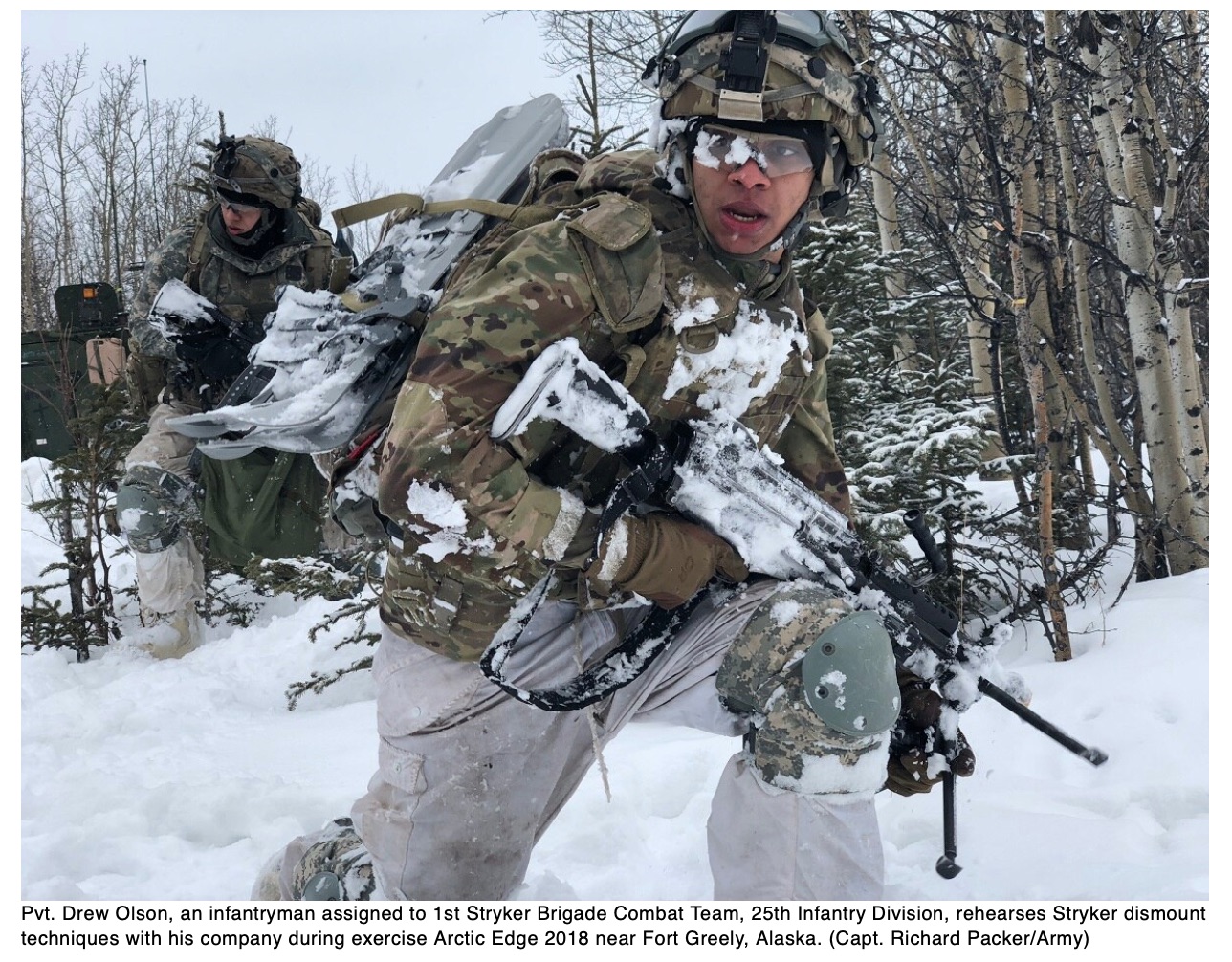
The U.S. Army has released its Arctic strategy, “Regaining Arctic Dominance.” The strategy lays out how the Army will generate, train, organize, and equip U.S. forces to partner with Arctic allies and secure our national interests and maintain regional stability.
The new Arctic focus for all branches of the military is a result of work by Sen. Dan Sullivan, a member of the Senate Armed Services Committee. He included in the Fiscal Year 2019 National Defense Authorization Act a provision requiring each branch of the Armed Forces to produce its own Arctic strategy.
“I commend the U.S. Army, under the leadership of former Secretary of the Army McCarthy, acting Secretary of the Army Whitely, and Army Chief of Staff General McConville, for their efforts to rebuild the Army’s Arctic capabilities, which have significantly atrophied over the past decades,” said Senator Sullivan. “The Army’s intent to establish a Multi-Domain Task Force with specially-trained and equipped combat brigades in Alaska highlights the strategic importance of our state, and provides the Army with the tools to create unique challenges for our competitors in the Arctic. This strategy, and those of the other services, sends a strong message to our allies and adversaries that the United States plans to project and sustain power throughout the Arctic now and into the future.”
Among other provisions, the Army’s Arctic strategy places a focus on:
- properly training and equipping the U.S. Army’s Arctic Warriors for extended operations,
- improving the physical and mental health of soldiers stationed in the Arctic,
- highlighting Russian military activity and Chinese interest in the region,
- developing military concepts and doctrine for operating in cold weather and mountainous regions,
- prioritizing Arctic training and expertise for certain command positions,
- examining benefits of establishing an Arctic Army Prepositioned Stocks set,
- expanding joint and international training with our allies and partners in the Arctic, and
- cooperating and consulting with Alaska Native communities.
The Department of Homeland Security, U.S. Air Force, and U.S. Navy have already released their new Arctic strategies.
“The release of this strategy is timely, especially given increasing levels of great power competitor activities in the Arctic region. Operating in the Arctic allows the Army to powerfully project our forces to enhance our ability to respond in competition, crisis and/or conflict,” the Army noted in a press release.
The Arctic is a vital area containing many of our nation’s natural resources and key shipping channels, and is a platform for projecting global power and a possible avenue of attack in conflict, the Army wrote. Enhanced Arctic capability will increase the Army’s ability to operate in extreme cold-weather, mountainous and high-latitude environments and reflects the Department of Defense’s overarching Arctic Strategy, which was issued in June 2019.
The Department of Defense ― driven by Congress and the National Defense Strategy focus on Russia and China ― took some convincing that Alaska is an economic and strategic stronghold.
“Although it’s changing, the Pentagon has had to be dragged into this. They’ve been the laggard, not the leader,” Sullivan told Defense News last year, when he chaired the Senate Armed Services Committee’s Readiness and Management Support Subcommittee. “I’ve seen the awakening across the board, which is a positive thing, but we still need to get there.”


