
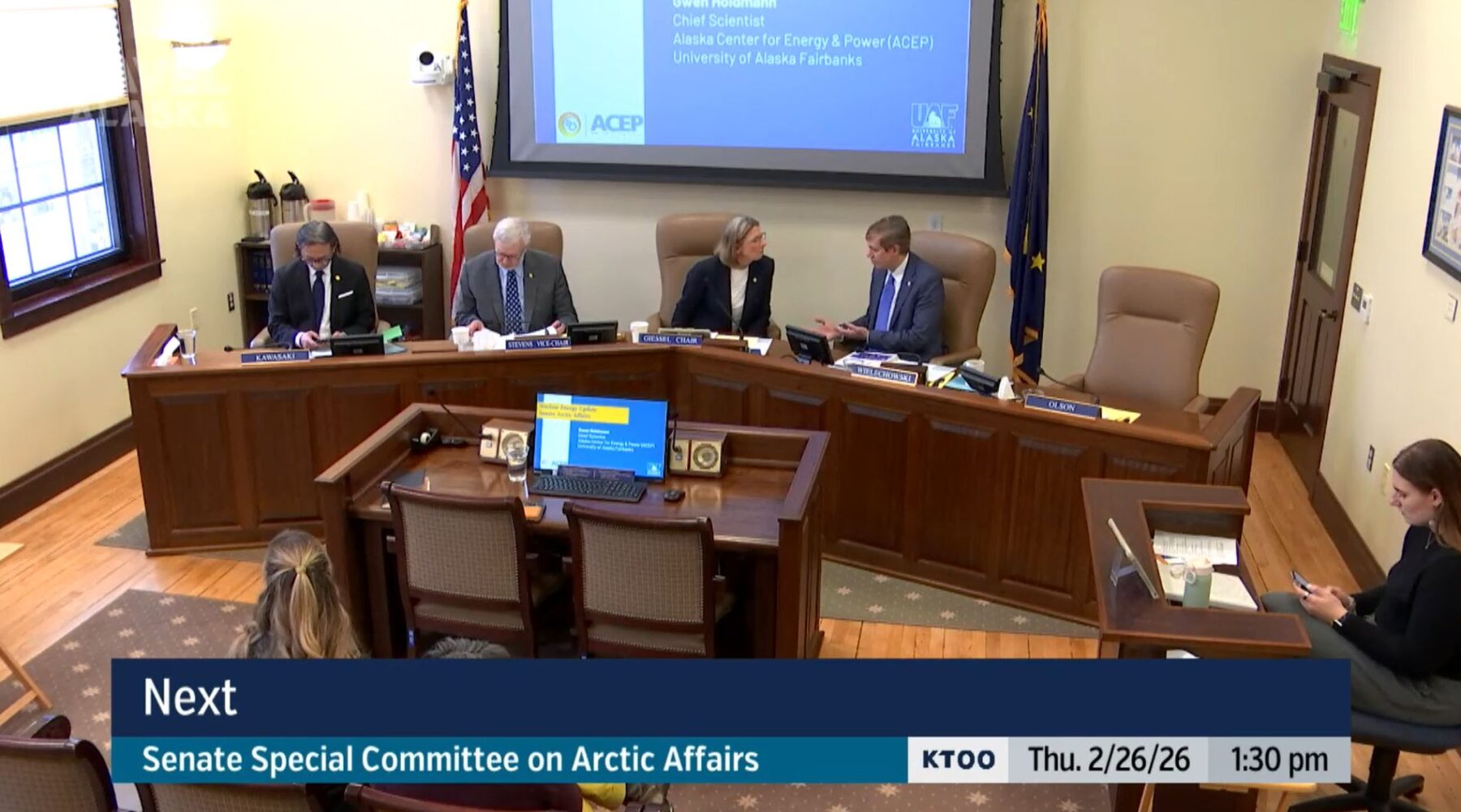
The Alaska Senate Arctic Affairs Committee convened Thursday in Juneau for a wide-ranging briefing on advanced nuclear technologies and a resolution reaffirming ties with Greenland, highlighting the state’s push for energy innovation and circumpolar cooperation.
Advanced Nuclear Briefing Highlights Safety, Timelines, and Rural Energy Savings
Chief Scientist Gwen Holdmann of the Alaska Center for Energy and Power delivered a detailed overview of small modular and microreactors, stressing their inherent safety features and factory-built modularity. She placed printed draft guides on advanced reactors before each member, noting persistent public confusion. “These reactors have a negative reactivity coefficient,” Holdmann explained. “They really can’t melt down in the way conventional reactors did.”
Holdmann updated the committee on the Eielson Air Force Base microreactor project, where Oklo received a notice of intent to award last summer, and Fort Wainwright’s potential under Project Janus. She described 2028 as the publicly stated target for Eielson operations but called it “very optimistic.” On licensing, she noted military and test reactors bypass full NRC processes, while commercial designs face longer reviews. “The ten-year horizon is shrinking,” she said, citing ongoing INL pilots and fuel supply chain milestones like Project Pele’s TRISO delivery.
Turning to rural energy, Holdmann presented data showing AVEC communities save residents roughly $1.7 million annually compared to independent utilities in Southwest Alaska through pooled resources and efficiency. “Pooling of resources and trying to get a little bit more bang for your buck,” she emphasized, while noting Alaska’s subsidy levels remain lower than many northern peers.
SJR 24 Honors Enduring Alaska-Greenland Relationship
The committee then considered Senate Joint Resolution 24, which honors longstanding U.S.-Greenland-Denmark cooperation in the Arctic. Staff Paige Brown outlined shared challenges including high living costs, food security, and climate impacts such as coastal erosion. “Progress in the Arctic depends on strong relationships with trusted partners, particularly Greenland and the Kingdom of Denmark,” Brown stated.
Chair Cathy Giessel (R – Anchorage) framed the resolution as a proactive affirmation of circumpolar collaboration rooted in cultural and historical ties between Alaska Natives and Greenland Inuit. “The Arctic has been noted for its peaceful collaboration, and this is intended to emphasize that and a desire to maintain it,” Giessel said. Senator Scott Kawasaki (D – Fairbanks) expressed support but cautioned about potential misperceptions amid federal discussions. Senator Gary Stevens (R – Kodiak) added a call for historical accuracy regarding past U.S.-Greenland relations.
The committee set an amendment deadline of March 4 at 5:00 p.m. and held the resolution for further consideration on May 5.
The session underscored Alaska’s dual priorities: positioning for next-generation energy solutions that could transform rural power economics and reinforcing diplomatic ties critical to Arctic stability.


