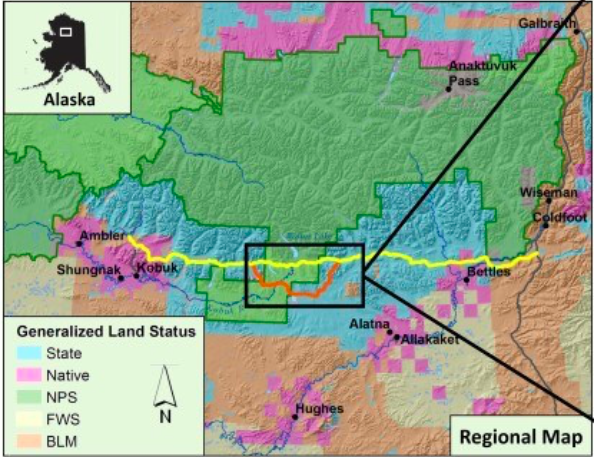
The U.S. Department of Interior has again postponed the release of a final decision regarding the highly debated Ambler Road, an industrial access to mining in Northwest Alaska.
The proposed road, which would link to extensive reserves of copper, zinc, lead, silver, and gold, has faced numerous challenges due to its location crossing federal land.
Initially, the permits for the road were issued by the Trump Administration, which recognized the long-established need for access to the mining area, particularly for minerals that are key to national security.
Last year, the Biden Administration revoked these permits, citing concerns over inadequate consultation with Alaska tribes and insufficient evaluation of the road’s potential impact on fish and caribou habitats.
The decision was made despite a joint authorization issued in 2020 by the Bureau of Land Management, the Army Corps of Engineers, and the National Park Service.
The project, estimated to cost $799.6 million, holds the potential to yield significant quantities of valuable minerals over its projected 12-year lifespan, including approximately 159 million pounds of copper, 199 million pounds of zinc, 33 million pounds of lead, 3.3 million ounces of silver, and 30,600 ounces of gold.

The next “final” record of decision on the Ambler Road project has now been delayed until the second quarter of 2024, a decision that comes as a surprise, given the Department of Interior’s previous assurance that a decision would be reached by the end of 2023.
The Ambler Mining District access was promised to Alaska under the Alaska National Interest Land Conservation Act (ANILCA) in 1980. The federal government has repeatedly reneged on the promise. In 2022, the Bureau of Land Management’s approval delays led to a shorter field season, resulting in job losses.
The 2023 field season was expected to build upon the past, since delayed approvals and continue with crucial field studies, permitting, and data collection. To progress the pre-development work, the Alaska Industrial Development and Export Authority Board has approved $44.8 million of the $70 million budget.
The Ambler project is of strategic importance, as it supports America’s national defense efforts and reduces reliance on mineral imports from China, according to AIDEA Executive Director Andy Ruaro. By developing domestic critical minerals production, the United States can lessen dependence on China, which has few pollution requirements and seeks to control and dominate critical mineral supplies similarly to how OPEC controlled oil in the 1970s.