

IAN TUTTLE / NATIONAL REVIEW
“I’ve listened to your stories. Now I have to listen to the animals.” – former Interior Sec. Sally Jewell, 2013
The 950 residents of King Cove, Alaska, have been trying to build an emergency road to nearby Cold Bay. They have been trying to build the road for 40 years.
King Cove is near the western tip of the Alaskan Peninsula; a few miles west begin the Aleutian Islands. King Cove has a school and two churches and a Chinese restaurant, and its economy is buttressed by the presence of PeterPan Seafoods, one of the largest commercial fishing operations in North America, whose seasonal employees constitute about one-third of the local population. But like most towns in the Alaskan bush, it has only a small clinic and no full-time physician. For everything from minor surgeries to delivering a baby, residents must venture to a proper hospital — 625 miles away, in Anchorage.
Rarely can that be done direct from King Cove. The town’s 3,500-foot gravel airstrip, built in 1970 in the Delta Creek Valley north of town, cannot accommodate large aircraft, and the single- and twin-engine aircraft that use it are particularly vulnerable to King Cove’s weather and geography — which are, to put it lightly, forbidding. The airstrip is situated between two volcanic peaks, which funnel into the valley winds that regularly reach 70 mph. And while clear, calm days do visit King Cove, bad weather — thick fog, lashing rain, driving snow — is Mother Nature’s curse on King Cove a third of the year, sometimes more.
So getting to Anchorage requires first getting to next-door Cold Bay, a hamlet of 100 people, mainly transient state and federal employees, that happens to be home to a 10,000-foot, all-weather airstrip capable of handling the long-distance flight to the state’s largest city. (Why tiny Cold Bay has such an outsized role in King Cove’s story is something of a historical accident: Cold Bay Airport was built in World War II, when this distant patch of the Alaska Territory became a strategic outpost against a possible Japanese invasion. The site chosen, Army engineers agreed then, and locals agree now, was the only one in the area suitable for an airstrip of such size.)
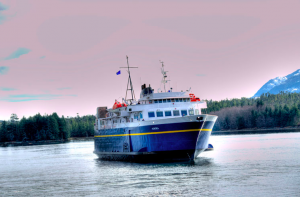
The problem is getting to Cold Bay. In clear weather, that can be done with an air taxi from King Cove’s airstrip. But when the weather is foul, making the trip to Cold Bay requires a boat (and calm seas) or a medevac helicopter (often supplied by the Coast Guard) — and, potentially, more time than a patient has.
To solve this problem, King Cove residents have sought to build a one-lane, gravel road from King Cove to Cold Bay, across the two-mile-wide isthmus that links the towns. Nineteen miles of the 30-mile road already exist. But eleven miles remain — and they traverse the Izembek National Wildlife Refuge.
This is one infrastructure project in which the Obama administration has not the slightest interest. In August 2013, with King Cove’s decades-long effort seemingly about to come to fruition — a bill having passed Congress, the president having signed it — Sally Jewell, secretary of the Department of the Interior, flew to King Cove and, to people who told her of loved ones waiting desperately for a rescue helicopter, and of friends perishing in plane crashes in the cloud-swathed mountains, announced: “I’ve listened to your stories. Now I have to listen to the animals.”
Read this story, first published in 2015, at National Review
Subscribe to National Review at this link.
On Dec. 23, 2013, former Interior Secretary Sally Jewell announced she would not allow the road from King Cove to Cold Bay, which had been approved by Congress on a bipartisan basis.
Since then, King Cove has had an additional 157 medevacs. Most occurred in dangerous weather conditions and many had to be carried out by the U.S. Coast Guard, risking the lives of crews and patients alike.
“Sally Jewell made a horrible decision eight years ago, and it is the good people of King Cove who have paid the price ever since. A single medevac is too many, let alone 157. It is simply unconscionable that the federal government has failed to protect these Alaskans’ health and safety, especially in the midst of a global pandemic that has made emergency medical access all the more critical,” Sen. Lisa Murkowski said in a statement on Thursday.
Murkowski reiterated her request to current Secretary of the Interior Deb Haaland – who has prioritized tribal consultation – to visit King Cove and finally address this decades-long environmental injustice.
“I am calling on Secretary Haaland to visit King Cove to see the need to protect local residents’ health and safety as soon as possible. The federal government has a trust responsibility to the Tribes of King Cove, but it has been broken for decades. I also urge her to consider alternatives that could help us construct this road in an environmentally sound manner sooner than litigation will allow. As governments, Tribes must deliver a wide range of critical services, including healthcare, to their citizens. The Secretary must recognize this and act now, because King Cove needs this life-saving road more than ever,”Murkowski said.
Numerous King Cove officials today expressed hope that Secretary Haaland would uphold the federal government’s trust responsibility and help them. The officials held a teleconference with Haaland in August and have asked her to visit their community to better understand the need for a life-saving road.
“Secretary Haaland understands our deep-rooted connection to our ancestral land where we and our Aleut families have lived for thousands of years,” said King Cove (Native) Corporation Spokeswoman Della Trumble. “She recognizes the trust responsibility the federal government has to Native people.”
“We’re hopeful U.S. Interior Secretary Deb Haaland will visit King Cove soon to talk with residents and see first-hand the daily challenges we face,” said King Cove Mayor Warren Wilson. “Many people in King Cove have either been medevaced themselves or have family members who experienced dangerous medevacs during harsh weather.”
“We’re hopeful the Secretary will support us,” said Aleutians East Borough Mayor Alvin Osterback. “This issue is an injustice the federal government needs to correct so King Cove residents can feel safe when they require access to a higher level of care.”


