
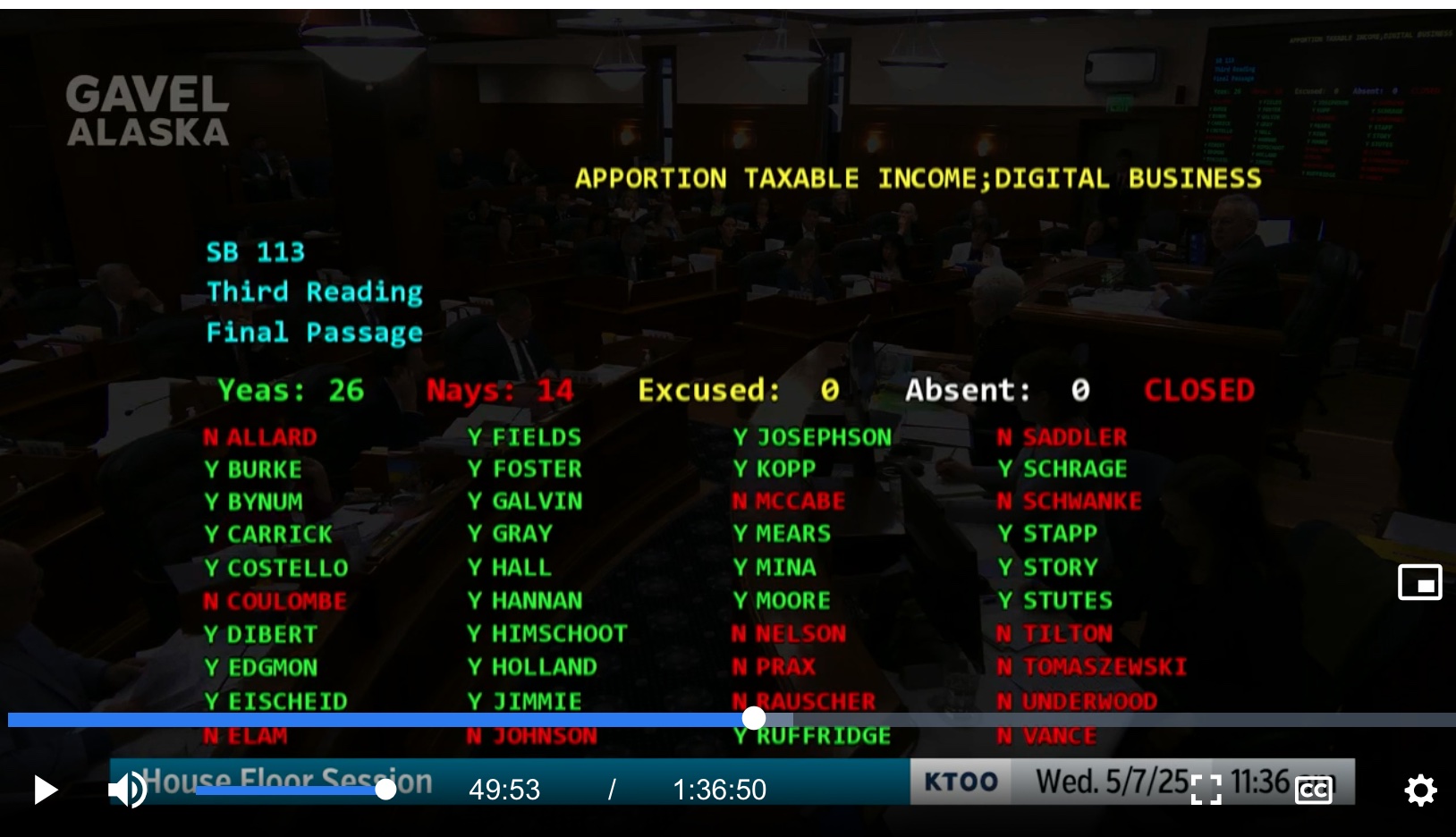
On Wednesday, the House voted in favor of a new internet-based corporate tax, Senate Bill 113, the creation of Democrat Sen. Bill Wielechowski.
The final vote was 26-14, with Republicans Jeremy Bynum, Mia Costello, Chuck Kopp, Justin Ruffridge, and Will Stapp joining the Democrats to pass it. It had earlier passed the Senate.
SB 113, titled “An Act relating to the Multistate Tax Compact; relating to apportionment of income to the state; relating to highly digitized businesses subject to the Alaska Net Income Tax Act, sponsored by the Senate Rules Committee and presented by Sen. Bill Wielechowski, bill amends Alaska’s corporate income tax code to target out-of-state, highly digitized businesses (e.g., Amazon, Etsy) conducting digital transactions with Alaskan consumers.
SB 113 targets businesses deriving 50% or more of their Alaska sales from intangible property or electronically delivered services (e.g., online retail, digital services). Those businesses, many of them small family enterprises, will pay corporate tax to the State of Alaska. The high rate of Alaska’s corporate tax may drive many businesses to stop doing business in Alaska.
The bill’s rushed process in the House drew criticism from Rep. Sarah Vance for limiting debate and public input, potentially overlooking long-term impacts on Alaskan businesses and consumers. The bill only had 1.5 hours of committee review before the final vote.
All Democrats in the Legislature voted for the tax. The Republicans who opposed the tax didn’t have sufficient time to bring in experts from conservative groups like the Tax Foundation or the Reason Foundation to explain how the Multistage Tax Compact would work in this case, and the tax’s impact on rural Alaskans.
Despite the Multistate Tax Compact goal of avoiding double taxation, its apportionment methods, such as the shift to market-based sourcing that SB 113 is using, can lead to inequities, misaligning tax liabilities with business activities, and creating complexity and burdensome paperwork for small business owners. Businesses worry that uniform rules don’t account for diverse industry practices, leading to unfair tax burdens. Regulations that will be adopted to enact this tax may also end up being unfair to businesses.
For example, Business A that sells in Alaska will now pay corporate income tax that is apportioned to them in ways that might not be accurate. If Business A uses Quickbooks, LegalZoom or another service to help it sort out the confusion, that becomes an extra cost that Business A must bear, and that extra cost will be passed along to the consumer.
Alternately, the thousands of small businesses that provide goods and services using internet-based stores can simply choose to not do business in the high-corporate tax state of Alaska, where the corporate tax is 9.4%, the third highest in the nation.
Etsy has a page dedicated to helping the small business sellers sort out their tax liabilities. You can read it at this link.


