
By ALEXANDER DOLITSKY
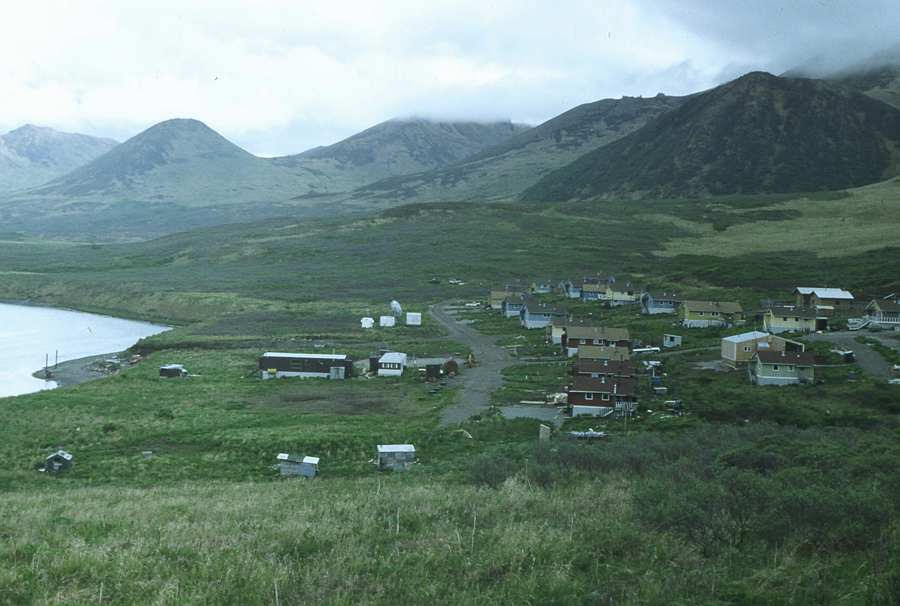
In 1983, I was a participant in the archaeological expedition at Karluk Village, located approximately 75 air miles southwest of the City of Kodiak on Kodiak Island. Surrounded by picturesque low-lying mountains and wet tundra, the mouth of the Karluk River and the Karluk Lagoon have been a homeland to the Alutiiq people for more than 5,000 years.
A deeply stratified prehistoric archaeological site on the bank of the lagoon sits in close vicinity to the contemporary Alutiiq village and to the significantly aged Russian Orthodox Church on the top of hill overlooking the lagoon.
At the time, I was a PhD candidate at Bryn Mawr College, Pennsylvania. There were several trained and experienced archaeologists in the group, including Rick Knecht, Kevin Philbrook Smith, Glenn Sheen — then all PhD candidates at Bryn Mawr College — and several enthusiastic volunteers. The expedition leader was the late Dr. Richard Jordan of Bryn Mawr. None of us had extensive experience or expertise in this geographic area under investigation, but we had some theoretical background.

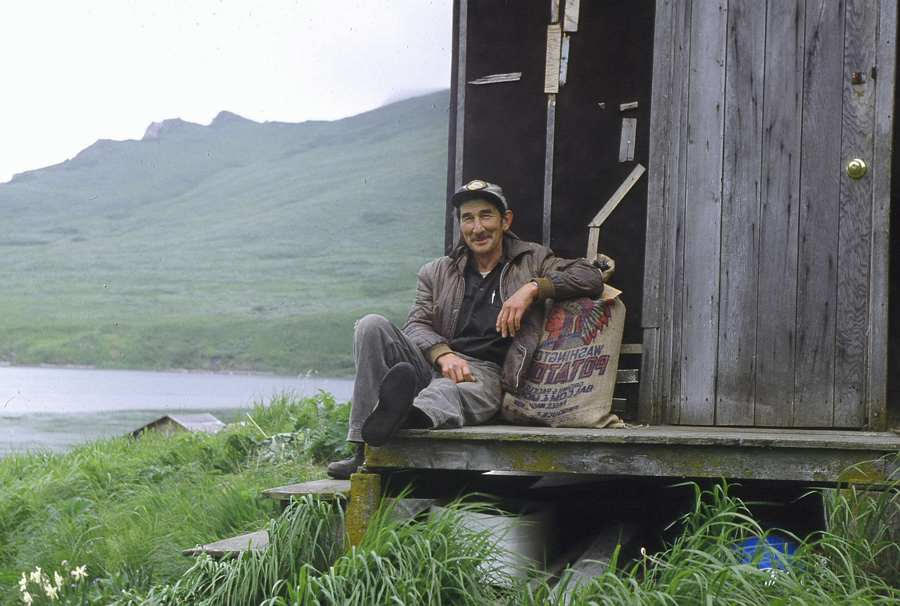
Between the contemporary village and archaeological site was a small wooden hut occupied by Lawrence Ponamoryoff, an Alutiiq in his early 60s. Lawrence and his wife resided in Los Angeles during the winter season. But in the summer, Lawrence would escape from California and find a sanctuary in Karluk. He was connected spiritually and physically to his native land. Lawrence had a basic secondary school education, but his intelligence and wisdom were second to none. He thoroughly knew his Native land—he was an integral part of it. Lawrence kept repeating, “I am invigorating here when the salmonberries begin to ripen, and the red salmon are just about to swim up the river to spawn.”
Remnants of the rectangular prehistoric dwellings were the main archaeological features that we excavated. Richard Jordan was convinced that these dwellings were above-ground Russian houses of the Russian American period in Alaska (1741 to 1867). Rick Knecht and I argued with Richard Jordan that those structures were, most likely, native barabaras, but with no success. Aleutian barabaras were the traditional homes of the Aleut and Alutiiq people of the Aleutian Islands. These communal dwellings were partially underground, like pit-houses.
In one of the intense arguments, Richard Jordan declared, “I am going to eat my shorts to prove that these are Russian dwellings.” Rick Knecht, with some degree of cautiousness, responded to Jordan’s declaration, “You better wash your shorts, before you eat them. These are not Russian dwellings.” Richard Jordan was our key professor at Bryn Mawr; I was impressed by Rick Knecht’s courageous response.
In my free time from digging, I enjoyed Lawrence’s company in his wooden hut. Lawrence was always a gracious host, treating me with a delicious smoked salmon and fish soup. I especially enjoyed his mysterious native stories. One day, I shared with Lawrence our intense arguments with Professor Jordan and our inability to persuade him to adopt a proper interpretation of archaeological and ethnohistoric data.
Lawrence listened attentively to my troubling concerns, then paused for a short moment and said: “I will tell you a story that I heard from my grandpa, the wise man.” I nodded my head in anticipation of the engaging story.
“One day a Bear and Ground Squirrel, ‘Tsik Tsik’ for ground squirrel in our native language, had an argument over the color of grass. The Bear argued that grass is green, and Ground Squirrel argued that grass is blue. They argued and argued, but neither could prevail. They decided to ask an old and wise Owl to resolve their dispute.
They approached Owl and asked, “Bird of Wisdom, tell us whether the grass is green or blue? Squirrel insists that it is blue, but I know for fact that it is green, not blue,” insisted the Bear.
Owl slowly turned his head to the right then to the left and answered, “It is a blue color.”
Ground Squirrel happily hopped to his underground home, bragging, “I won, I won against a big Bear, the grass is blue!”
The Bear was puzzled by Owl’s answer, “Why have you said that the grass is blue? You are perfectly aware that the grass is Green!” roared the Bear angrily.
“Yes, indeed, the grass is green,” responded Owl. “But you wasted your time and efforts in trying to convince a stupid squirrel about something that is so obvious to all of us. You cannot rationalize someone who is brainwashed, irrationally stubborn and believe in the squirrel’s narrow-minded stupidity. Bear, go home,” Owl continued, “Believe in yourself, believe in your righteousness and always stand up for the factual truth and justice.”
“That is all. And that’s the way I heard it,” concluded Lawrence.
The heated arguments between Professor Jordan and all crews of the Karluk expedition continued daily and brought a lot of stress to all of us. For me, the expedition in Karluk ended after three weeks and I moved to the Kenai Peninsula to excavate an archaeological site in the vicinity of the Russian River under the auspices of the Chugach National Forest. I also had a chance to visit the Russian Old Believers community of Nikolaevsk Village near Anchor Point, Kenai.
Today, there are so many moral parallels between Lawrence’s insightful story of the “Bear and Squirrel Argument” and the socio-political environment in our country. And, yet it is so unbearable to tolerate an extreme leftist’s beliefs, destroying our democratic Republic with its remarkable corruption, moral distortion and indoctrination of American youth, namely: White Privilege Doctrine, Critical Race Theory, Systemic Racism, delusional transgender identity, neo-Marxism, violent anti-Semitic pro-Palestinian protests and rhetoric, and all other progressive nonsense.
I wonder, what learning and moral story the wise Alutiiq Lawrence could have for the humanity today?
Alexander B. Dolitsky was born and raised in Kiev in the former Soviet Union. He received an M.A. in history from Kiev Pedagogical Institute, Ukraine, in 1976; an M.A. in anthropology and archaeology from Brown University in 1983; and was enroled in the Ph.D. program in Anthropology at Bryn Mawr College from 1983 to 1985, where he was also a lecturer in the Russian Center. In the U.S.S.R., he was a social studies teacher for three years, and an archaeologist for five years for the Ukranian Academy of Sciences. In 1978, he settled in the United States. Dolitsky visited Alaska for the first time in 1981, while conducting field research for graduate school at Brown. He lived first in Sitka in 1985 and then settled in Juneau in 1986. From 1985 to 1987, he was a U.S. Forest Service archaeologist and social scientist. He was an Adjunct Assistant Professor of Russian Studies at the University of Alaska Southeast from 1985 to 1999; Social Studies Instructor at the Alyeska Central School, Alaska Department of Education from 1988 to 2006; and has been the Director of the Alaska-Siberia Research Center (see www.aksrc.homestead.com) from 1990 to present. He has conducted about 30 field studies in various areas of the former Soviet Union (including Siberia), Central Asia, South America, Eastern Europe and the United States (including Alaska). Dolitsky has been a lecturer on the World Discoverer, Spirit of Oceanus, andClipper Odyssey vessels in the Arctic and sub-Arctic regions. He was the Project Manager for the WWII Alaska-Siberia Lend Lease Memorial, which was erected in Fairbanks in 2006. He has published extensively in the fields of anthropology, history, archaeology, and ethnography. His more recent publications include Fairy Tales and Myths of the Bering Strait Chukchi, Ancient Tales of Kamchatka; Tales and Legends of the Yupik Eskimos of Siberia; Old Russia in Modern America: Russian Old Believers in Alaska; Allies in Wartime: The Alaska-Siberia Airway During WWII; Spirit of the Siberian Tiger: Folktales of the Russian Far East; Living Wisdom of the Far North: Tales and Legends from Chukotka and Alaska; Pipeline to Russia; The Alaska-Siberia Air Route in WWII; and Old Russia in Modern America: Living Traditions of the Russian Old Believers; Ancient Tales of Chukotka, and Ancient Tales of Kamchatka.



