FULL SPEED AHEAD FOR PURELY POLITICAL MATTER
State emergency? National crisis? No worries. The Alaska Supreme Court will hear oral arguments on Wednesday, March 25 in a purely political matter — the partisan attempt to recall Gov. Mike Dunleavy.
For the State Department of Law, one lawyer — Margaret Paton-Walsh — will represent the Division of Elections, which decided the merits of the recall case did not qualify for a recall. She will argue that the law and Alaska Constitution never intended that the recall process should be used for frivolous partisan and policy disputes over how large the budget cuts should be in a time of fiscal crisis. She’ll argue that appointing a judge a few days after the statutory deadline is not the same as “breaking the law,” especially when there was no judicial vacancy. She’ll argue that all communications from the Governor’s Office are political, and that attacking a governor for being political is absurd, when he occupies a political office.

For the Recall Dunleavy Committee, former members of the Walker Administration will argue that it’s not for the Division of Elections to decide what is worth a recall — they followed the process outlined by Alaska Statute to the letter. Former Attorney General Jahna Lindemuth and former Walker Chief of Staff Scott Kendall will tell the Supreme Court that it’s up to voters to decide the merits of the recall, not for the Division of Elections.
The two lead lawyers from the Walker Administration won’t be alone, however. They have three support lawyers in Anchorage-based Samuel Gekler Gottstein and Susan Orlansky, and Seattle super lawyer Jeffrey Feldman.
One lawyer against five lawyers seems daunting, but in fact most Alaska political and legal observers think the Supreme Court has already made up its mind and that this is merely a small bump in the road for the Recall Dunleavy Committee.
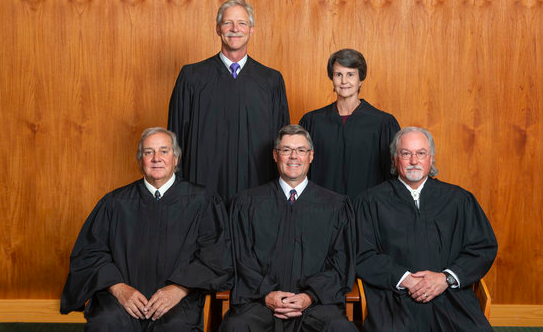
Last month, Chief Justice Joel Bolger was pressured to recuse himself from the case because he had made several statements that appeared prejudicial against Gov. Mike Dunleavy. He eventually relented.
Another Supreme Court justice is married to a highly compensated employee at the University of Alaska, an organization that took a 17 percent cut from the Dunleavy Administration in last year’s budget, and will get a similar cut this year. If Dunleavy is removed from office, the University may escape a cut that the Board of Regents negotiated with Dunleavy for next year. That justice, Daniel Winfree, has a direct conflict of interest due to his wife’s job, but has not recused himself.
[Read: Under pressure, chief justice recuses himself from recall case]
The arguments in front of the Supreme Court will be heard via telephone, since the courts are practicing social distancing as a result of fears over the COVID-19 coronavirus. All criminal jury trials have been postponed for now, but it appears the Supreme Court wants to clear this political trial off of its calendar.
The Alaska Supreme Court advises that the public may be able to witness the event by watching Gavel Alaska, although there is no guarantee that the public station will be broadcasting it. No members of the public will be allowed in the courtroom.
Not all oral arguments are videotaped and with the State ban on nonessential travel, there’s no guarantee this one will be available. Sometimes these Supreme Court arguments broadcast are broadcast live and one with the level of interest this case generates will surely fall into that category with Juneau-based KTOO, which operates Gavel Alaska. That is, if the current Anchorage shelter in place orders from the mayor and the current travel bans from the Department of Health and Social Services do not apply.
Oral arguments before the Alaska Supreme Court typically air on Sundays, from 4 p.m. to 7 p.m. Check the Gavel Alaska website for the schedule.
Here is the exact recall petition language that will be considered by the Supreme Court at 1:30 pm on March 25:
Statement of Grounds: Neglect of Duties,Incompetence, and/or Lack of Fitness, for the following actions:
- Governor Dunleavy violated Alaska law by refusing to appoint a judge to the Palmer Superior Court within 45 days of receiving nominations.
- Governor Dunleavy violated Alaska Law and the Constitution, and misused state funds by unlawfully and without proper disclosure, authorizing and allowing the use of state funds for partisan purposes to purchase electronic advertisements and direct mailers making partisan statements about political opponents and supporters.
- Governor Dunleavy violated separation-of-powers by improperly using the line-item veto to: (a) attack the judiciary and the rule of law.
- Governor Dunleavy acted incompetently when he mistakenly vetoed approximately $18 million more than he told the legislature in official communications he intended to strike. Uncorrected, the error would cause the state to lose over $40 million in additional federal Medicaid funds.