Unlike last year, the Alaska Senate this year didn’t pull a fast one on the Alaska House of Representatives and hold the budget hostage this month. Instead, senators passed the operating budget with nearly two weeks to go before the constitutionally mandated end date for this year’s session.
The decision to not repeat last year’s drama, in which the budget was held by the Senate until it was too late for the House to make decisions, is likely a reflection of 2024 being an election year in which half of the Senate will be facing voters in August. Forcing a special session would not be a good strategy for this Democrat-dominated Senate majority.
House Bill 268 passed on Wednesday with the liberal majority voting yes, and the three conservative Republicans voting no.
In the budget, the Permanent Fund dividend amount for qualifying Alaskans follows the Senate’s own 75-25 formula, in which the government takes more from Alaskans’ Permanent Fund dividends than allowed to take by statute. The Legislature has not followed the statutory formula since Gov. Bill Walker broke the formula in 2016 and vetoed half of Alaskans’ dividends, awarding the money to state workers.
Using the Senate’s own flexible formula, fully 75% of the available funds in the Senate version go to government, and only 25% of the oil royalties available for a dividend goes to Alaskans, for a dividend this year of $1,360.
But then, the Senate added back in a novel “energy relief payment” of $220 to bring the amount up to $1,580.
The House version of the budget has a Permanent Fund dividend of $2,223, closer to the statutory formula, including an energy relief payment. The two amounts must be negotiated in a conference committee.
The governor’s budget proposed the statutory formula of $3,500 per Alaskan, but it meant using $2.3 billion in funds to do so.
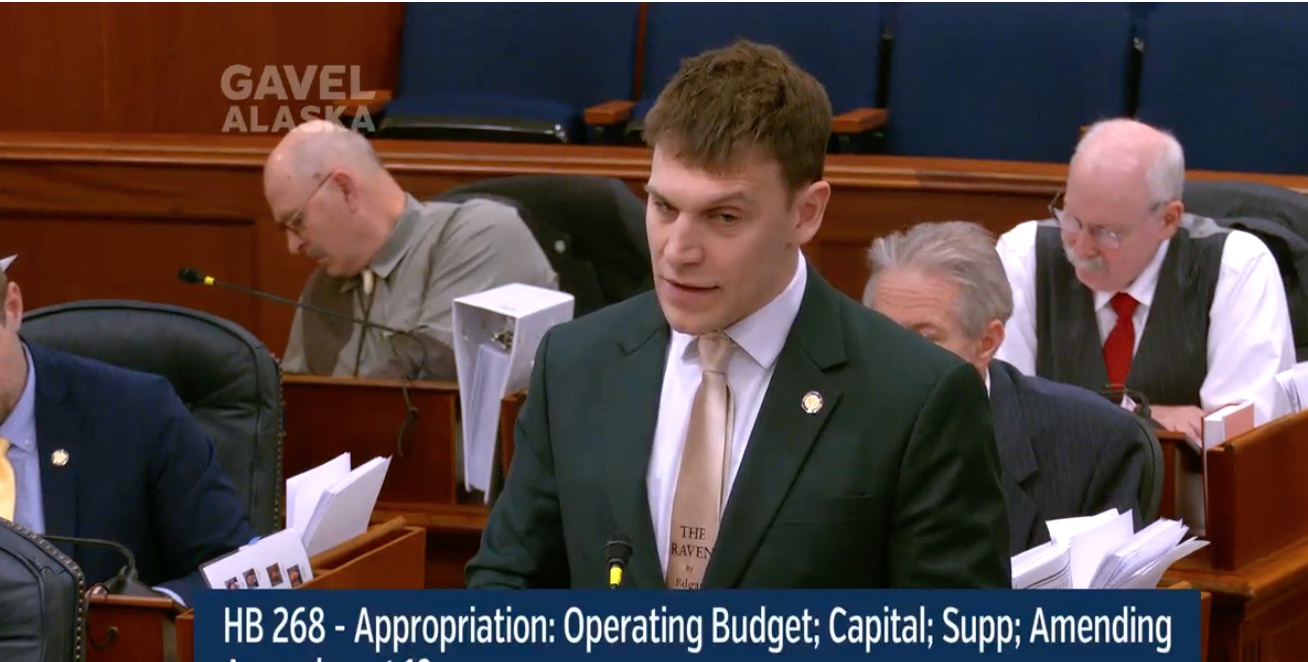
During floor debate over the budget, majority member Democrat Sen. Forrest Dunbar said he supports a large dividend because he claimed he represents one of the poorest districts in the state (East Anchorage). But he called for a state income tax: “We need a broad-based tax, we need a progressive income tax, it is the most equitable way to do it. If we want to have a healthy, sustainable PFD, we cannot any longer be the only state in the country without any kind of broad-based revenue measures.”
Sen. Mike Shower, Sen. Shelley Hughes, and Sen. Robb Myers, the three-member Republican team excluded from the liberal majority, argued for a 50-50 formula for the PFD, to be paid for with either earnings reserve funds or by simply not filling state vacancies that exist.
The Senate budget has $6.5 billion in state spending, which includes the following:
- $174.7 million for additional resources outside of the Base Student Allocation, the basic formula for K-12 education. This is the equivalent of a $680 increase to the funding per student, but is not baked in as a permanent item for future years.
- $7.3 million in additional pupil transportation for school district increased costs;
- $5.2 million for the Alaska Reads Act to help with K-3 reading;
- $5.2 million for Head Start to match federal funds to serve more children;
- $1.2 million for rural Public Broadcasting to enhance emergency communication capability;
- $30 million for Community Assistance for FY 25 and 26 to help lower local property taxes throughout the state;
- $4 million to the Municipality of Anchorage for the summer operations of the municipal homeless shelter;
- $1.3 million for Central Region recruitment and hiring of highway and aviation staff to support snow removal;
- $7.5 million for grants to childcare providers to increase access to services;
- $15 million for in-home and personal care assistant services; and
- $3.7 million to the Council on Domestic Violence and Sexual Assault.