
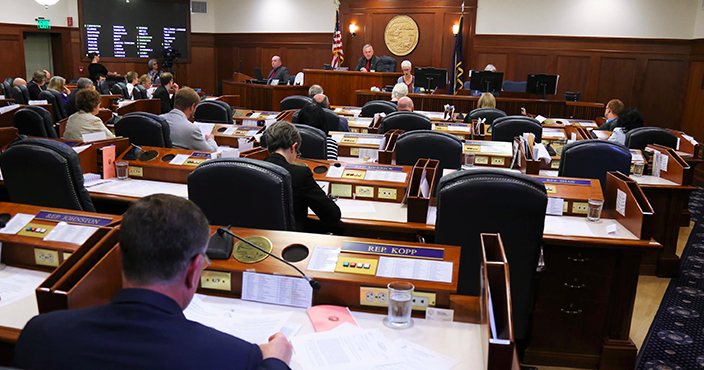
A memo from the Alaska House Coalition makes it clear that Rep. Louise Stutes, now the Alaska House Speaker, will stay with the bipartisan, Democrat-dominated caucus.
So will Reps. Bryce Edgmon and Neal Foster, both of Western Alaska.
“Our coalition has proven its unwavering support for essential services, protecting our Permanent Fund and savings accounts, and providing sustainable dividends,” said Stutes, a Republican of Kodiak. “Alaskans expect us to be ready to work in January and to get the job done on time. We look forward to working across the aisle with our colleagues in the House and Senate, as well as with the administration on bi-partisan solutions to make that happen.”
“From school closures to record outmigration and a declining economy, the challenges facing our state are monumental, ” said Rep. Bryce Edgmon, who switched a few years ago from Democrat to being without a party. “That’s why I’m proud to stand with a coalition who will work hard to put partisan differences aside on behalf of the best interests of Alaskans across the state.”
Rep. Neal Foster, a Nome Democrat, said, “I’m committed to working with my colleagues in the Alaska House Coalition to ensure these priorities are realized this next session.” He was speaking about public safety, and power cost equalization for rural Alaska communities.
That means there is a nearly impossible path for Republicans in the House to form a majority, which would take 21. Indeed, there are 21 elected Republicans, but Stutes is one of them, and Rep. David Eastman of Wasilla is the other. Eastman cannot be seated as a legislator until a judge decides that he is not a threat to democracy. He has been accused of violating the “disloyalty clause” of the Alaska Constitution due to his membership in a patriot group that was associated with the Jan. 6, 2021 disruption at the U.S. Capitol. His case will be heard this month in the Palmer courthouse.
The Democrats have 13 seats and no-party candidates have six, including Bryce Edgmon, Dillingham; Daniel Ortiz, Ketchikan; Cal Schrage, Anchorage; Josiah Patkotak, Utqiagvik; Alyse Galvin, Anchorage; and Rebecca Himschoot, Sitka.
All of the no-party candidates are likely to join the Democrats, giving the House coalition 19 members. With Rep. Stutes, that makes 20, creating a 20-20 split with Republicans, a similar situation that happened in 2019. Then, it took the House until mid-February to get a majority coalition, and in doing so, Republicans who stuck with their party were sidelined into minority status. The majority was 21 to 18, with Edgmon as speaker.
There may be Republicans willing to go over to the Democrat-controlled bipartisan coalition, and some have already signaled they are willing to hear an offer. But the bipartisan coalition won’t need but a couple of them, and thus will pick the most malleable, least drama-prone Republicans to woo with choice assignments.
The Senate, although it has a majority of elected Republicans, organized as a Democrat-led majority, with Sen. Gary Stevens, a Kodiak Republican, as Senate President. The Senate majority has all but three senators in it — Sens. Shelley Hughes, Mike Shower, and Robb Myers were left out in the cold, too small of a group to even have acknowledged minority status.
The statement released by the Alaska House Coalition on Monday was the first official statement from the group on any topic since mid-September.


