
The Senate State Affairs Committee met today, Jan 27, at 3:30pm to hear from the Alaska Industrial Development and Export Authority (AIDEA). AIDEA’s mission is “to promote, develop, and advance economic growth and diversification in AK by providing various means of financing and investment.”
Democrat Introduced AIDEA Accountability Act
Last week, the House State Affairs Committee heard and discussed HB 124, known as the AIDEA Accountability Act, sponsored by Representative Ashley Carrick (D-Fairbanks). HB 124 seeks to enhance “legislative and public oversight of AIDEA as a state corporation.” Representatives Kevin McCabe (R-Big Lake) and Sarah Vance (R-Homer) criticized the bill as “micromanagement” and “anti economic development.”
Reports of Continued Success
At the Senate State Affairs meeting today, AIDEA Chief Investment Officer Geoffery Johns presented on AIDEA’s progress and significant projects. Johns was accompanied by Chief General Counsel Kent Sullivan and Infrastructure Development Senior Finance Officer Jeff San Juan.
Johns began by stating that AIDEA was created by the State Legislature to take on state development projects, specifically focused on economic development and job creation in Alaska. The state-owned corporation has seen great success with a cumulative $60.1 billion in economic output from 1987 to 2026. In 2025, AIDEA declared a $17 million dividend. The corporation’s net position has risen from $1.491 billion in 2024 to $1.560 billion in 2025.
Highlights of Significant Projects
Johns highlighted AIDEA’s significant projects, touching on the corporation’s role in Alaska’s small business economy, the Ambler Road project, West Susitna Access project, Arctic National Wildlife Refuge 1002 leasing, Delong Mountain Transportation System, Interior Gas Utility project, Ketchikan shipyard, Alyeschem North Slope plant, HEX Furie, and Blood Bank of Alaska.
The Committee’s discussion focused heavily on the Ambler Road project.
Ambler Road Discussion
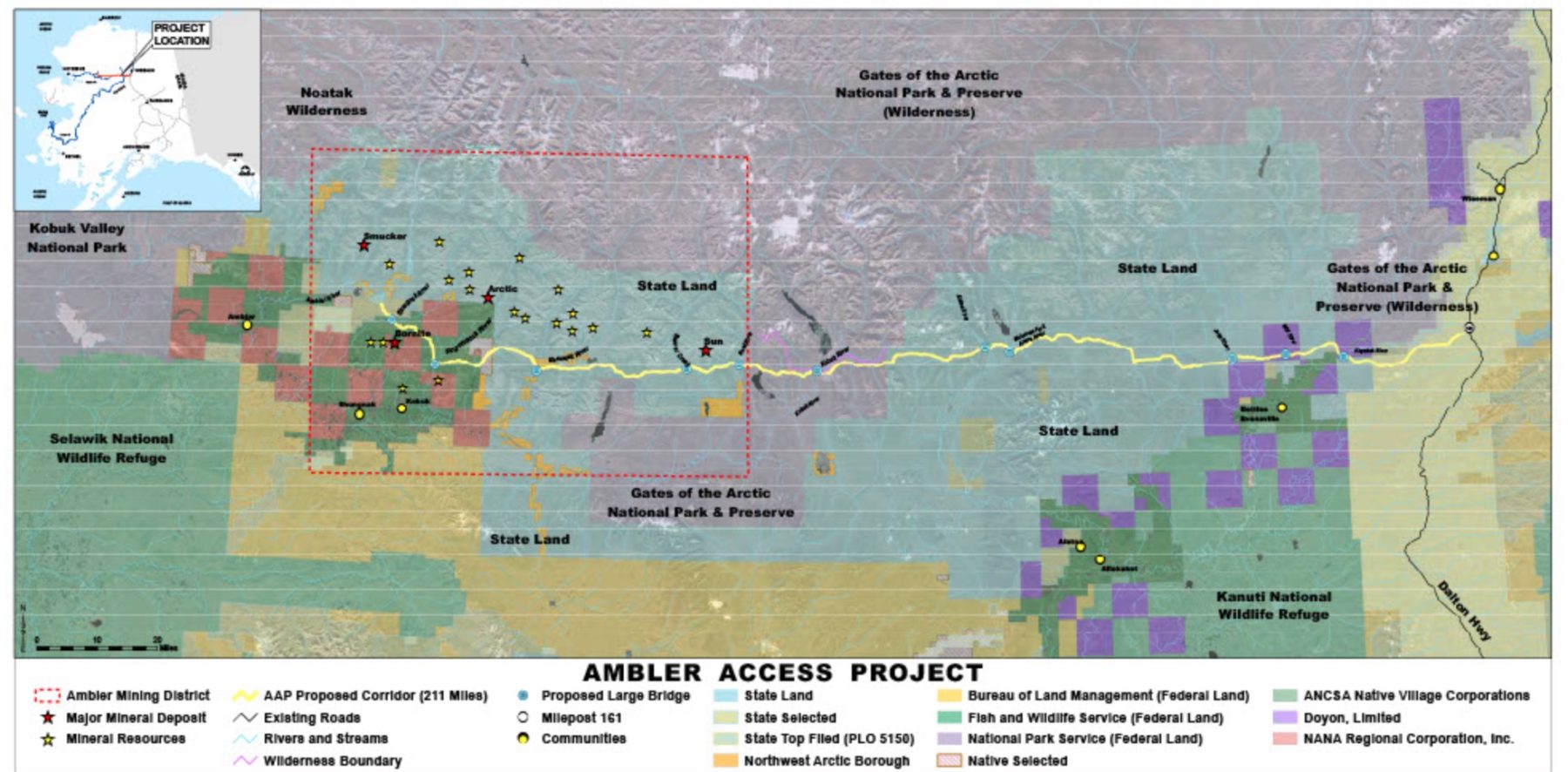
According to Johns, the Ambler project will create over 3,000 direct jobs and approximately $1 billion in profit for the State. The AIDEA board approved over $100 million of its own money to invest in the project.
Permitting
Senator Scott Kawasaki (D-Fairbanks) asked Johns if the road has been fully permitted. Johns handed the question to AIDEA’s Infrastructure Development Senior Finance Officer Jeff San Juan. San Juan replied that the corporation has secured all the state permits and expects federal permits to be secured soon.
Ownership and Accessibility
Sen. Kawasaki then asked if the road will be accessible to the public. San Juan answered that the road will be private industrial access only with no public access. Later in the discussion, Chief General Counsel Kent Sullivan clarified why the Ambler Road project cannot permit public access. He explained that the native corporations NANA and Doyon required AIDEA to guarantee private industrial access only, otherwise the native corporations would refuse to allow the project to continue over their lands. “There was no other way,” he stated.
Sullivan also clarified that the road will not be owned by just one mining company but will be owned by all stakeholders along the road.
Then San Juan addressed Sen. Kawasaki’s next question related to differences in permitting between the Ambler Road project and the Pogo Gold Mine. San Juan said the two have different permitting because the Pogo permits assume transfer to the public at some point, whereas the Ambler Road will never be made public.
Senator Jesse Bjorkman (R-Nikiski) jumped into the conversation, asking where NANA stands on Ambler. NANA had originally supported the project, but then later expressed opposition. According to San Juan, AIDEA is working with NANA and “NANA is starting to communicate… the relationship is starting to get rebuilt.”
Targeted Hiring
Shifting to the project’s hiring potential, Sen. Kawasaki asked if AIDEA will require contracted companies to hire local Alaskans to work on the project. San Juan responded that AIDEA, as a state-owned corporation, cannot impose a hiring preferential. Legal Counsel Sullivan corroborated, stating that as a state corporation, AIDEA cannot do preferential hires for Alaska natives, but NANA and Doyon can prefer to hire natives to work on the portions of the road going across NANA and Doyon land.
Sen. Kawasaki then asked if AIDEA still prioritizes “jobs for Alaskans,” as their mission statement proposes. Sullivan answered, “yes, it is a big consideration… it is a part of the conversation.” Sen. Kawasaki asked how it could be part of the conversation if AIDEA is prohibited from preferential hiring. Sullivan responded that AIDEA can choose which companies it wants to contract with based on that company’s percentage of in-state vs. out-of-state employment, but AIDEA cannot impose a hiring bias when it comes to the individuals hired to work on the project. Furthermore, Sullivan emphasized that AIDEA has an Alaska preference (which it express through contracts with companies who hire Alaskans), but not a native corporation shareholder preferential.
Wildlife Impact
The conversation about Ambler finished with Rep. Bjorkman asking AIDEA to confirm that the project will have minimal impact to wildlife. Sullivan and San Juan both confirmed that AIDEA’s study found that the project would have minimal impact to wildlife, particularly to caribou.
AIDEA’s Relationship to the PFD
After wrapping up his presentation on significant project highlights, Johns spoke briefly on AIDEA’s relationship to the Permanent Fund. According to Johns, the State Legislature formed AIDEA as “a shield to protect the Permanent Fund.” AIDEA is a distinct institution, not part of the Permanent Fund Corporation, and its dividends help cushion the Permanent Fund.


