In the quiet shadow of Denali, on the grounds of St. Bernard Catholic Church in the small Alaska town of Talkeetna, stands a four-foot aluminum statue of the Blessed Virgin Mary. Her arms are outstretched in welcome. At the center of her breast rests a golden heart. A clear plexiglass encasement now surrounds the statue, protecting it from the harsh northern weather while still allowing pilgrims to approach and pray. Locals and visitors pass it often without knowing its full story. Yet for one young family, that statue became the place where they experienced what they firmly believe was a profound act of God’s mercy.
Before recounting their story, it is important to understand what Catholics mean by the word “miracle.” In Catholic understanding, a miracle is an extraordinary event that surpasses the ordinary powers of nature and is attributable to the special intervention of God. It serves as a sign pointing beyond itself—toward faith, conversion, and the glory of God. The Church approaches claimed miracles with great caution. For an event to be declared miraculous in an official sense (especially in causes of saints or the approval of shrines), rigorous investigation is required: medical experts must rule out natural explanations, theological criteria must be met, and the local bishop or higher authority must issue a formal judgment.
Private healings attributed to the intercession of the Blessed Virgin, even when well-documented and deeply consoling to those involved, remain matters of personal faith. They do not bind the conscience of other Catholics, and they carry no official ecclesiastical declaration unless one is later given. The events surrounding Bruce Paul are presented here precisely in that spirit—as a testimony of one family’s experience, not as a decree of the Church. Private experiences of grace, including reported healings, do not bind the conscience of other Catholics. The Church encourages gratitude and prayer while reminding the faithful that God alone is the source of all healing, whether through ordinary medical means or extraordinary intervention.
The story of this particular statue begins far from Alaska, in the dark days of World War II. In 1944, an American GI named George Herter was among the forces liberating Belgium. He fell in love with a local woman, Berthe Charleroi, a devout Catholic. After the war, they married. By then they already had an infant son, Jacques. Military policy required them to travel to the United States on separate ships. Berthe and the baby boarded the SS Brazil. A mysterious and violent illness broke out among the children. Aboard another ship, the SS Zebulon Vance, ten children died. The two little ones on the Brazil were dangerously dehydrated.
Once the ship docked, Berthe raced her son to a Catholic hospital in Pittsburgh. In her possession was a small leaf taken from the famous hawthorn tree in Beauraing, Belgium—the tree beneath which the Virgin Mary had appeared to five children between November 29, 1932, and January 3, 1933. During those apparitions the Mother of God had revealed a golden heart shining in the center of her breast. Because of that vision she became known as Our Lady of the Golden Heart.
Berthe placed the hawthorn leaf under Jacques’ pillow. By some reports the cure was almost instantaneous. Newspaper accounts noted that the Herter baby arrived on a Thursday and was discharged the following Tuesday. Another sick child on the same boat received the same medical care but without the leaf; that child’s outcome was not the same.
In thanksgiving for his son’s life, George Herter later commissioned approximately fifty aluminum statues of Our Lady of the Golden Heart, each said to contain a splinter of the sacred hawthorn. One of those statues eventually made its way, by paths still partly mysterious, to the outdoor grounds of St. Bernard Church in Talkeetna. A protective plexiglass encasement now surrounds the figure, preserving it for future generations while inviting the faithful to draw near.
Nearly eighty years later, another family would stand before that same image and ask for the same motherly intercession.
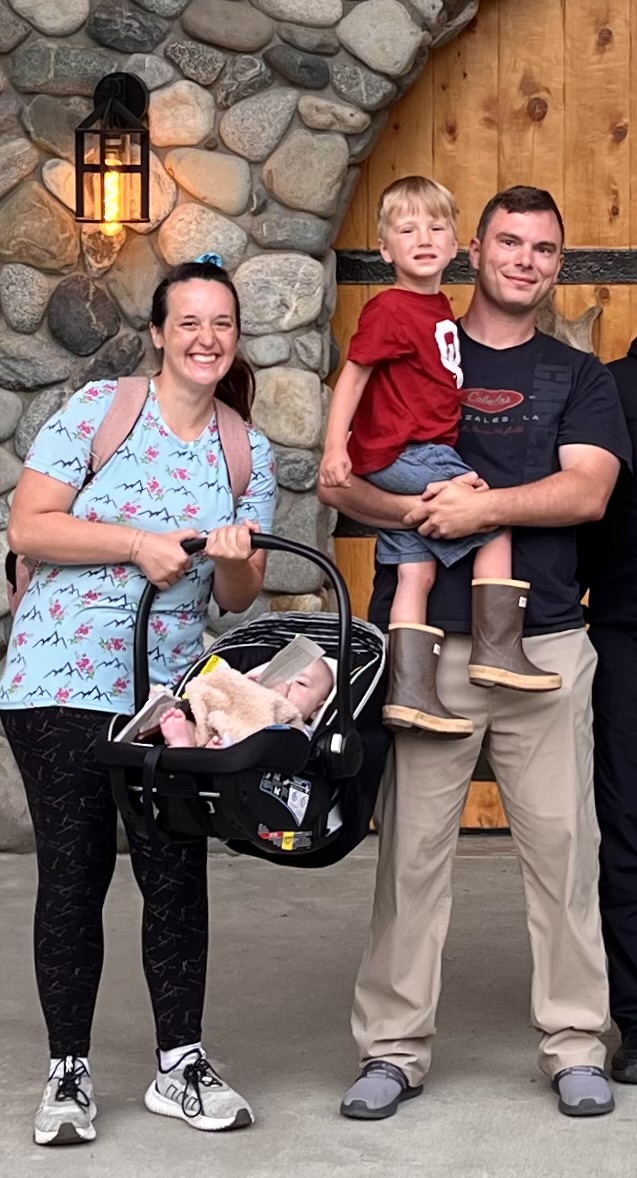
In September 2022, Eric and Andrea Paul welcomed their first child, Bruce. Early check-ups revealed a heart murmur. Tests showed large holes in the infant’s heart. At five months old Bruce underwent open-heart surgery. The operation closed the defects, yet problems remained. Medications helped only partially. The baby struggled to gain weight, and his heart valves were not aligning properly. Doctors prepared the family for the likelihood of another major open-heart surgery when Bruce reached the age of six.
Andrea’s sister Natalie began searching for any relic or place of prayer in Alaska that might offer spiritual support. An old article in the archdiocesan newspaper April 25, 2008 by James DeCrane led her to the statue of Our Lady of the Golden Heart in Talkeetna—only about fifty miles from their home. The family decided to make a pilgrimage.
In April 2024, Eric and Andrea, little Bruce, Natalie and her family, and even the family’s two dogs, Bear and Moose, drove to St. Bernard Church. The outdoor shelter that housed the statue was simple. Behind it grew devil’s club and wild rose. Protected now by its plexiglass encasement, the golden heart remained clearly visible. The adults gathered close and began to pray, asking Mary to intercede for Bruce exactly as she had once interceded for the soldier’s little boy Jacques.
What happened next remains vivid in their memory. They gathered around the statue, and each family member expressed, in their own words, prayers of petition for Bruce—for his healing, if it be God’s will, and for the grace they would need to persevere and endure if Bruce were to face another open-heart surgery or ongoing medical needs. The sincerity of each person’s heart being poured out in prayer was, according to Andrea, Bruce’s mom, “truly encouraging and uplifting.” “You could just really feel like she was there with us,” Andrea later said. “That was really miraculous, just in itself.” Eric added, “He was enthralled with this heart… It felt like she was standing there.”
The dogs, normally obedient, behaved strangely. They approached the area around the statue and, according to the family, displayed an unusual reverence that lasted several minutes—echoing, in a small way, the reports from Beauraing in 1932 when even fierce dogs had suddenly become gentle in the Virgin’s presence.
The family left Talkeetna with peaceful hearts but no dramatic signs of change that day. The true confirmation came at the next medical appointments. Bruce’s once-loud heart murmur was gone. Subsequent echocardiograms and EKGs showed that the valves were now moving better and closing properly with each heartbeat. The surgery that had loomed over the family’s future was no longer necessary. Bruce began gaining weight and growing with new energy. “Praise God, and thank you, Mary!” Eric exclaimed.
There was another healing as well. Eric had been raised Protestant and had never practiced Marian devotion. Standing before the statue in Talkeetna, he knelt and prayed. The experience opened a door. He began praying the Rosary and entered the process of becoming Catholic.
The messages of Our Lady of Beauraing have always been simple and profound: a call to prayer, penance, sacrifice, and the renewal of faith. She asked for a chapel and for people to come on pilgrimage. In the quiet Alaska woods, far from the original hawthorn tree, one of her images continues that invitation. A soldier’s gratitude after the Second World War carried her statue across an ocean and a continent. Decades later, a young mother’s desperate hope and a toddler’s spontaneous touch met the same Golden Heart.
Unique to this Alaskan setting is a quiet reminder that, in the eyes of faith, there are no mere coincidences. Just north of Talkeetna lies Fairbanks, long known as the “Golden Heart of Alaska” or the “Golden Heart City.” The nickname arose from the Gold Rush era that founded the community in the early 1900s, when prospectors sought earthly gold in the heart of the Interior. Today the city still celebrates that identity with Golden Heart Plaza and other landmarks. That the statue of Our Lady of the Golden Heart stands so near the place already called Alaska’s Golden Heart feels, to those who pray here, like a gentle divine signature—an invitation to seek a different kind of gold, the pure gold of Mary’s heart and the healing it can bring from her Son through her prayerful intercession for us.
Today, Bruce runs and plays with the unselfconscious energy of a healthy little boy. A few colleagues and I had the opportunity to meet Bruce, along with his parents and sibling, this past August. He is truly a happy, vivacious, congenial, and playful four-year-old who shared books, played games, and showed us his favorite toys. As we parted, he shook everyone’s hand and insisted on giving a hug to the only ordained clergy member who accompanied us. His parents continue to share the story of their miracle with anyone who inquires, and they plan to revisit Our Lady of the Golden Heart soon.
The aluminum image stands as it has for years—arms open, golden heart visible—under the vast Alaskan sky. For those who know its story, it is no longer just a statue. It is a reminder that the Mother of God still travels with her children, still hears their cries, still places her golden heart against the broken places of the world, and still intercedes for a world in need of healing, one small life at a time.
Disclaimer: This account is a narrative based on the family’s own experience of faith and answered prayer as well as historical records concerning a claimed healing. It is not an official declaration of a miracle by any diocese, archdiocese, or ecclesiastical authority. In the Catholic Church, such local claims remain private matters of faith unless formally investigated and approved.