
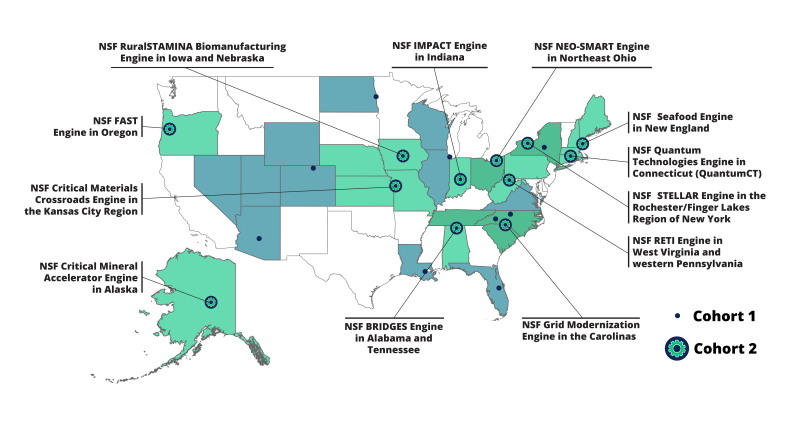
Today, July 14, the National Science Foundation (NSF) announced that the Alaska Critical Minerals Collaborative (ACMC), led by the University of Alaska Fairbanks (UAF), has been selected as one of the new NSF Regional Innovation Engines. The designation could bring up to $160 million in funding to Alaska over the next 10 years and will help advance critical mineral development, innovation, and collaboration across Alaska and the United States.
According to an NSF fact sheet, the program “envisions supporting multiple flourishing regional innovation ecosystems across the U.S., spurring economic growth in regions that have not fully participated in the technology boom of the past few decades.”
“These new NSF Engines will be transformational for America’s innovation infrastructure— helping secure our national competitiveness in technologies and future industries that will be critical to our economic and national security for decades to come,” said Brian Stone, performing the duties of the NSF director. “These engines will unlock innovation and enable technologies that will improve the quality of life and result in good-paying jobs for all Americans.”
A press-release from NSF explains how NSF Engines create a connected national network to “build domestic supply chains, fill capability gaps and accelerate technology advancement across key sectors and regions.” The network spans key technology and resource areas such as critical mineral extraction, energy grid security, and quantum computing. Alaska’s contribution will be in advancing critical mineral extraction with the Critical Mineral Accelerator Engine led by the University of Alaska Fairbanks.
“The new NSF Engine anchored at UAF, one of our nation’s premier research universities, will position the United States to lead not only in mineral production but also in the technologies that make mining smarter, safer, and more sustainable,” said Sen. Sullivan, who played a key role in advocating the ACMC proposal. “Alaska is home to 56 of the 60 minerals designated as ‘critical’ by the United States. That’s why I’ve championed efforts in the Senate to secure our nation’s critical mineral supply chains and realize Alaska’s untapped mineral potential to reduce America’s dangerous overreliance on China. ACMC’s proposal is another mineral initiative that I strongly advocated for, including through several letters and conversations with the leadership of the National Science Foundation. Alaska’s NSF mineral accelerator engine is one piece of a larger vision for UAF and our research institutions across the state that I’ve been pushing for years. UAF’s recently announced collaboration with the Department of War is another sign of the growing recognition of Alaska’s strategic importance and the state’s emergence as a world-class hub for research and innovation, including now in the critical minerals sector. I want to congratulate members of the Alaska Critical Minerals Collaborative on all your hard work in putting forward such a strong proposal.”
“Senator Sullivan has long recognized that Alaska’s critical minerals are essential to America’s economic future and national security,” said Lee Ann Munk, Director of the Alaska Critical Minerals Collaborative. “His leadership in advancing domestic mineral development and secure supply chains has helped create the momentum that made this opportunity possible. We are grateful for his steadfast support and look forward to working together to ensure Alaska becomes the nation’s leader in critical minerals innovation, technology, and workforce development.”
Below is a timeline of Sen. Sullivan’s recent advocacy for the ACMC proposal:
- In July 2025 and October 2025, Sen. Sullivan led two Alaska congressional delegation letters of support endorsing the ACMC proposal.
- In February 2026, Sen. Sullivan participated in a virtual site visit (roundtable) intended to provide NSF leaders and external reviewers with an Alaska leadership perspective as part of the ACMC’s final application review process. Roundtable participants included University of Alaska (UA) President Pat Pitney, UAF Chancellor Mike Sfraga, Alaska Department of Natural Resources leadership, Alaska Native Corporation representatives, mining industry stakeholders, and research partners. During the roundtable, Sen. Sullivan emphasized Alaska’s strategic importance to U.S. critical mineral supply chains, the strength of the cross-sector coalition supporting the engine, and his commitment to helping bridge federal coordination or policy gaps if ACMC’s proposal is selected.
- In March 2026, Sen. Sullivan sent a follow-up letter to NSF leadership thanking them for the February 2026 roundtable and reiterating his support for the ACMC proposal.
- In June 2026, Sen. Sullivan met with Brian Stone, acting director of the NSF, and conveyed his support for the ACMC application to the NSF Regional Engines Program.
Timeline provided in a press release from the Office of U.S. Senator Dan Sullivan.


