
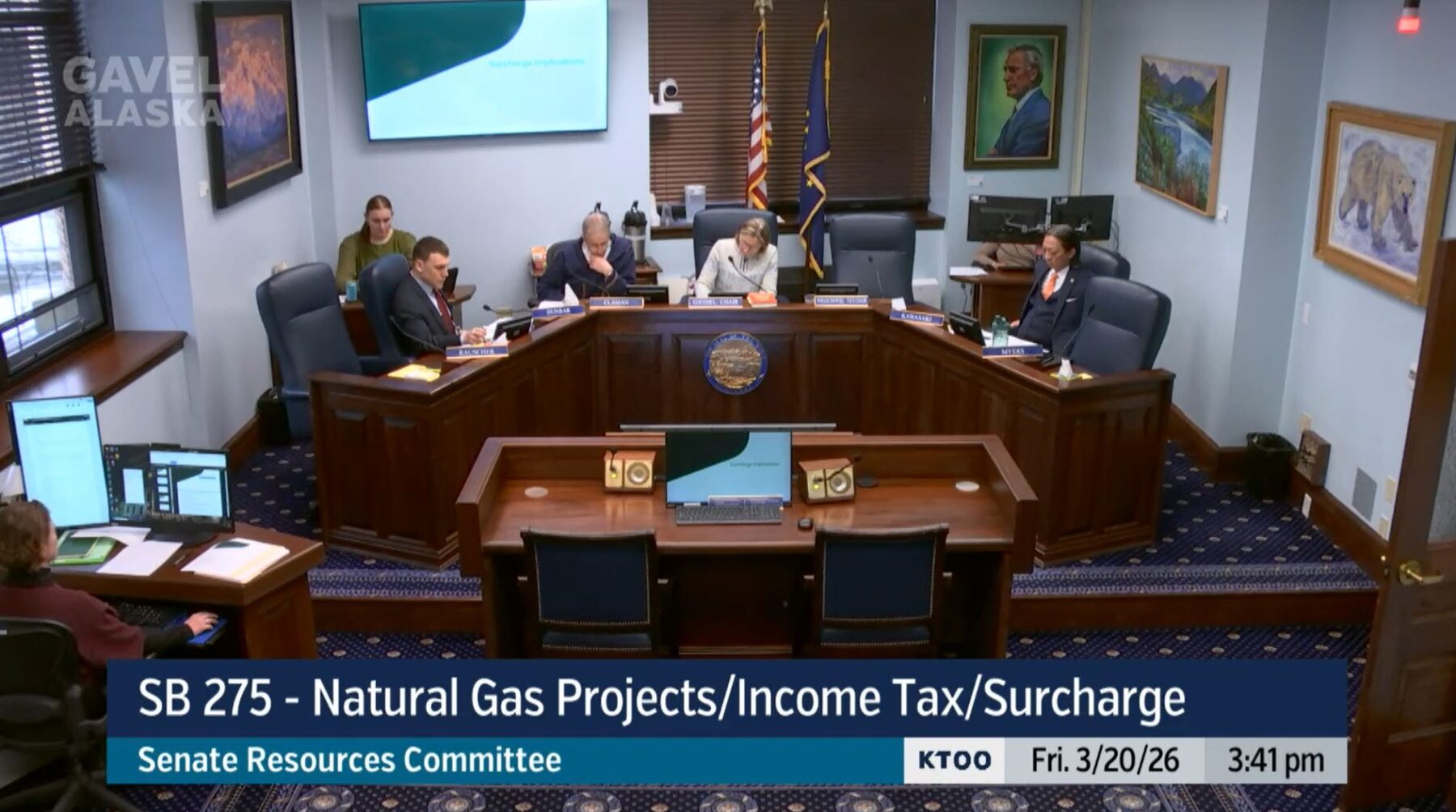
The Senate Resources Committee continued its detailed review of SB 275, which proposes a 15-cent-per-MMBtu processing surcharge on LNG export volumes alongside adjustments to natural gas project taxation. Over two sessions, consultants from Gaffney Cline provided illustrative modeling on project economics, tax comparisons, and the surcharge’s potential impacts, while members repeatedly highlighted the absence of firm financial data. The committee ultimately set the bill aside.
Chair Sen. Cathy Giessel (R-Anchorage) opened by referencing recent industry analysis from RBN Energy that omitted Alaska’s LNG project entirely from discussions of North American export prospects. Sen. Forrest Dunbar (D-Anchorage) noted the article’s emphasis on binding commercial offtake agreements and feed gas supply at 1.2 to 1.4 times nameplate capacity—elements Alaska currently lacks. He observed, “Alaska isn’t mentioned at all,” prompting reflection on the project’s competitive positioning. Giessel acknowledged public feedback, stating that “99% of those emails that I’ve been receiving have been thank yous for taking the time to dig into this project and into maximizing the benefit to Alaskans.” She tied the discussion to the book How Big Things Get Done, advocating “make haste slowly” and rigorous “what if” scenario planning to avoid the “iron law” of mega-projects: over budget, over time, under benefits.
Gaffney Cline Senior Director Nick Fulford resumed the presentation, framing the surcharge within two scenarios. In a positive-rent case, sufficient economic headroom exists to absorb the levy while satisfying upstream producers and midstream returns. In a marginal case, even after CAPEX optimization and federal support, the surcharge risks “slowing down the process to FID or even suspending the dialogue.” Fulford illustrated the surcharge’s scale: approximately $150–$160 million annually—comparable to projected state corporate income tax from the pipeline itself. He equated it to roughly two mills in property tax or 1.5 percent of a hypothetical $10 delivered sales charge and about 25% of potential 45Q carbon-capture credit value. On an illustrative 10% post-tax IRR baseline, the surcharge reduces returns by roughly one-third of a percent to 9.6%.
Comparisons to LNG Canada in British Columbia underscored competitiveness concerns. Canada’s combined federal-provincial rate of 27% is reduced by a 3% natural gas credit to an effective 2%, with minimal property taxes. Alaska’s baseline (excluding property tax) sits at 28.4%; adding the surcharge pushes the effective rate to 29.5–30.5%. Fulford confirmed the levy applies solely to the Nikiski LNG plant, not the North Slope CO2 removal facility. Sen. Dunbar noted Canada’s lack of any per-unit surcharge and broader systemic advantages, while Fulford highlighted Station 2 hub forward prices (roughly $2, potentially rising to $3) as a factor that could narrow Alaska’s gap if Henry Hub strengthens.
Economic incidence drew sharp focus. Sen. Robb Myers (R-North Pole) asked who ultimately bears the “wedge effect”: lower North Slope gas prices (affecting royalties), reduced project margins, or higher Asian buyer prices. Fulford deemed pass-through to buyers unlikely in a competitive market and suggested upstream negotiation possible but limited, concluding the surcharge would primarily depress midstream and pipeline economics. Net fiscal impact: $150–$160 million gained, offset by roughly $15–$16 million in lost corporate income tax—a 10:1 ratio consistent with the 9.4% federal rate.
Lease operating expense (LOE) treatment emerged as particularly complex. Fulford illustrated that allowing $1 billion in gas-conversion CAPEX (e.g., Point Thomson) against a hypothetical 13% gross gas tax could reduce the gas sale price by 3–5 cents per MMBtu. Sen. Dunbar warned such deductions remove cost-control incentives and invite audits and disputes. Giessel requested further modeling on integrating LOE into Alaska’s existing net oil tax framework.
Discussion of the gas processing plant highlighted CO2 removal for liquefaction specs, potential enhanced oil recovery sales, and 45Q credits valued at $85 per ton for 12 years (monetized at 80–90 cents on the dollar via tax partnerships). Fulford noted construction must begin by January 1, 2033 for eligibility and suggested a separate CO2 entity to optimize credits, with LNG or upstream participants possibly holding equity.
Sen. Bill Wielechowski (D-Anchorage) invoked the constitutional duty to maximize resource value, asking what information the committee needs. Fulford affirmed modeling feasibility but stressed key unknowns—CAPEX, capital structure, federal support—limit reliability without data sharing. The committee acknowledged that fiscal certainty is typically a FID prerequisite, citing LNG Canada’s multi-year negotiations that shifted from proposed taxes to credits.
In closing, Chair Giessel stressed the long-term nature of LNG contracts and the state’s fiduciary obligation. “It’s important for the people of Alaska who are listening to understand that we have no financial information. We’re working blind here,” she stated. “We’re going to take time to do it right.” No action was taken on SB 275; the bill was set aside pending additional data and modeling from Gaffney Cline and Pegasus.
While the surcharge aims to capture economic rent, members recognized risks of depressing margins or delaying FID in a marginal project environment. Further modeling on LOE, incidence, and comparisons will inform whether adjustments preserve competitiveness against jurisdictions offering credits rather than surcharges.
The next meeting on March 23, 2026, will address appointment confirmations.


