
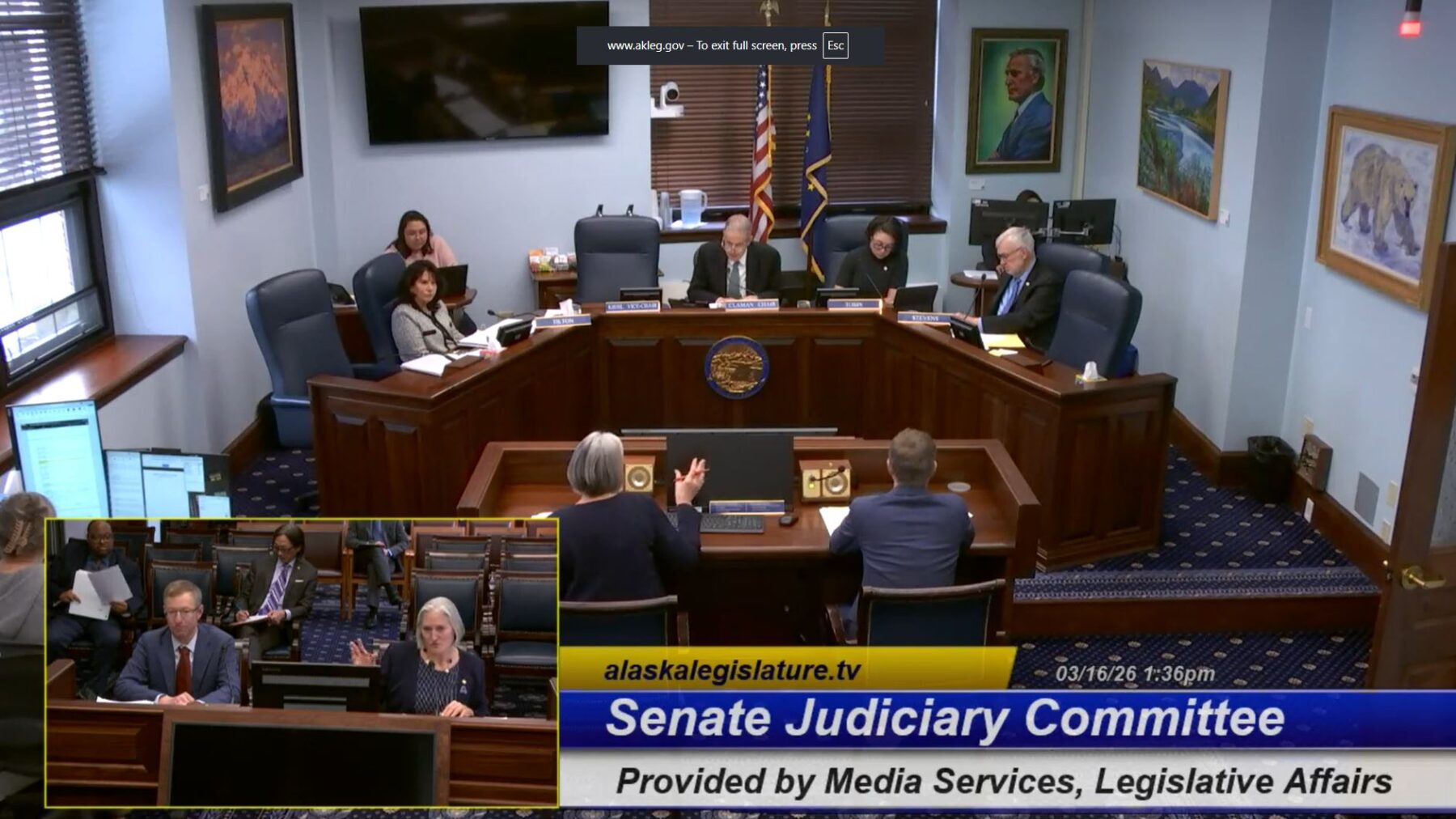
The Alaska Senate Judiciary Committee held a detailed hearing Monday on two consumer-focused bills: HB 93, which seeks to align residency requirements for hunting, trapping, and fishing with established Permanent Fund Dividend standards, and SB 241, aimed at curbing deceptive “junk fees” in consumer transactions.
HB 93 – Residency Requirements for Hunting, Trapping, and Fishing
Rep. Rebecca Himschoot (NA-Sitka), sponsor of HB 93, returned to the committee for its second hearing, joined by staff Thatcher Brouwer. The bill proposes tying resident hunting and fishing privileges to a 180-day physical presence standard in the prior year, modeled after the tested framework for Permanent Fund Dividend eligibility. A committee substitute was adopted early in the session, incorporating a new allowable absence category for pilots serving U.S. airlines certified by the Federal Aviation Administration as air carriers. Conforming changes were made throughout, with a delayed effective date of January 1, 2028, to avoid disrupting 2027 plans.
Chair Sen. Matt Claman (D-Anchorage) led a constitutional inquiry, asking whether the right to hunt and fish carries a higher level of interest than the economic interest in a dividend, which courts have deemed lower-tier. Himschoot explained a sliding scale: voting rights sit at the fundamental level, dividends at a lower governmental payment tier, and hunting/fishing rights—anchored in Article VIII—fall between them. “If you talk to Alaskans about this bill, that right to hunt and fish in the minds of Alaskans is a higher right than the dividend,” she stated. The state interest, she argued, lies in enforcing existing resident preferences for bag limits and fees, long set by statute and Board of Fish/Board of Game policy. “What this bill is about is the enforceability of that standard,” she added, noting that for many year-round residents, “a full freezer can make the difference between staying and leaving.”
The discussion turned to the pilot exemption. Staff Breanna Kakaruk outlined the addition, prompting Sen. Loki Tobin (D-Anchorage) to seek clarification on scope—whether it extends beyond pilots to flight attendants or crew. Himschoot deferred to invited testimony, while Sen. Gary Stevens (R-Kodiak) expressed skepticism: “I have nothing against pilots… but why are we being so generous to them?” He questioned whether crews could accumulate absences exceeding six months while maintaining residency. Himschoot noted pilots’ duty stations and mandatory training often require out-of-state travel, sometimes a month at a time, though some training might qualify under existing education exemptions. Burke Anderson, Government Affairs Chair for the Airline Pilots Association, testified in support, representing 700 Alaska-resident pilots. He emphasized work-related absences are not elective: “You could say that our office moved. It just so happens that our office is moving across the surface of the planet.” Anderson advocated expanding the exemption to “flight crew” for equity, estimating 700–800 Alaska-resident flight attendants face similar schedules.
Claman flagged three unresolved questions for the next hearing: fiscal impacts of adding pilots versus broader flight crew coverage; Department of Revenue confirmation on aggregate day-counting (versus block periods); and a precise definition of “United States airline,” likely tied to FAA air carrier certification. Legislative Legal’s Alpheus Bullard was available for statutory clarification, while Anderson confirmed cargo carriers like UPS and FedEx hold FAA certificates. The bill was set aside pending these details, with amendments due by March 18 at 5:00 p.m. The committee will reconvene March 18 at 1:30 p.m.
SB 241 – Consumer Fee Transparency (“Junk Fees”)
The committee then turned to SB 241, sponsored by Sen. Scott Kawasaki (D-Fairbanks), marking its first hearing. The bill amends AS 45.50.471(b) by adding a prohibition on advertising, displaying, or offering prices that exclude mandatory fees or charges (except government taxes). An effective date of July 1, 2026, was proposed. Kawasaki framed the measure as addressing widespread consumer harms, noting Americans spend billions annually on hidden fees. “Various states across the United States have introduced similar legislation over the years,” he said, highlighting the need for upfront transparency to protect rights and maintain fair markets.
Claman tested practical application, referencing airport restaurant signage offering cash discounts (three percent off) versus card payments. Staff Joe Hayes clarified compliant pricing requires upfront disclosure—consumers must know the total before transacting, eliminating surprise add-ons at checkout. Kawasaki noted many merchant agreements prohibit passing card processing fees directly, reinforcing that advertised prices should reflect the base cost without hidden surcharges.
Stevens sought recognizable examples, prompting Hayes to reference sectors from the American Economic Liberty Project guide: auto sales, cable, carpet cleaning, cell phones, food delivery, hotels, ticketing, rents, rental cars, moving trucks, restaurants, storage, travel sites, and utilities. Tobin inquired about digital platforms like Venmo or Cash App, asking whether instant transfer fees would require disclosure and what penalties would apply. Hayes committed to follow-up on enforcement specifics. Claman pressed on telecom bills, already regulated by the Regulatory Commission of Alaska (RCA)—whether itemized disclosure suffices or a single all-in price is mandated. Kawasaki distinguished RCA-regulated telecom from broader consumer protections, noting some “administrative” or “regulatory” charges in other states have been ruled improper when not truly government-mandated.
The bill was set aside for further review, with the sponsor’s office tasked to provide penalty mechanisms and illustrative compliant pricing examples across scenarios. The committee will revisit enforcement details, including digital payments and distinctions between upfront itemized totals versus hidden fees.
SB 241 advances consumer protection without heavy-handed regulation, requiring businesses to play straight with Alaskans by disclosing true costs upfront. By mandating transparency, the bill empowers informed choices and levels the playing field—principles long championed in free-market oversight.


