
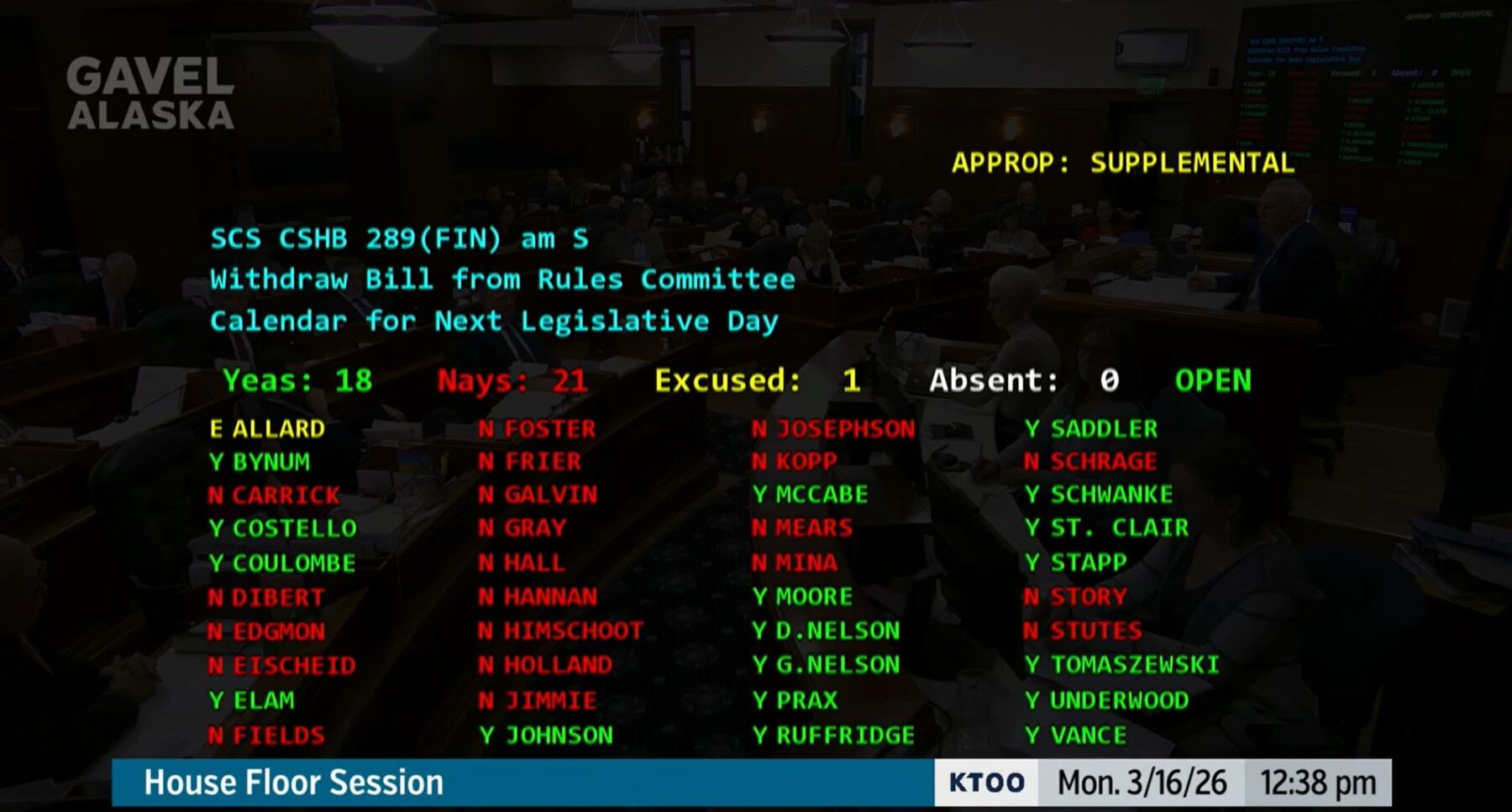
The Alaska House of Representatives spent nearly two hours in vigorous debate Monday over a motion to pull Senate Committee Substitute for HB 289—the critical supplemental budget measure—from the Rules Committee for immediate floor action. The chamber ultimately voted 18-21 to reject the discharge, leaving the bill in limbo and underscoring a conservative emphasis on deliberate fiscal stewardship rather than rushed appropriations in an environment of pronounced oil-price volatility.
The motion, offered by Minority Leader Delena Johnson (R-Palmer), sought to bring the bill back for concurrence after it had been returned to Rules following a failed Constitutional Budget Reserve (CBR) draw vote last week. Johnson framed the request as a straightforward opportunity to advance funding for essential items—including federal highway match dollars, disaster relief, fire suppression, and recapitalization of the Higher Education Investment Fund (HEIF)—without further delay. She argued the spring revenue forecast released Friday confirmed sufficient general fund resources, citing a reported $785 million available balance against less than $400 million in unrestricted general fund needs for the package.
Debate revealed deep divisions over funding mechanics and risk tolerance. Supporters of the motion, primarily from the minority, stressed that the general fund already held ample cash on hand, rendering a supermajority CBR draw unnecessary and potentially counterproductive. They pointed to non-petroleum corporate income tax gains and unaccounted upside from projects like Pikka as further buffers. Several members expressed frustration that the bill’s previous 40-0 passage had been derailed by procedural maneuvers, arguing that contractors and communities deserved immediate certainty to avoid disruptions in the upcoming construction season.
Opponents, largely aligned with the majority, countered that relying solely on forward-looking revenue projections—especially in a period of historic oil-market volatility—amounted to budgetary gambling. They highlighted the forecast’s dependence on elevated price assumptions and warned that any shortfall could leave critical obligations unmet without a secure backstop. Concerns were also raised about reconciling the general fund balance with outstanding obligations and expected expenditures through June 30, with some questioning whether the $785 million figure fully accounted for all near-term demands. The majority emphasized that the CBR exists precisely as a “rainy day” reserve for such uncertainty, and using it conditionally would protect essential services without premature depletion of savings.
Rep. Zack Fields (D-Anchorage) captured the majority’s caution during floor remarks, noting the risks of proceeding without thorough vetting in Finance Committee. He stressed the need for confirmation that all agencies could meet obligations through fiscal year-end and that the Department of Transportation could secure its federal match without delay. Other members echoed calls for additional analysis of the forecast’s assumptions, including sensitivity to price swings and the interplay between designated and dedicated funds.
The vote failed along largely partisan lines, 18 yeas to 21 nays, sending a clear signal that the body intends further review before advancing the measure. The outcome preserves the bill in Rules Committee, where it awaits potential conference or additional procedural steps. With the spring revenue forecast now public and both chambers’ Finance panels actively examining its implications, lawmakers signaled a preference for measured deliberation over expediency.
“We have the money in the bank account right now, Mr. Speaker. Right now. $785 million is the current general fund balance that is available to spend,” Rep. Justin Ruffridge (R-Soldotna) declared during debate, underscoring the minority’s position that general fund resources were sufficient without tapping reserves.
Beyond the budget drama, the session included routine business. Citations honored individuals and community milestones, including recognitions for service members and the University of Alaska Fairbanks Native Arts Center’s 60th anniversary. HJR 44 supporting Alaska Native corporations in the SBA 8A program was introduced and referred. The House adjourned until Wednesday, March 18, at 10:30 a.m.
While all sides expressed support for the supplemental’s core priorities—disaster relief, fire suppression, highway matching funds, and higher education recapitalization—the failure to discharge the bill ensures lawmakers will continue scrutinizing the fiscal picture. With oil prices subject to rapid global shifts and non-petroleum revenues providing some diversification, the House’s decision favors caution, prioritizing long-term fiscal health over short-term procedural momentum.
The supplemental’s fate now hinges on further negotiations, potential conference committee work, and additional Finance Committee analysis. Contractors and communities await clarity on federal match dollars and disaster funding, while the broader budget process moves forward amid heightened awareness of revenue risks. As one member noted, the CBR’s high threshold exists for a reason: to prevent routine reliance on savings when general fund resources can suffice.
This episode highlights the tension between urgency and responsibility in state budgeting. The coming days will test whether bipartisanship can produce a path that meets immediate needs while safeguarding Alaska’s fiscal future.


