
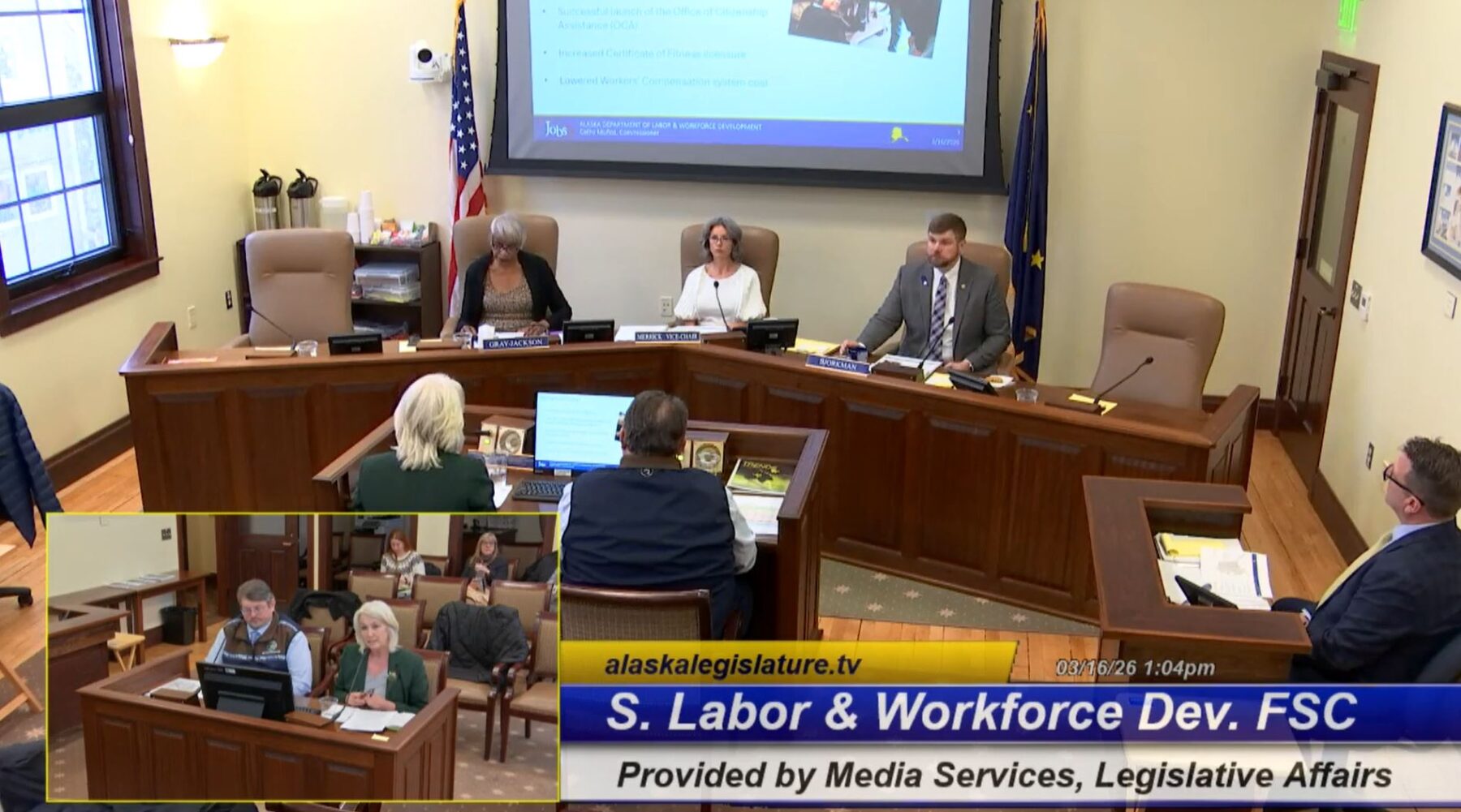
The Senate Labor and Workforce Development Finance Subcommittee convened Monday afternoon to examine the Department of Labor and Workforce Development’s proposed Fiscal Year 2027 budget. The subcommittee received a clear overview of statewide operations and measurable FY25 accomplishments before turning to modest budget adjustments. Commissioner Cathy Muñoz and Administrative Services Director Dan DiBartolo presented a record of program growth, safety-driven savings, and efficient service delivery.
Commissioner Muñoz opened by outlining the department’s broad footprint: 14 job centers, including a new satellite in Kotzebue, and nine vocational rehabilitation offices serving Alaskans across urban and rural regions. The department administers the federal Workforce Innovation and Opportunity Act through nine regional recipients and the State Training and Employment Program (STEP), which supported 37 grantees last year ranging from union and non-union providers to private and public entities. Seven construction academies and the Alaska Vocational Technical Center (AVTEC) in Seward round out the training infrastructure, delivering targeted skills aligned with Alaska’s economy.
Muñoz highlighted FY25 successes that demonstrate effective stewardship. AVTEC expanded its industrial electricity and plumbing programs while launching a new industrial machine and maintenance track. Most programs now operate at capacity with waiting lists, reflecting strong demand. USA Today recognized AVTEC as one of the nation’s top vocational centers, crediting seasoned industry instructors and state-of-the-art facilities. “We have very strong participation,” Muñoz stated. “Most of our programs are at capacity with waiting lists. So we’re really proud of the work that’s happening at AVTEC.”
Safety initiatives produced tangible taxpayer relief. The Alaska Occupational Safety and Health (AKOSH) Diversionary Program allows first-time or penalty-free employers to correct violations in exchange for full penalty waivers. In its inaugural year, the program saved businesses more than $1 million while improving workplace conditions. The model has drawn national interest, with other states and federal OSHA adopting similar approaches. The new Office of Citizenship Assistance has already assisted over 250 legal immigrants with employment services, credential translation, immigration support, English and computer classes, and employer guidance. The office is also overseeing the state’s direct management of refugee services previously contracted to Catholic Community Services, maintaining partnerships for housing and direct aid while adding workforce training components.
Licensure reforms streamlined the certificate of fitness process for electricians and plumbers through third-party testing, provisional licenses, expanded reciprocity, and military credit. These changes have boosted apprenticeship enrollment, with more than 400 new electrical trainees registered in the past year alone. Ongoing collaboration with the medical community, the Alaska Workers’ Compensation Board, and the Medical Services Review Committee has driven a 38 percent reduction in workers’ compensation benefit costs over the past decade by publishing annual medical rate charts that guide reimbursements and lower premiums.
Director DiBartolo then detailed the FY27 budget structure and implementation status. Workforce development comprises 57% of the mission budget, underscoring its priority. Leadership and administration account for just over 10%, worker safety and compensation functions 15 percent, and income replacement programs 18%. He reviewed last year’s funded items, including AVTEC’s industrial electricity expansion, which doubled capacity from 15 to 30 students using supplemental STEP funds for equipment and instructors. Photos presented during the discussion illustrated temporary staging of new workstations in heavy diesel space and ongoing renovations of the permanent facility.
A $3.1 million federal authority increment for the Alaska Workforce Investment Board supports the refugee services transition, though only $25,000 has been received so far due to federal timing. Several prior-year requests went unfunded, including Alaska Safety Advisory Program positions, a UGF offset for mechanical inspection fee losses from SB 24’s renewal extension, and the $125,000 Stay at Work coordinator position under SB 147. The department continues partial implementation of the Stay at Work program within existing resources.
For FY27, non-technical changes include shifting STEP funding authorization to budget language—mirroring TVEP—for greater mid-year flexibility when revenue projections rise. This would allow additional grants to training providers without waiting for legislative session. The primary new request is a one-time $1.4 million increment to sustain Workers’ Compensation operations. Director Chuck Collins will provide detailed analysis Thursday, March 19. DiBartolo explained that the division’s revenue derives from 2.7% of employer workers’ compensation insurance premiums. As safety improvements have lowered rates and claims, revenue has declined—ironically penalizing success. The division currently operates at a 28–30% vacancy rate and struggles to meet statutory targets despite aggressive cost controls. The one-time bridge funding aims to maintain services while a longer-term revenue solution is developed.
Sen. Elvi Gray-Jackson (D-Anchorage) inquired about the refugee funding shift. Muñoz clarified it is largely mechanical: the state becomes the direct recipient but will continue contracting with Catholic Community Services for housing and direct support while adding employment and training services. Gray-Jackson also expressed disappointment over the unfunded Stay at Work position. Muñoz reaffirmed commitment to the program’s goal of rapid workforce re-entry and noted the impact of prior funding sweeps. “Even getting the $1.4 million that we have suggested in this budget, if we could get that money secured, it will help us to a longer-term solution,” she stated.
The subcommittee will reconvene Thursday for deeper discussion of the Workers’ Compensation request.
The presentation reflected prudent management: leveraging federal partnerships without new state spending, expanding proven training programs that fill workforce gaps, and achieving dramatic cost reductions through safety and medical oversight. The modest one-time request for Workers’ Compensation underscores fiscal reality—success in lowering premiums has tightened the division’s own budget—while avoiding permanent general fund reliance.


