
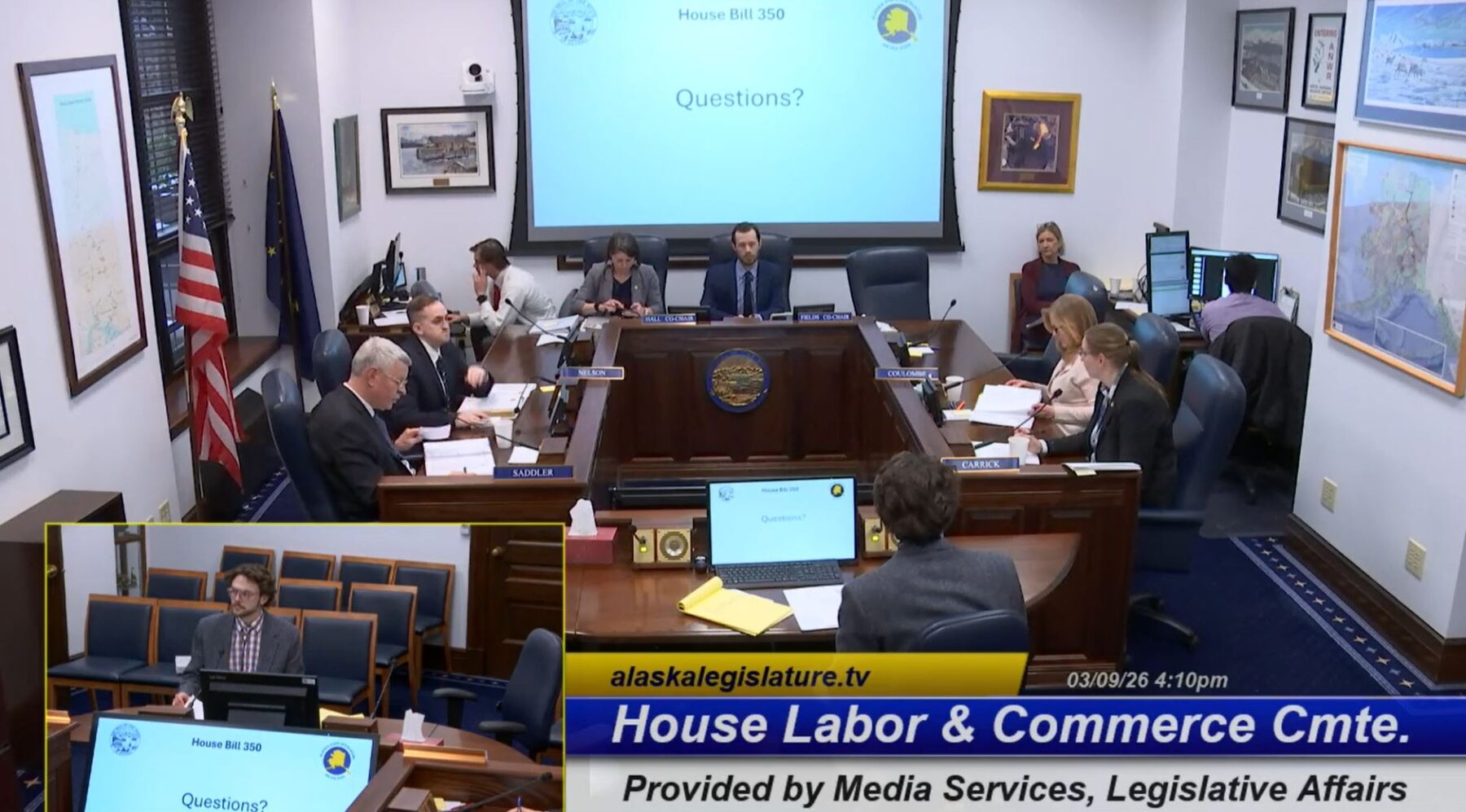
During Monday’s House Labor and Commerce Committee meeting, lawmakers discussed HB350, a measure sponsored by Representative Fields (D-Anchorage) that would impose a state income tax on S-corporations and LLCs generating over $25 million annually in taxable income. The bill sparked debates on tax equity, economic competitiveness, and the state’s outdated fiscal framework, reflecting broader concerns about funding public services.
Evan Anderson, staff to Rep. Fields, provided a recap, explaining the bill targets “qualified entities” like S-corps and LLCs taxed as partnerships, which currently do not pay state income taxes despite significant revenues. “This bill would impose a 9.4% state income tax on qualified entities with more than $25 million in annual taxable income,” Anderson stated.
Fields elaborated on the rationale, highlighting the growth of S-corps since Alaska repealed its income tax in 1980. He pointed to Hilcorp as an example of a successful S-corp that benefits from the current system. “Hilcorp has invested hundreds of millions, billions of dollars in development. They’ve done a great job getting gas out of Cook Inlet,” Fields acknowledged. However, he argued the tax code is “way outdated” and fails to reflect modern business structures. “I don’t think when the legislature eliminated the income tax, they foresaw Hilcorp, and we’re going to have other S-corps come in here,” he said, emphasizing the need for “greater parity” in taxation for large corporations.
The discussion revealed committee members’ mixed views on fairness and impacts. Representative Sadler (R-Eagle River) noted Hilcorp’s outsized role: “Hilcorp has the largest; I probably assume that revenue wise they’re doing the most under an S-corp, so Hilcorp would be the biggest payer of taxes under this bill.” Fields agreed but stressed long-term planning: “They would right now, but I want to look ahead.”
Representative Coulombe (R-Anchorage) raised concerns about equity and potential deterrents to investment. ” I am not sure that the problem is funding core services; it’s managing our core services. They’re not being managed well, and it’s very expensive,” she countered, suggesting the bill might penalize companies like Hilcorp that have committed heavily to Alaska. Fields responded by advocating for incentives like royalty modifications in Cook Inlet to encourage production, while modernizing the code: “We have to modernize our tax code around S-corps and C-corps.”
Fields framed HB 350 as a step toward sustainability: “I introduced the bill because I don’t like people criticizing Hilcorp. I support Hilcorp; I think they do great work.” He called for balancing competitiveness with revenue needs, noting Alaska’s low overall tax burden but reliance on oil.
As the state faces budget gaps projected at $300–500 million for FY27, HB 350 could reshape corporate taxation. Critics worry it might drive businesses away, but proponents see it closing loopholes in a system unchanged since the 1980s.


