
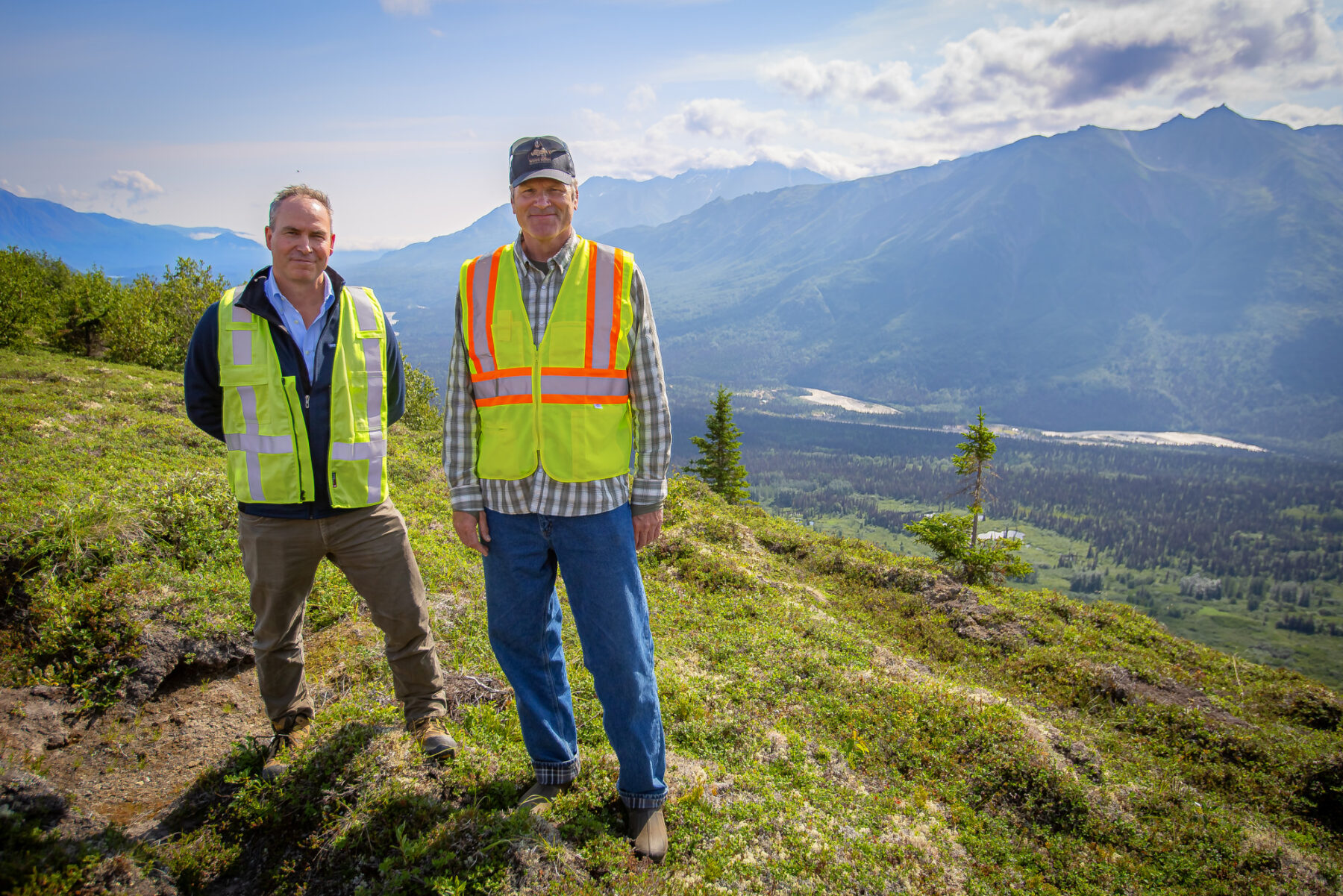
US GoldMining Inc. released an update last week regarding its exploration activities in the northern part of its Whistler Gold-Copper Project, 105 miles west of Anchorage in the West Susitna Mineral District.
Spanning 53,700 acres of state mining claims, the Whistler Project hosts the Whistler-Raintree mineral system, also known as the “Whistler Orbit,” a 5×5 km porphyry cluster containing multiple mapped and interpreted intrusions, including the established Whistler and Raintree West mineral resource deposits.
The mining project has indicated resources of 6.5 million gold equivalent ounces and inferred resources of 4.2 million gold equivalent ounces.
Porphyry deposits, a primary global source of copper, often contain significant gold, silver, and other metals like molybdenum. The Whistler Project is a gold-rich variant, with over 25 individual exploration targets identified within the Whistler Orbit.
These targets, a mix of mapped diorite porphyry rocks, surface geochemical anomalies, and interpreted intrusions from 3D magnetic modeling, highlight the area’s potential for new discoveries, the company said. Recent drilling results, announced Feb. 10, underscore this potential.
Tim Smith, CEO of US GoldMining, emphasized the project’s strategic importance: “The Whistler Gold-Copper Project is located within the West Susitna Mineral District, which contains established gold, copper, and silver mineral resources, plus potential for other critical metals such as antimony and tungsten. The Whistler-Raintree Mineral System already contains two of the three deposits delineated to date and over 25 additional potential exploration targets identified over an area of approximately 5 x 5 km.”
The Whistler Orbit is underlain by a large causative batholith, fostering a cluster of high-level intrusive bodies prospective for porphyry-style gold-copper-silver mineralization. Exploration leverages advanced techniques, including 3D inversion modeling of airborne magnetic survey data, which maps magnetic minerals in the upper crust. This method has identified dozens of pipe-like porphyry intrusions, some comparable in scale to the Whistler Deposit’s host diorite-porphyry, while others represent smaller “pencil” porphyries or dyke swarms.
Key targets include Mammoth, a magnetically similar intrusion to the Whistler Deposit with elevated gold, copper, and silver values in 2024 surface till sampling, suggesting a nearby source. Big White and Sunbowl are interpreted as extensions of the Whistler Deposit’s magnetic and chargeability anomalies, potentially offset by faulting or post-mineral intrusions.
Historic drilling at Raintree North and East has intersected encouraging results, such as 120.66 meters at 0.73 g/t gold equivalent in 2011, indicating potential for additional porphyry mineralization. The Hotfoot target, 0.75 km south of Raintree West, features a large pipe-shaped magnetic anomaly and alteration suggestive of nearby porphyry mineralization.
The company’s exploration strategy builds on two successful field seasons in 2023 and 2024, integrating drilling, historical core relogging, surface mapping, sampling, and geophysical data, the company said. Despite challenges from till and gravel cover obscuring direct surface mapping, remote sensing and drilling are enabling targeted exploration. U.S. GoldMining is currently prioritizing targets for future programs, potentially commencing this summer, to expand resources while advancing an initial economic assessment announced April 15, 2025.
The Whistler Project, with existing deposits occupying less than 1% of the total land package, represents an unusual opportunity for resource growth and potential large-scale mining development in the future for Alaska. Start dates are yet to be confirmed as geological analysis and planning continue, the company noted.


