
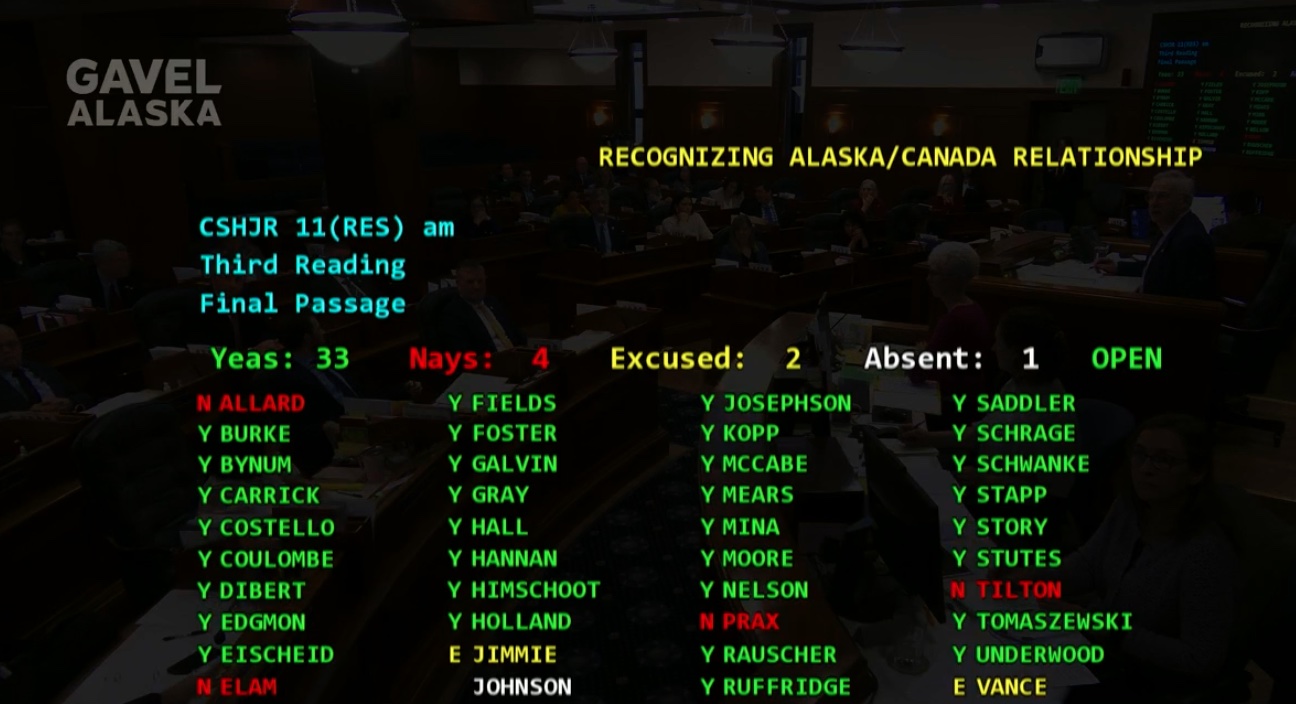
The Alaska House of Representatives passed a resolution on Monday that raised a white flag to Canada in the modest trade war that has developed between the United States and its neighbor to the north. They may have raised a red flag in the White House.
Although none of the House members has the inside track on how President Donald Trump is working the international relationship, House Joint Resolution 11 might be interpreted by the president as a direct rebuke to his efforts to balance trade.
The resolution affirms Alaska’s deep ties with its neighbor and opposes restrictive trade policies.
It is a symbolic surrender to Canada amid rising tensions fueled by Trump’s response to Canada’s high tariffs. The resolution, while meddling in international affairs, does not acknowledge the numerous executive orders that Trump has signed to help Alaska restore its economy.
Introduced by House Majority Leader Chuck Kopp, HJR 11 passed on a vote of 33-4, with two Republicans absent. Only four members voted against it: Rep. Jamie Allard, Rep. Mike Prax, Rep. Bill Elam and Rep. Cathy Tilton. All four are Republicans.

The resolution highlights the “mutually beneficial” relationship between Alaska and Canada, with their shared history, economic interdependence, and mutual defense efforts, such as last summer’s joint interception of Russian and Chinese warplanes near Alaskan airspace. It explicitly calls on the federal government to refrain from imposing measures that would “harm the unique relationship between Canada and Alaska or negatively affect our integrated economies.”
The timing of the resolution’s passage — on March 24 — comes just days before Trump’s 25% tariffs on Canadian goods are set to take effect on April 2.
The Trump Administration may take it as a slap in the face to the president and appears to be raising a white flag to Ottawa, prioritizing state concerns over federal policy.
The House members caved into the threats of British Columbia Premier David Eby, who has said he will impose additional tariffs for any trucks coming from Washington State to Alaska and passing through his province.
The resolution follows a similar measure, Senate Joint Resolution 9, sponsored by Senator Cathy Giessel of Anchorage, which was introduced to the Senate earlier this month.
Before the trade dispute escalated, Canada’s tariffs on U.S. goods varied. Some US goods were allowed into Canada tariff-free, while others, such as milk (up to 270% tariff on US milk), cheese (up to 245% tariff), butter (up to 298% tariff), and chicken (up to 237% tariff), have long had high tariffs.
The current 25% tariffs Canada has imposed on the US are a retaliatory measure that will be administered by the Canada Border Services Agency as a surtax on top of existing duties, targeting goods originating from the US.
Rep. Jamie Allard wrote about her decision to vote against the resolution:
“Today I voted NO on House Joint Resolution 11. President Donald Trump, immediately upon taking office, signed historic executive orders to help Alaska and undo the damage of the prior administration. He singled Alaska among all 50 states out for his help because he knows how much damage was done to us. His executive orders position Alaska and our nation for prosperity and greater national security. Alaska has never had such a president who was so pro-Alaska in all of our state’s history. Sadly, the House turned their back on him and passed HJR 11, which counters our president’s strategic policies. I consider this resolution to be misguided and anti-American, and I surely hope our president does not lose confidence in Alaska’s ability to be a strong and pro-American home of patriots who put America First,” Allard wrote.
In contrast to the white flag raised by the Alaska House, US Sen. Dan Sullivan wrote last week that the president needs to change the law that requires foreign-flagged cruise ships to stop in a Canadian port before continuing on to Alaska.


