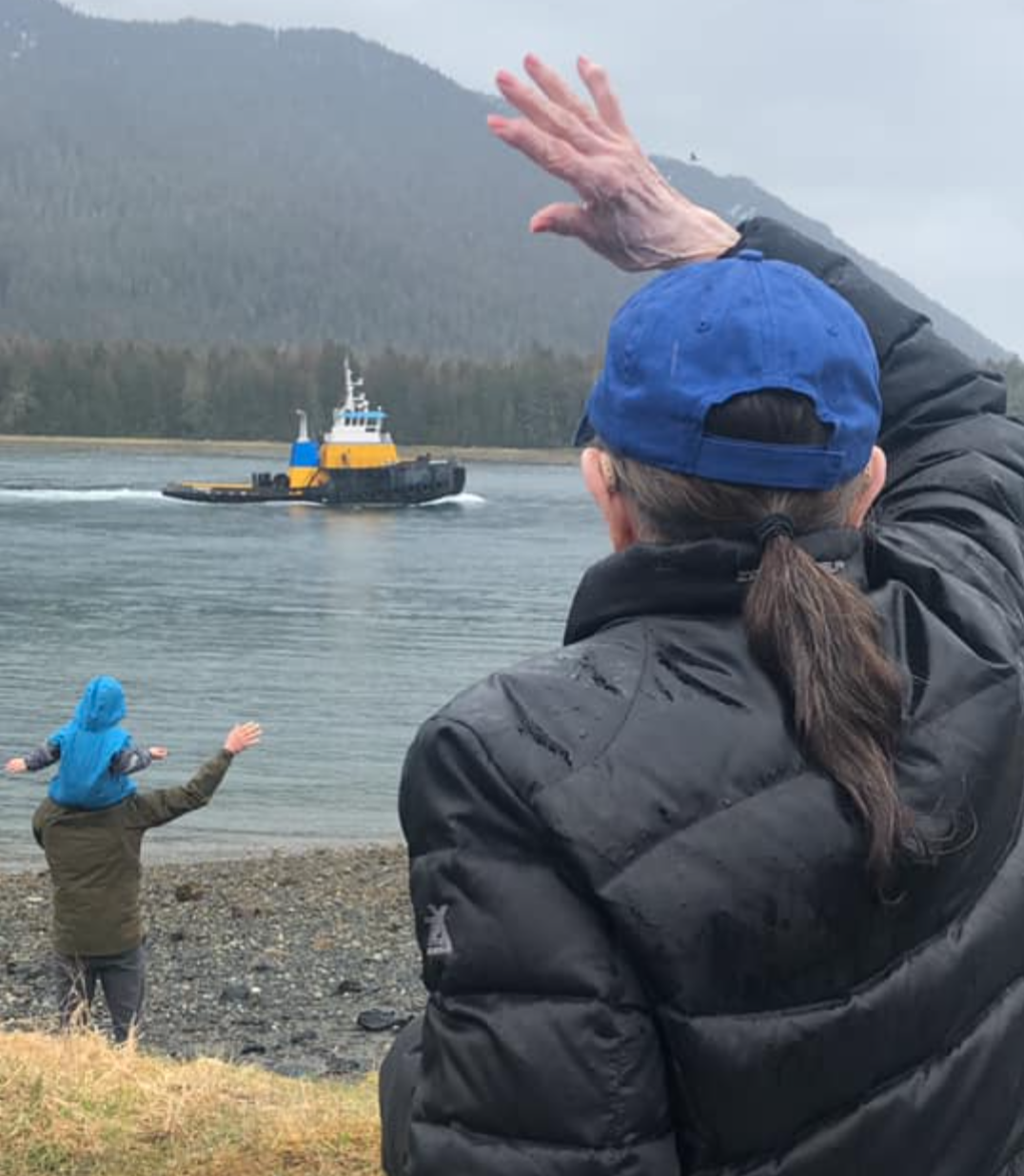
Pete Erickson couldn’t figure out who all those people were on the beach. As he steered his tug and barge through the Wrangell Narrows leaving Petersburg, where he was born and raised, he only expected to see his daughter and his grandson waving him by.
Erickson had just finished his 14-day quarantine after coming down with the COVID-19 coronavirus, which he evidently caught while visiting his father in the hospital in the Seattle area.
His dad, Pete Sr., was the first Alaskan to die of the coronavirus; he passed on March 16 at a hospital in Federal Way, Wash., where he had gone for care for other serious health conditions.
[Read about Pete Erickson Sr.’s life in Alaska at this link]
Erickson and his wife Kris had spent a lot of time with the 76-year-old Petersburg patriarch while he was hospitalized. And as one might expect, Erickson picked up the bug, while his wife, who had spent even more time with Pete Sr. managed to escape infection.

Erickson, who was born and raised in Petersburg, had mild symptoms after his father’s passing, and spent his two weeks of quarantine chopping wood, clearing brush, and shoveling horse manure at his island ranch in Washington. After his COVID-19 tests came back clear, was finally back on his usual tug run, moving barges full of shipping containers of food and other goods from the Port of Seattle to Ketchikan, Petersburg, Juneau, Haines, and Skagway.
In the wheelhouse on Sunday, he grabbed his binoculars. He could hear horns blaring, and sirens wailing. He could see people waving flags and their hands in the air. The town of Petersburg had come out to say hello to Erickson as he was making his first post-COVID tug-and-barge run.

“I have deal with my daughter that she and my grandson drive to the north end of town and wave and watch me go by. But on Sunday, I could see all these people on the beach, and cars, and flags and umbrellas. Police cars and a State Trooper truck. I could hear them yelling, honking horns, and the police cars hitting their sirens and flashing their lights. And then all of a sudden I was getting Facebook messages and text messages from people — ‘Love you, Buddy,'” he said, while in Juneau on Tuesday on his return trip to Seattle.

Erickson, a muscular Swede of a man, said it made him cry to see everyone showing him such support after having lost his father and at the same time contracting a scary virus the past month.
“Petersburg will always be my home — I was born and raised there and lived there for 48 years,” he said. By now, he was taking some time getting the story out.
The Western Titan made its way north to Juneau, Haines, and finally to Skagway, where another impromptu group had assembled on the dock as a thank-you rally for the crew of the tug and the dedication they have to bringing freight to the small town at the head of Lynn Canal.
Once again, Erickson was surprised by the small-town, “old Alaska” gesture. He brings freight routinely to these towns in Southeast Alaska, and never before had anyone made a big deal out of it. It’s a normal weekly occurrence.
“At first, I thought maybe the fire department was doing a drill on the docks, but then there was an American flag and a Swedish flag, and I put it all together,” Erickson said.
It was the work of his aunt Kathy (Erickson) Hosford, who with her husband Fred Hosford runs the Chilkoot Trail Outpost lodge in Dyea. She and a couple of friends had hatched a plan to show appreciation to the entire tug crew, not just her nephew. And the town responded to the call to come to the dock and lean on their horns.
“Even people who could not make it to the docks were outside banging pots and pans together,” Hosford said. She added that it was a way to show the people who are working through the pandemic that they are truly appreciated by the people of Alaska.