

A new poll shows that the vast majority of Alaskans are abiding by either local mandates or state recommendation to wear a face mask over nose and mouth when in public, to ward off the highly infectious COVID-19 virus.
Anchorage, Seward, and Juneau have mask mandates, while most of the rest of the state is going by recommendations, rather than mandates. Several large stores like Fred Meyer and Carr’s have their own mask requirements.
According to the statewide public opinion poll conducted over the Thanksgiving holidays, more than eight in 10 Alaskans report wearing a face mask “some or all of the time.” Also, 82 percent believe it’s important to change their daily habits to prevent the transmission of the virus.
But only 75 percent of Alaskans who responded to the survey think masks actually work to prevent the spread of the virus that came from China late last year. One out of four Alaskans do not think the masks work as promised by medical experts.
According to scientists, COVID-19 is transmitted from human to human, and can spread rapidly through a population that is in close proximity to others. One contagious person can infect hundreds of people without knowing it. Hand-washing, disinfecting touch surfaces, and physical distancing from others are three methods for slowing down the spread. Masking is another method widely touted.
A separate multi-university study of behaviors shows that nationally, the first three components of preventative actions — hand washing, disinfecting, and avoiding crowds — reached an all-time low in October. But mask wearing was increasing, and by November, 77 percent of respondents were reporting they adhere to the mask recommendations.
Alaskans exceed that masking compliance level, yet Democrats in the Legislature and in local governments have repeatedly demanded that masks be mandated on a statewide level by the governor because Alaskans are not to be trusted to follow the health recommendations.
The Alaska governor’s approach has been to treat Alaskans like grownups, explain to them the importance of precautions, and encourage them to do the right thing.
California’s governor, on the other hand, has numerous mandates in place, but doesn’t enforce them. Instead, the California government is forcing businesses, such as restaurant workers and store clerks, to enforce the state’s mask mandates, turning shopkeepers into mask police and pitting customer against store employees.
In the Alaska study, conducted by Dittman Research, 67 percent of respondents also said they trust the advice of state health officials.
That leaves a gap of one third of the public that is not trusting the official state advice. However, about the same number — 65 percent of Alaskans — are limiting their social interactions due to COVID-19. When the vaccine is available to them, 64 percent say they plan to get it.
The national survey points out the partisan divide on behaviors:
Democrats and Republicans have both tended to increase mask wearing and decrease social distancing during this study period, which began in the spring. The gap between Democrats and Republicans when it came to wearing masks was 16 points in the spring, but had increased to 20 points in November.
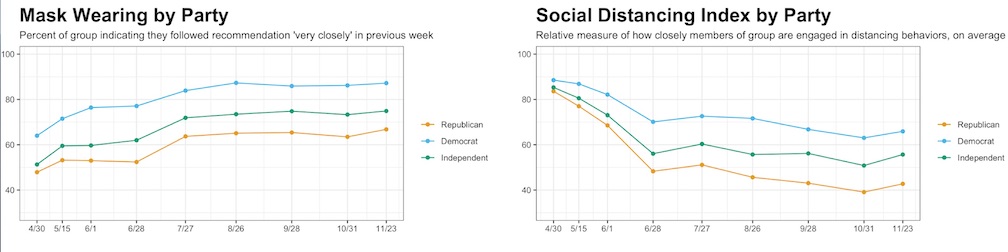
While the national study reflect a partisan divide and sorting among gender, race, and education, the age of survey participants yielded some thought-provoking results. While younger people tend to be more Democratic, they had lower ‘social distancing” scores. Younger Democrats, it seem believe that masks will protect them even if they go to crowded places.
If the State of Alaska study has breakdowns by demographics and partisan preferences, it did not release those tabs to the public.
In other survey news, USA Today released a poll on Christmas Eve showing that more than 37 percent of all Americans don’t believe Joe Biden was legitimately elected.
The breakdown was 78 percent of Republicans, 3 percent of Democrats, and 32 percent of Independents who do not believe the election result is legitimate.
The poll of 1,000 registered voters Dec. 16-20 show that 57 percent of Republicans don’t think Trump should concede the election.


