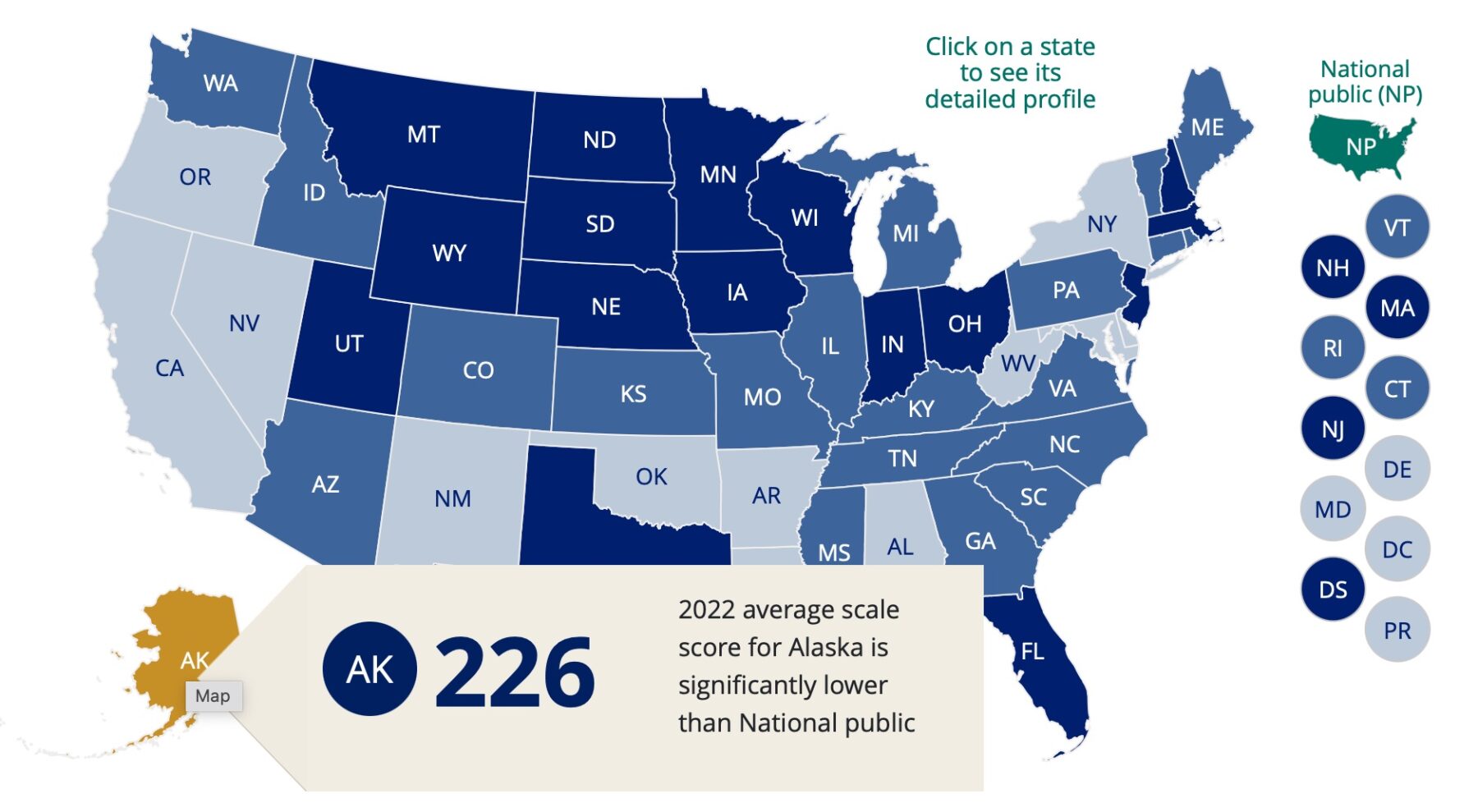
Alaska’s school proficiency standards are evidently too high. But soon, more Alaska students will be “above average,” because what is considered proficient is changing.
The Alaska Board of Education on Wednesday adjusted down the state’s test score standards for what is considered proficient for the different grade levels.
The changes, proposed by the Dunleavy Administration through the Department of Education and Early Development, will be applied to the Alaska System of Academic Readiness (AK STAR) tests.
DEED Commissioner Deena Bishop said that while these changes may lower expectations for proficiency, it does not mean that Alaska’s standards are now subpar. It’s just that Alaska is not at the top, but at least remains in the top third.
At one point in Alaska history, Alaska students were at the top in national standardized tests. In the 1990s, only rural schools were consistently showing student performance in the 25th to 30th percentiles. Since the 1990s, the proficiency has steadily dropped in all Alaska schools, and now Alaska has some of the worst test scores in the nation.

In the fall of 2022 results of the National Assessment of Educational Progress (NAEP), also known as the Nation’s Report Card showed that nationwide, U.S. averages in fourth-grade mathematics wiped out all incremental gains made since 2005, and fourth-grade reading since 1992.
The Alaska Policy Forum has been documenting Alaska school performance for years.
Alaska experienced alarming decreases in mathematics since 2019, the NAEP scores showed, according to APF.
“Fourth graders dropped six points in mathematics, and eighth graders dropped four points. Every 10 points on the NAEP represent roughly one year of learning. By that rule of thumb, Alaska’s fourth graders lost more than half a year of math learning, while eighth graders lost nearly as much,” wrote Sarah Montalbano, a researcher and writer for the Alaska-based public policy think tank.
What’s more, “reading scores are still approximately a full year of learning behind the national average, and 2.1 years behind Florida, which was third in fourth-grade reading. Only 28% of Alaska’s fourth graders were proficient in mathematics, and only 24% were proficient in reading in 2022.”
According to APF’s Montalbano:
“Alaska has changed its standardized assessments several times during the time frame examined here. During the five years between the 2009-2010 school year and the 2013-2014 school year, the paper-based Standards Based Assessment (SBA) was administered to students grades 3-10 with exams in reading, writing, and math.”
In the 2014-2015 school year, Alaska adopted the Alaska Measures of Progress, a computerized assessment and combined reading and writing into an English Language Arts assessment. The assessment was canceled in the 2015-2016 school year due to “repeated technical disruptions” that rendered the test invalid.
That assessment was replaced by the Performance Evaluation for Alaska’s Schools (PEAKS) in the 2016-2017 school year. PEAKS was canceled in the 2019-2020 school year due to the Covid-19 pandemic’s abrupt closure of schools in the spring of 2020. Finally, the Alaska System of Academic Readiness (AK STAR) was implemented in the 2021-2022 school year, Montalbano wrote.
The decision to revise the cut scores for student proficiency in Alaska reflects another pivotal moment in an ongoing national debate on the levels of expectation Americans should have for their publicly funded education system.