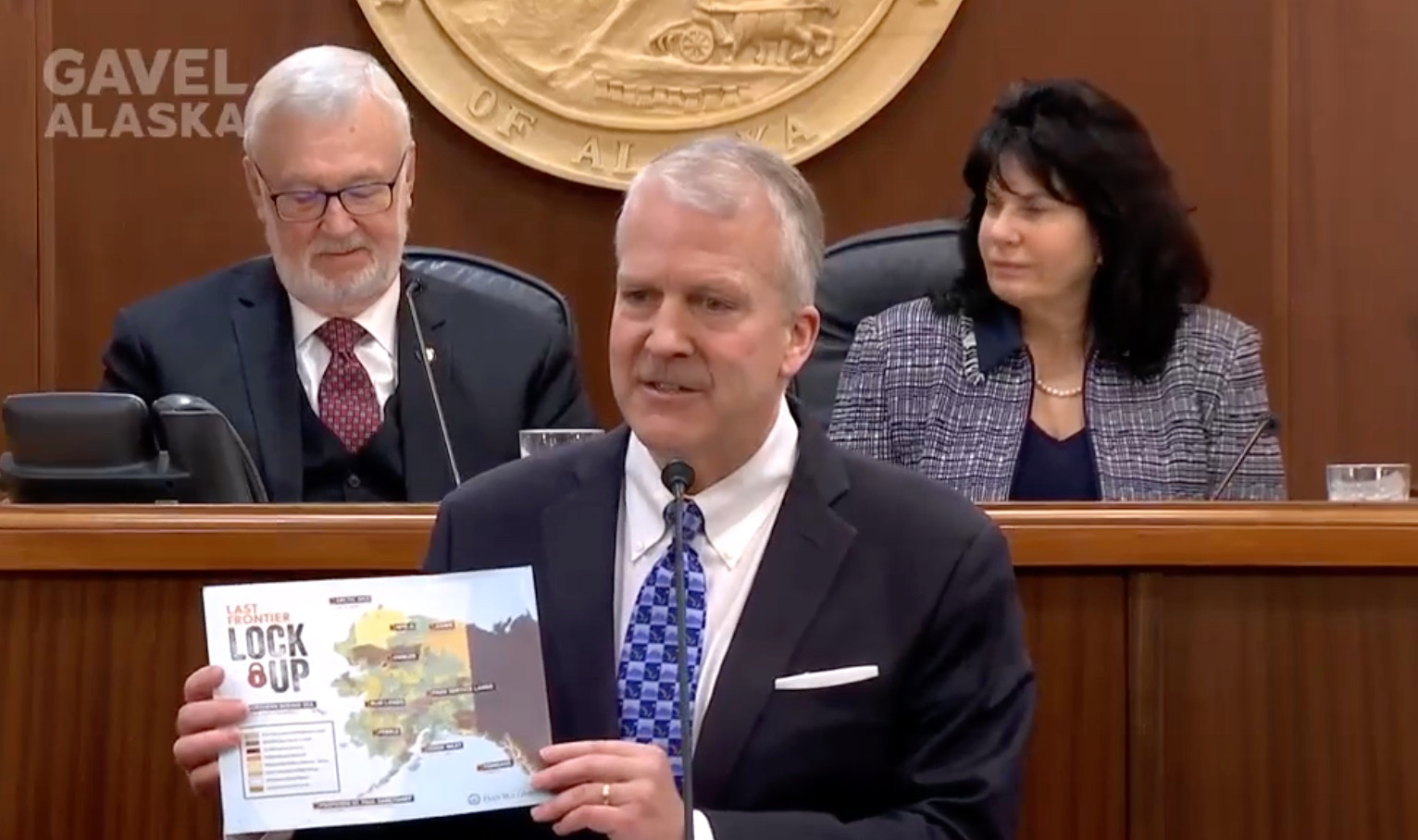
In a spirited address to the Alaska Legislature on Wednesday, U.S. Sen. Dan Sullivan, first was elected in 2014, reaffirmed Alaska’s position as the “superpower of seafood” in the United States, while highlighting the challenges and victories in the state’s fishing industry, bashing the Biden Administration for multiple adverse actions against Alaska, and criticizing President Joe Biden for not taking a tougher stance against war-mongering Iran, which has been attacking America’s assets in the Mediterranean.
He started his Wednesday morning speech by highlighting the 56 lockup orders from the Biden Administration — actions taken against the state of Alaska’s economy, since President Joe Biden took office.
“This is what I call the ‘Last Frontier Lock-Up’ — 56 orders and actions specifically targeting our state by the Biden administration, something I’m fighting against every day,” he said, while showing a map that identified every executive order Biden has made that has hurt Alaska.

“It’s an outrage. No other state in the country gets singled out like this. I handed a version of this chart to the President when the congressional delegation met with him last March on Willow. I told him, respectfully, that this was just wrong, and we needed a ceasefire in this war against Alaska,” he said.
Sullivan, now in his 10th year in the Senate and a member of the Senate Commerce Committee, emphasized the crucial role Alaska plays in the nation’s fisheries, stating, “Fish is in Alaska’s DNA.”
“I never tire of telling my colleagues that Alaska is the ‘superpower of seafood.’ Over 66% of all seafood harvested in America—commercial, sport, subsistence—comes from our state.
Sullivan recounted advocating for Alaska’s fisheries to federal officials, and touted his staff as the best equipped to address the challenges facing Alaska’s fishing communities.
One such challenge, he highlighted, was the impact of geopolitical tensions on Alaska’s seafood exports. Sullivan recalled the repercussions of the Russian invasion of Ukraine, which led to sanctions on Russian seafood imports into the United States.
However, a loophole exploited by Russian and Chinese officials allowed Russian seafood to enter the U.S. market through China, undercutting Alaska fishermen and indirectly supporting authoritarian regimes.
After years of persistent advocacy by the Alaska delegation and the state, the loophole was closed by the U.S. Treasury in late December, and went into effect on Feb. 21, the day of Sullivan’s speech to the Legislature. That announcement received a round of applause from the House and Senate.
Sullivan addressed Lower 48 environmental radicals’ attempts to disrupt Alaska’s small-scale troll salmon fishery through legal challenges. He praised the collaborative efforts between the state and the federal delegation that prevented the financial harm to trollers last year.
Highlighting concerns over declining salmon populations, particularly king salmon, Sullivan pointed to the establishment of the Alaska Salmon Research Task Force. Championed by his wife, Julie Fate Sullivan, the task force aims to investigate the causes behind salmon declines and formulate strategies to restore healthy salmon runs in the state.
Finally, Senator Sullivan advocated for the inclusion of fishermen in federal support programs akin to those available to farmers. He introduced the National Seafood Supply Act as part of negotiations for the Farm Bill, aiming to provide financial security and risk mitigation measures for Alaska’s fishing operations.
Sullivan delved with as much enthusiasm and depth into issues such as energy, national security, Mexican cartels bringing fentanyl to the 49th State, Iranian aggression, the war in Ukraine, the creation of an intellectual hub in Alaska, housing, and more.
He even broke the news that Anchorage state Sen. Forrest Dunbar has recently become engaged to be married.
In closing, Sullivan expressed optimism about the future of Alaska’s fisheries, urging continued collaboration and support from both federal and state entities to ensure the prosperity can grow the state.