
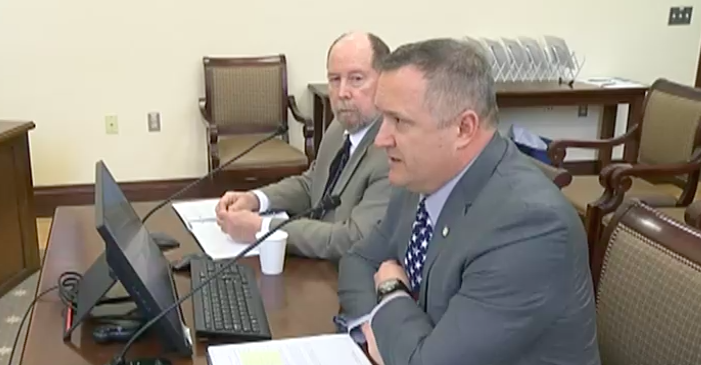
A couple of retired judges sat in the back of the Senate Judiciary meeting and cackled loudly on Friday as Sen. Mike Shower and his aide Scott Ogan presented SJR 3, which proposes an adjustment to the way Alaska appoints members to the Alaska Judicial Council.
Retired Chief Justice Walter “Bud” Carpeneti was one of the cacklers, and not once, but twice he and his colleague were loud enough to disrupt the proceedings. Sen. Shower turned around to see who was making the disruption. Clearly, the retired judges did not like SJR 3 and were making their feelings known to the committee.
Shower had a small audience in front of him. Finance Committee was meeting at the same time, so for most of the meeting, it was just Sen. Shelley Hughes and Sen. Jesse Kiehl listening to Shower and Ogan.
Shower said that Article 1 Section 2 of Alaska’s Constitution provides that all power is inherent in the people. But when it comes to appointing people to the Judicial Council, Alaska’s Constitution has left it up to the professional members of the Bar Association. It’s unwise, Shower argued, to leave something so important to this special interest group.
The Judicial Council is the body that recommends who will become a judge in Alaska. It screens and nominates judicial applicants; evaluates the performance of judges, and makes evaluation information and recommendations available to the voters; and conduct studies.
How does one become a member of the Judicial Council?
Alaska Constitution Article IV, Section 8 sets the Judicial Council at seven members. Three are attorneys appointed by the Alaska Bar Association. Three cannot be attorneys and these are appointed by the governor, subject to confirmation by the legislature. The appointments are for staggered six-year terms, must be spread over different areas of the state, and must be made without regard to political affiliation.
The chief justice of the Alaska Supreme Court is the Council’s seventh member and serves as chairperson.
Sen. Shower believes that the three that are appointed by the Alaska Bar should also stand for confirmation by the Legislature because of Article 1, Section 2 of the Constitution — the “power inherent in the people” clause. And he’s suggesting this change in the Alaska Constitution be placed before the voters in the next General Election.
This would lessen the unilateral influence that the Alaska Bar has over the selection of judges, he said.
Shower explained that the judicial branch is one-third of government, and has immense power over people’s lives. Most Alaskans are not aware that judges are picked by the Judicial Council. The judges are then appointed by the governor based on those council choices. Judges stand for reelection, but it is difficult to remove them.
“The only part of our state government where people get no direct vote over who sits in control of one-third of our government is the judicial branch. More concerning is this system was designed so lawyers get the final and ultimate say in who becomes a judge. Even with three non-attorneys on the Judicial Council, the Chief Justice can and does weigh in to choose the appointee as the tie-breaking vote, siding with the three attorneys on the council,” Shower said.
“This is quite far from the constitutional precept of the founding fathers of our Republic, in which the people should be represented in all branches of government. Alaska’s system removes the voice of the people directly from the equation. In fact the consultants brought in during Alaska’s constitutional convention believed this system went far beyond what they considered safe and far removed the citizens from the process,” he said.
The Alaska Supreme Court has come out squarely against the proposal.
SJR 3 will be taken up again by the Senate Judiciary Committee today.


