Saturday, December 27, 2025
Home Blog Page 1722

The wave of discontent over Trump

0
screen-shot-2016-10-08-at-12-37-14-pm
Reason enough: U.S. Sen. Dan Sullivan, with his wife, Julie Fate Sullivan and their daughters.

PARENTS ARE IN RETREAT: THEY HAVE TO ANSWER TO THEIR CHILDREN

In a tsunami, the water recedes as it builds a powerful wave that is going to do some unknown damage once it rushes in.

Today, that wave started hurling itself toward Donald Trump. How bad it will be is anyone’s guess.

It’s Trump’s tsunami weekend: Bad habits caught on tape, badly managed apology, and a debate with Hillary on Sunday night. What else could go wrong? Lots.

Over the past 12 hours, U.S. Senators Dan Sullivan and Lisa Murkowski both withdrew their support from Trump after revelations of crude and demeaning remarks about women came to light.

Sullivan spent years working on domestic violence issues as a member of the Parnell Administration. As a father of three daughters, he has helped lead the fight to change the culture and the thinking in Alaska about how women are treated. It’s not lost on the senator that this is Domestic Violence Awareness Month and his office even put out a statement about that yesterday.

screen-shot-2016-10-08-at-12-37-54-pm
Choose Respect Initiative was one of the first efforts of Gov. Sean Parnell’s Administration. Dan Sullivan was his DNR commissioner and before that, his attorney general.

And although Sullivan had accepted the Republican Party’s nominee because change is so desperately needed in this country, the senator is also man who, as a father, as a Marine, and as a leader of the Choose Respect initiative, had just heard enough.

Trump’s statements about how, because he’s a star, he was able to get away with groping, kissing and fondling women, was caught on tape back in 2005.

“I’ve got to use some Tic Tacs, just in case I start kissing her. You know I’m automatically attracted to beautiful — I just start kissing them. It’s like a magnet. Just kiss. I don’t even wait,” he continued. That was just the beginning.

“Grab them by the p—y,” Trump said. “You can do anything.”

Here’s another thing you can bet happens when you’re a star: You’re being recorded all the time. Did he not know that this material was out there?

Bring on the crisis communications team: “I’ve never said I’m a perfect person, nor pretended to be someone that I’m not. I’ve said and done things I regret, and the words released today on this more than a decade-old video are one of them. Anyone who knows me knows these words don’t reflect who I am,” Trump has explained in a video statement last night.

Apology accepted and we’d like to move on, if we could. After all, the candidate he is opposing, Hillary Clinton, is married to someone just as sexually boorish as Trump, who has done things every bit as bad, maybe worse. Bill Clinton is the kind of predator you wouldn’t want your daughter anywhere near.

But whether or not America can “unhear” those crude Trump words is another matter. They will be played for us in anti-Trump ads for one exact month until the Nov. 8 General Election. That’s how this works in campaigning.

Sens. Sullivan and Murkowski are not alone in rebuking Trump. His own vice presidential nominee, Mike Pence, had to distance himself. And also pulling their support were Senators John Thune, Mike Lee, Mark Kirk and other conservatives. All are up for re-election except Sullivan. House Speaker Paul Ryan cancelled an event with Trump. Sen. John McCain has said he’s done, too.

Sen. Murkowski has long been on the fence about Trump. Her wait-and-see mode has ended and now she’s taking a stand: “I have always supported the Republican presidential nominee and I had hoped to do the same in 2016,” Murkowski said in a brief written statement. “The video that surfaced yesterday further revealed his true character. He not only objectified women, he bragged about preying upon them. I cannot and will not support Donald Trump for president — he has forfeited the right to be our party’s nominee. He must step aside.”

As for Rep. Don Young, he issued a statement saying he thinks the comments are terrible and demeaning: “Nobody deserves to be treated that way.”

But Young, who has always spoken bluntly and has been criticized for it, says we have to focus on Alaska right now. And what the alternatives are.

The reason? Benghazi. Obamacare. Hillary Clinton sold us downriver to the likes of ISIS. The nation is now $20 trillion in debt. And Obama has cleaved America into two with more Americans dependent on entitlement programs than at any time in U.S. history.

The RNC has ordered its contractors to stop all production of materials for Trump. And the RNC does have a rule that allows them to remove a candidate. But ballots have been printed and have been already sent out to members of the military.

As of this morning, there has been no comment from Alaska Republican Party Chairman Tuckerman Babcock. But the party is a rule-bound entity that doesn’t allow a chairman to make a unilateral decision about withdrawing support for a candidate. He did say he had heard there are emergency meetings being held at the national level, but he had no details about those meetings.

Babcock said he would be polling members of the state party’s executive committee to determine if there’s a need to meet to discuss the situation.
About that Permanent Fund Dividend…

2.jpg

SEN. MIKE DUNLEAVY FILING SUPPLEMENTAL APPROPRIATION

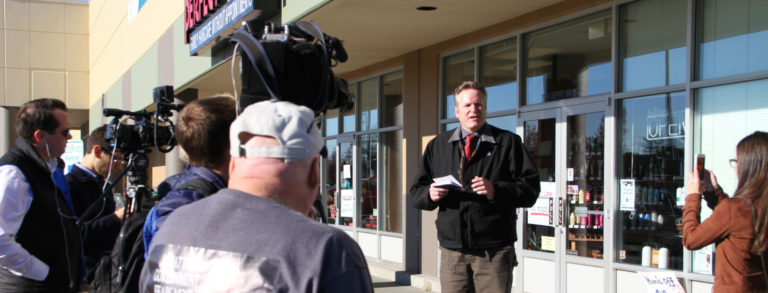
On Tuesday morning, Sen. Mike Dunleavy hopped into his Dodge Ram long-bed truck and drove past his horse barn, his mules, and his sprawling vegetable garden, over the river and through the woods, until he made his way from the rural outskirts of Wasilla into East Anchorage.

He stopped at the Fred Meyer shopping center for a press conference on his way to other business in town.

Dunleavy doesn’t typically have press conferences. That’s not how he rolls.

But on a gorgeous warm October day, he surprised everyone by announcing he will prefile a bill this November to restore full funding for every Alaskan’s Permanent Fund dividend.

He made his remarks one day before Alaskans got shortchanged on their dividends by their own governor, who vetoed half their dividends for the first time in Alaska history.

The 2016 Permanent Fund dividend was bifurcated by Gov. Bill Walker when he vetoed the funds for it in late June. Half of their money would go into the Permanent Fund Earning Reserves Fund. That way, he would have money to work with as he builds a sovereign wealth fund model that gives him the collateral he needs to borrow money to build his gasline.

Dunleavy didn’t consult with other senators before drafting the supplemental appropriation bill. He isn’t running for office this year.

He said he simply has heard from enough Alaskans over the past few months and they’re telling him loud and clear: What Governor Walker did was a direct and personal harm to every Alaskan family and the private economy.

What Dunleavy did, by drafting a supplemental appropriation bill, will put that money back into the economy of Alaska. If the legislation passes. And if the governor doesn’t veto it.

There are always the ifs.

RESPONSE HAS BEEN STRONG

Since his announcement yesterday, Dunleavy reports he’s receiving a steady stream of emails and text messages:

“I’m hearing from everyday Alaskans, not people inside the political bubble. I just had three text messages just now, one from a teacher who said, ‘thank you very much for what you did. You understand what is happening out here in real Alaska.'”

Dunleavy said he wants Alaskans also to remember this: The Republicans voted for the entire Permanent Fund dividend distribution when they voted numerous times for passing the operating budget, where that line item is.

The Democrats voted against the budget, always holding out for more spending in other areas, but never stepping up to protect the dividend in any way while they had a chance.

BILL WIELECHOWSKI’S LAWSUIT PLAY

A few weeks ago, Democratic Sen. Bill Wielechowski filed a lawsuit to ask the courts to decide whether the governor actually has the legal authority to veto the Permanent Fund dividend.

That lawsuit is widely seen as a bit of political theater, but good theater, as a union lawyer like Wielechowski knows how to do. He got old-time

It also gives him a media advantage during his race for his own seat, where he’s being challenged by Kevin Kastner.

The problem is that most political observers and legal pundits don’t think his lawsuit stands a chance. The Permanent Fund dividend comes out of the operating budget, and the governor has always had veto authority there.

Wielechowski’s lawsuit is expected to court before December.

Nageak wins by 2

0

JUDGE ORDERS DIVISION OF ELECTIONS TO CERTIFY

Superior Court Judge Andrew Guidi today declared Rep. Ben Nageak the winner in the House District 40 race and ordered the Division of Elections to certify the results.

That decision will most likely be challenged at the Alaska Supreme Court by a chastened Division of Elections and Dean Westlake, the man who sought Nageak’s seat, representing the North Slope and Northwest Arctic Borough.

Judge Guidi acknowledged that the confidence of the election system is an important value, and that integrity in elections is key to the health of the republic.

He said that most of the irregularities of the District 40 primary election were not a result of malconduct, but that what happened in Shungnak was of a serious and concerning nature. It was, in fact, malconduct.

In Shungnak, election workers knowingly gave every voter both the open ballot and the Republican ballot, and the judge ruled it was illegal to allow people to vote two ballots. Guidi  found that Shungnak’s outcome actually changed the election results, where Dean Westlake had originally been awarded the district win by eight votes.

The judge found that the Division of Election offered training to the Shungnak election workers in preparation for the 2016 primary, but they did not participate, and there was no training followup by the Division of Elections.

Guidi said that election officials in Shungnak acted in reckless disregard of the law. Their trainer, their supervisor, and the Division share in the responsibility for their conduct, he said: They didn’t participate in training, they didn’t review materials sent to them, and they did not follow the instructions on the ballot choice poster and placards sent to them. Then they gave everyone two ballots to vote.

“This conduct cannot be characterized as an ‘honest mistake,’ said Guidi, “without robbing the term of all meaning and undermining the accountability of the elections.”

In the end, Guidi decided the best solution was to decrease Westlake’s votes by 11 and Nageak’s votes by 1 in the Shungak precinct, and to subtract one vote each in the Kivalina precinct, which had also seen irregularities. That came to 12 votes subtracted from Westlake and 2 from Nageak. The eight-vote win by Westlake was reversed.

“The Division of Elections is directed to retabulate the vote total in conformance with the decision expressed above and recertify the results…At the conclusion of its retabulation, the Division of Elections shall certify Mr. Nageak as the winner of the Democratic primary in H.D. 40,” the judge concluded.


Caelus’ Smith Bay press release strategy

0

screen-shot-2016-10-05-at-9-27-26-am

TAX CREDITS VETO REVERBERATES ACROSS NORTH SLOPE

It was October of 2013, and then-Gov. Sean Parnell was welcoming the news that Caelus Energy had signed an agreement to buy up Pioneer Natural Resources’ Alaska subsidiary. A big exploration project was ahead.

Not many in Alaska had heard of Caelus. No one even knew how to pronounce the name. But the company said it was ready to spend $1.5 billion in Alaska in the next six years, and it had solid investors behind it, such as private equity behemoth Apollo Global Management LLC. This was several steps up from merely a wildcat operation.

Other companies were also coming north: Brooks Range Petroleum and Great Bear Petroleum applied for the tax incentives, which helped them with financing their exploration.

“The More Alaska Production Act is already leading to new jobs and opportunities for Alaskans. Simply put, it’s working,” said Parnell.

Caelus President James C. Musselman in 2013 cited MAPA, Senate Bill 21, as a big reason for the investment.

“We are attracted to Alaska because of the enormous geologic opportunity as well as the incentives, such as SB 21, that the state has put in place to encourage energy investment by independent oil and gas companies,” he said.

At that point, SB 21 was being vilified by oil-industry critics like Sen. Bill Wielechowski, who wanted to go back to the higher taxation model, of Sarah Palin’s “Alaska’s Clear and Equitable Share” or ACES model.

Gubernatorial candidate Bill Walker, who became Alaska’s next governor, also criticized it, but said he would follow the will of the people. Democrats gathered signatures and put the entire matter to the voters, which was a battle that took place through the primary  in 2014.

Ballot Measure 1 did not pass, and SB 21 remained law, giving explorers and producers confidence that Alaska had finally achieved tax stability. Alaska voters realized that ever-higher taxes had driven away the industry and more competitive taxes would bring it back.

Fast forward to 2016. Gov. Bill Walker has, for two years, cancelled the tax credits that had been put in place to draw in the smaller exploration companies like Caelus.

Caelus owner Jim Musselman was, no doubt, furious when the first set of tax credit obligations were not paid. A serious businessman with a strong portfolio going into the Alaska energy market, his investors and his contractors were counting on that money so they could drill more wells this winter.

It’s not a stretch of the imagination to think that Musselman called the governor directly and chewed him out when Walker did it again this year.

What happened next was that the governor’s attorney general and former law partner Craig Richards quickly exited his prestigious job, with just one day’s notice, and immediately began working on contract for the governor.

And when the writer says immediately, she means just that: Richards ended his career as attorney general on June 23, and by July 5 was deeply embedded in the Executive Office of the Governor.

And what did Richards work on? Matters pertaining to Caelus. Here’s the July billing to the state from Craig Richards Services:

richards-invoice-7-05-2016

It appears from Richards’ invoice that he met with Caelus representatives numerous times and also prepared and met with bankers from ING and Bank of America.

WHY DID RICHARDS MEET WITH ING AND BOA?

Investors get involved with energy tax credit plays because they can get as much as 20% return on investments. But with big rewards come big risks: Last year, Apollo Global Management’s fourth-quarter profits tanked, as unpaid tax credits took their toll on their investments. Apollo has a big stake in Caelus.

Banks such as ING and Bank of America have gotten into the market lately, but for them as well risk is a factor in their decisions. They know their investments could end up in bankruptcy if the tax credits are not paid.


Let’s say, for argument’s sake, that Caelus was not happy with the tax credits being pulled out from under them. It knew it had a big play at Smith Bay, and it needed to get drilling going this winter to prove up some additional wells. That was the plan.

But without those tax credits, the drilling had to be put on ice. Everything is delayed, and the entire financial model is structurally shattered.

This was a case of Governor Walker lighting the house on fire, and hiring former law partner Richards to put out the fire.

Part of the arsenal that Richards employed was his recent membership on the Permanent Fund Corporation Board of Directors. He was in front of the board by the end of August, asking them to pay the tax credits to the companies and let the State of Alaska owe that money to the Corporation.

That didn’t work.

THE BIG ANNOUNCEMENT

Then comes early October. Caelus put out a press release announcing a massive find at Smith Bay. It’s a story so big that the Wall Street Journal picks it up nicely.

Caelus announced that it can recover between 1.8 billion and 2.4 billion barrels of oil at Smith Bay, which could put 200,000 barrels a day through the Trans Alaska Pipeline System. The whole find, Caelus estimates, is 6 billion barrels. To put that in perspective, since TAPS started up in 1977, the total throughput has been nearly 17 billion barrels.

That’s great news for Alaska, because taxes and royalties comes from what flows through TAPS, and the more the merrier. With its current throughput of 513,000 barrels a day, another 200,000 is nothing to scoff at.

Governor Walker put out a press release applauding the announcement with this three-line statement:

“With an oil pipeline that is three-quarters empty, this is good news for the state of Alaska. I applaud Caelus for this major discovery, and for the company’s commitment to do business in our state. My administration will continue to work with the industry to identify new development opportunities in Alaska’s oil and gas sector, and provide appropriate investment incentives given our current fiscal climate.”

Caelus has likely been sitting on the information about Smith Bay for months, as it’s a company that typically holds its cards close. A press release of this magnitude probably means it’s trying to entice investors to come play, because there is real money to be made.

Now that Caelus has been burned by the State of Alaska, the company is doing the next best thing: Looking for new money in the private equity market so it can finish the work on the first two wells and drill another one this winter.

Caelus the company came to Alaska strong. It had its ducks in a row to do the work near the North Slope, one of the most trying places on earth to operate. The company earned the money from tax credits. It’s the law that the credits must be paid.

Governor Walker has been a squirrely teammate for Caelus, so Musselman had to pivot and throw the pass elsewhere with seconds on the clock, since drilling can only be done in the winter up on the North Slope. Alaskans might want to hope there’s a receiver there to catch it.


Beltrami’s junkyard snarl

0

CAN’T TWEET HIS WAY OUT OF THIS ONE

Union Boss Vince Beltrami has a journalism degree from University of Alaska Anchorage, and boy-howdy, he knows his way around Twitter in an #olddognewtricks sort of way.

Beltrami is the well-shaved head of the AFL-CIO in Alaska, and he decided it’s also time for him to be a state senator. He can be both!

Beltrami makes $180,000 as the union boss plus he can pull down another $50,000 as a senator, which might enhance the lifestyle to which he’s become accustomed.

screen-shot-2016-10-04-at-3-12-55-pm

But the “What-Me-A-Democrat” candidate for Senate District N ran into the social media buzzsaw last week like a rookie.

Beltrami on Twitter tried to deny that he supports a state income tax.

But the equally media-savvy people at Alaska Americans for Prosperity produced the document with Beltrami’s initials on it. On Beltrami’s own letterhead.

Like a boss, AFP.

screen-shot-2016-10-04-at-9-13-07-am

Beltrami wasn’t happy to see that AFP actually had the resolution by the Alaska AFL-CIO and wasn’t afraid to post it, in all its glory.  He rebutted:

“Never personally stated a position, but initialing a resolution from a statewide body is close enough for you? #dontbeslimyAFP.”

Exhibit A is the resolution in which Boss Beltrami makes it clear, by use of his union president letterhead and his initials, that he supports Governor Walker’s income tax legislation.

afl-cio

BEFORE THAT, BELTRAMI SUPPORTED STILL MORE TAXES…

screen-shot-2016-10-04-at-9-55-14-am

Jeremy Price of Alaska Americans for Prosperity, was getting a chuckle over the photo above from January, when he was working on getting the tax cap, Prop. 8, on the Anchorage municipal ballot.

New Mayor Ethan Berkowitz, a Beltrami ally, was blowing past the historic tax limits, and voters were having none of it (the petition easily received the required signatures and Prop. 8 passed with 60 percent of the vote).

Boss Beltrami? He wouldn’t sign the petition and came down on the side of higher property taxes.

Price said he’s made it his Facebook profile picture through the November election. Good times.

NICE-TO-NASTY ON FACEBOOK

Not to be outdone by his Twitter prowess, Beltrami posted his latest video ad on Facebook, in which he is benignly playing in his yard with a child, perhaps his own.

“Hate me?! How could anyone? If you really know me, it’s not possible from rational human beings. Can I get an Amen?” Beltrami wrote on Facebook.

The chairman of the Alaska Republican Party, Tuckerman Babcock, must have been up late because he fired back on the Facebook feed:

“What a charlatan! This is the same bossman who totally backed Barack Obama, Mark Begich and then demanded the Democrats drop their candidate and join with Walker. Posing as an independent: he is one of the the biggest frauds on the campaign trail. When the big boss sits on both sides of the public employees negotiating table what do you think will happen to the state budget? The sky will be the limit… This has nothing to do with ‘hate’, but everything to do with responsible, honest leadership.”

screen-shot-2016-10-04-at-3-13-36-pm

That’s when Beltrami transmogrified from his “Nice Twinkle-eyed Daddy” persona in the video to his Stink-Eye Junkyard Dog:

“I feel like I’m arguing with a kindergartner,” Beltrami snarled back at Babcock. “You obviously don’t have your facts straight which is why I ignored your query. But like a petulant child I’m sure you won’t stop until you get an answer. And I don’t want you to hold your breath and stamp your feet, so…no I wouldn’t be on both sides of the table. You, of all people, from your MEA union busting days, know that’s not how collective bargaining works. And no, I made no such demands of anyone in the gubernatorial race. All I said is what was published in the ADN article. And then I went fishing. 

So, on the policy issue, you think I’d have a conflict but that management employees of oil companies who happen to be senators (and whom I like) have no such conflicts when dealing with oil and gas issues? Your hypocrisy shreds your own assertions. 

Feel free to have the last word, as I’m sure you’ll be unable to resist yourself.”

So much for not fitting into a box.

PUNCH, DODGE, WEAVE

screen-shot-2016-10-04-at-2-22-58-pm

Monday’s candidate forum at the Anchorage Chamber of Commerce gave Beltrami a chance to go on the record on fiscal issues. But he either didn’t want to or he just couldn’t.

The candidates were asked to first introduce themselves, and most did just that. But Beltrami used his introduction to begin a volley of missiles at incumbent Sen. Cathy Giessel, a popular nurse practitioner from South Anchorage who he hopes to unseat. He introduced himself as having run the largest job training program in Alaska.

He was the only candidate present who refused to say whether he supports using the Permanent Fund Earnings Reserve to balance the State’s budget.

When asked more about the budget and whether State spending reductions are called for, Beltrami emphatically said that State of Alaska employees “were the only ones to give last year to fix the fiscal crisis.” In Beltrami’s own well-used Twitter insult…screen-shot-2016-10-04-at-10-02-24-am


John Henry Heckendorn for the defense

screen-shot-2016-10-03-at-6-23-32-pm
John Henry Heckendorn came to Alaska first in 2012 to work on Rep. Andy Josephson’s race. He was a student at Whitman College.

EXPERT WITNESS ALSO BILLING THE DEFENSE CANDIDATE FOR CAMPAIGN MANAGEMENT

Closing arguments in the case of Nageak vs. Mallott, also known as the “District 40 Election Law Mauling,” were made this afternoon. But not before the attorney for defense-side candidate Dean Westlake called his expert witness.

That expert witness, it turned out, was Westlake’s very own campaign manager, who took the stand and, under oath, and proceeded to list his unique qualifications as an expert: He is 26 years old. He graduated from Whitman College in 2012 and moved to Alaska from Andover, Mass., and for four years and four months he has worked in Alaska politics, mainly running campaigns.

Heckendorn became the political director for the Alaska Democrats. He now owns his own campaign consultancy, Ship Creek Group. He interned for Mark Begich. He took calculus and statistics in college and taught himself Excel.

He was, in fact, John Henry Heckendorn, the force behind Westlake’s rise to beat Rep. Ben Nageak by eight votes. The race is now subject to a judge’s decision about whether it’s yielded a valid result, given the multiple instances where election workers flouted the law, or whether there needs to be a do-over.

Heckendorn’s 54 months of campaigning qualified him in the eyes of the court as an expert witness. Of course, he first had to get to court. Heckendorn very nearly did not make the trial because he was defending a speeding ticket in traffic court nearby.

When he did arrive, he whipped out a spreadsheet he had built that showed how hard he and his fellow campaign consultants had worked on the Westlake race and how he believed they had won fair and square. They got started early on the Westlake campaign, pursued video, Facebook, and digital media buys. They hired a plane and flew Westlake into Shungnak not once but twice. They did yard signs. They worked that race like no other, raised and spent a lot of money on it. And that’s why the results should count.

That was the Heckendorn defense: We know we won because we know how hard we worked.

As the expert witness, the mop-topped politico also stated that Sen. Lisa Murkowski didn’t put up much of a campaign effort in District 40, so the people who came out to vote were doing so for the state House race, which pitted Democrat Nageak of Barrow against Democrat Westlake of Kotzebue.

In his analysis, Heckendorn stated that no one was motivated to come out and vote for Murkowski. With such heavy hitters as Westlake and Nageak as candidates on the Democratic ticket, why would anyone ask for a Republican ballot?

The case is in court because in various parts of District 40, voters were told to vote both the Republican ballot and the ADL ballot — the Alaska Independence Party, Democrats, and Libertarian ballot.

That way they could vote in every race. In other parts of the districts, numerous irregularities occurred, enough to possibly sway the vote.

It’s against the law to vote more than one ballot. It always has been.

Tim McKeever, the attorney for plaintiff Rep. Ben Nageak, asked Heckendorn about that spreadsheet in his hand. On cross examination, McKeever asked Heckendorn to explain some of the numbers.

Heckendorn admitted that his key sum had been entered in error — numbers were transposed. It was a mistake, but it was still right, he said, because it proved a point.

McKeever then asked the expert witness if he remembered what happened back in 2010. That would have been when Heckendorn was a sophomore in college, and his memory of the Lisa Murkowski-Joe Miller match up may have been more theoretical, since he had not yet been to Alaska.

McKeever asked the expert witness if he was using the preliminary numbers in his spreadsheet, or were they the certified numbers. Heckendorn seemed unsure. They were recent numbers, that’s all he knew.

Later, during closing arguments, McKeever pointed out to the judge that the expert witness who had been brought in by Westlake was not aware that in rural Alaska, the federal races are exceedingly important. In rural Alaska, they ask for the “Murkowski ballot,” as it’s known. That’s because so much of their lives are governed by the feds.

“They live in a federal sea. The implications of decisions made at the federal level are more meaningful to them,” he said, referring to fish, game, tribal, and land issues.


The curiosity of having a campaign manager for one side of a contest serve as the expert witness was not lost on observers. One said: “This is like if Lisa Murkowski went up on the stand and then they brought in Scott Kendall as an expert witness in the case.” Kendall is a campaign consultant for Murkowski.

Heckendorn explained in great detail how hard his team had worked on turnout because that was the key to winning, he said. He could not explain, then, why fewer people voted in 2016 than in 2014 in the District 40 area, other than to say that there were no ballot initiatives at play during the Aug. 16 primary.


At the end of the State’s final arguments defending the faulty election results, Assistant Attorney General Margaret Paton-Walsh finally dropped the race card. She said that to have a new election in District 40 would mean that Native voters in Shungnak were disenfranchised.

It was a Hail Mary pass, to be sure, because even the most elementary observer could deduce that if some villages in District 40 got to vote two ballots, while others were held to the law, then the true disenfranchised voters were everyone else outside of Shungnak and a couple of other villages. Native or otherwise, those who only got to vote one ballot are already aggrieved in this case, and it’s remarkable the State of Alaska would not rise to defend them.

Judge Andrew Guidi said his decision would come no later than Oct. 6. The case will likely also be heard at the Alaska Supreme Court on Oct. 12.

Previously:

State’s argument: Mistakes happen

Day in court for Ben Nageak

Governor targets Nageak with election hit squad

Recount: Eight votes apart

Democrats’ press release defends illegal voting


Sex. Now that we have your attention…

CAN ALASKA HAVE A RATIONAL DISCUSSION ABOUT SEX CRIME PUNISHMENT?

In Alaska law, if there are three years separating two persons under the age of 19 who are engaged in sex, the sentence for the older person could be as harsh if he was a 45-year-old male preying on a 14-year-old female.

Because each illegal sex act has its own sentence, young males straight out of high school having sex with younger females can face a lifetime of prison for something that has been going on between the sexes since…well, forever. A summer of teen sex can have a very high price for the older individual.

Maybe that’s fair. Maybe not. As they do elsewhere, Alaska’s laws governing sexuality change with the era and societal norms. Men, in particular, are held to a standard in 2016 that women are rarely bound to, and more and more men are locked up for longer and longer periods as a result.

Sex crimes and punishment were one of the topics lawmakers tackled with Senate Bill 91, the criminal justice reform bill that passed during the last legislative session. During committee hearings, lawmakers asked what could be done to deal with the very real differences in crimes as they pertain to rape, sexual assault, age differentials, and other matters that happen between sexual beings.

THE JKT AMENDMENT

screen-shot-2016-10-02-at-11-01-39-pmRep. Jonathan Kreiss-Tomkins, with the confidence of youth, bravely waded into it during a House Judiciary Committee review of SB 91 in April.

He may have been influenced by the story of a young man with a well-known Sitka last name of Grussendorf, who had drawn a severe sentence for a case stemming from an indictment for having had oral sex and other sexual acts, including penetration, with an underage someone.

This was an 18-year-old man using some very bad judgment and a victim who will probably have a lot to work through during her life. He happened to have some family members who had political connections, but that’s not the crime; in Alaska, just about everyone has access to their legislators.

But the sentencing of Grussendorf may have been the kind of overkill punishment that a young lawmaker would feel inclined to correct for the future.

Kriess-Tomkins brought forward an amendment to SB 91 to have the Alaska Criminal Justice Commission take a fresh look at all sentencing laws for sex crimes.

And it’s about time. Some 800 Alaskans are in prison for some kind of sex crime, ranging from distribution of child pornography to attempted sexual abuse of a minor. The number grows every year, and many of those perpetrators face a lifetime of discrimination for a crime that, to some, seems worse than murder. Can none of them be rehabilitated?

THE MEAT OF THE AMENDMENT

Kreiss-Tomkins proposed that the Commission “appoint a working group to review and analyze sexual offense statutes and report to the legislature if there are circumstances under which victims’ rights, public safety, and the rehabilitation of offenders are better served by changing existing laws; the commission shall deliver the report to the senate secretary and the chief clerk of the house of representatives and notify the legislature that the report is available; the commission may include in the  working  group people   representing a  variety of  viewpoints who are not members of the commission…”

It’s the kind of move for which, if you’re a Republican in Alaska, and you’re facing election, the media might savage you, as they do.

But reporters never batted an eye over the Kreiss-Tomkins amendment, even though this was a clear attempt to start the discussion of reforming sexual offense laws.

In August, Alaska Dispatch News columnist Shannyn Moore got the long knives out for Rep. Cathy Munoz, R-Juneau, for a simultaneous amendment addressing sentencing for sex crimes, while Moore ignored the fact that Democrat Kreiss-Tomkins actually got an even more sweeping amendment through without opposition.

The Munoz proposed amendment had been withdrawn before it was voted on, after Munoz consulted with a respected advocacy group. The Kreiss-Tomkins amendment, however, was never mentioned by the media or anyone else, for that matter.

As Kreiss-Tomkins explained to the House Judiciary Committee, the minimums associated with second-degree murder, and the minimums associated with various sex acts can result in a murder drawing a less severe sentence than some sex crimes.

Given the lopsidedness, his amendment asked the commission to simply take a good look at sentencing for sex crimes, and report back. The Kreiss-Tomkins amendment was adopted without objection from anyone on the committee and, in fact, seemed to be accepted by Quinlan Steiner, Alaska’s public defender, who was present during the hearing.

LOOKING AT SEX CRIME PUNISHMENT: IT’S A THING

Sex offender laws, like drug laws, have evolved imperfectly over the past decades in response to a need to protect the public and bring justice for victims, and hold people accountable.

Thoughtful observers are questioning whether the treatment of sex offenders, particularly young ones, in America is doing more harm than good. Has society gone too far?

Researcher Nicole Pittman (Soros Open Society Foundation fellow) spent 16 months researching a massively documented Human Rights Watch analysis on the effect of stringent punishment for young sex offenders. What she came away with is a picture of lifetime punishment and sanctions so severe that many perpetrators, after they complete their sentences, can never return to society. There are no jobs for them, they cannot find places to live, and the are forever “reporting in” their locations. Their suicide rates are through the roof.

The average sentence in the U.S. for sexual abuse offenders subject to the mandatory minimum penalty is over 235 months, or 19.5 years. Of the 2,317 sex offenders (sexual abuse or child pornography), more than half were convicted of an offense carrying a mandatory minimum penalty.

Is it time that Alaska takes a fresh look at how these crimes are punished?

Democrats and Republicans don’t agree on much, but they seem to agree that sentencing review is due. The ball is now in the court of the criminal justice commission, which will weigh whether the law has balanced on the fulcrum of justice and fairness.

Dingman gets his due

0
46961084 - hands of woman holding bars in jail
Women in prison are vulnerable to correction officer advances.

THE SORDID HISTORY OF ‘UNDUE FAMILIARITY’

By ART CHANCE

Undue Familiarity: This is a Department of Corrections term for any relationship between DOC staff and an inmate that might impugn the ethics and loyalties of the staff member.

It is most commonly used in reference to sexual relationships between Corrections staff and inmates or probationers, but there have been incidents involving financial and other relationships as well.

In the late ‘80s and early ‘90s, the problems became such that they could no longer be ignored or swept under the rug.

In the Gov. Steve Cowper Administration we dealt with those that came to our attention but we didn’t do anything to really go after the problem.

In the Walter J. Hickel Administration, we went after the problem first by changing the policy so that any personal relationship with an inmate was violative.

I spent the next several years in constant disciplinary meetings and grievance arbitrations over charges of undue familiarity with inmates; we won most of them, but the ones we lost were because of management complicity.

As a general matter, if you confronted a male correctional officer with a reasonably substantiated charge that he’d been “unduly familiar” with a female inmate, he’d just sign the resignation that we proffered. I never had a female correctional officer accept the offer to resign; if they’d decided that the inmate was their man, they’d go to the wall over it.

All of the undue familiarity cases I ever lost involved females, and all of them involved complicit management. In a couple of instances the manager was involved with the female officer himself and was compromised in testifying against her.

One that really sticks in my craw even after 20 years is the female correctional officer who took her inmate boy toy to the Rocket Park (Valley of the Moon Park) for a tryst after he’d been released to the halfway house, and then confessed all to a Corrections supervisor.

When I took it to arbitration, the staff and the manager took the stand for the union to first testify that this behavior was something everyone did, and also to attest to what a good officer she was. The offending officer went back to work and last I heard was living with the manager who testified on her behalf.

Another one that really sticks in my craw is a probation officer who took home an inmate who’d been released to probation. When the matter came to me, Corrections management was adamant that they’d given her a direct order that the probationer must leave her home or she would be dismissed.

When I got the manager in front of an arbitrator, the direct order became a wine and candlelight philosophical discussion of the morality of having sex with inmates. For all I know, the manager was entangled romantically with the correctional officer, who remained employed until she completed her stately progress to retirement.

Enter Satch Carlson, columnist for the Anchorage Daily News and English teacher at Bartlett High School in the late 1980s; Carlson drove a late ‘70s Lotus Esprit and had a habit of having “undue familiarity” with 17-year-old girls. The law named after him moved the age of sexual consent from 16 to 18, if the adult is in a position of authority.

Before it was a crime, “undue familiarity” was a matter of people who were getting something that others weren’t. If you were getting it, you got ratted out by someone who wasn’t.

Once it became a crime, if you ratted them out, you were a snitch; that meant the whole criminal code of conduct came into play.

We didn’t make a lot of undue familiarity cases after the Satch Carlson law was passed; nobody would give anybody up.

I don’t have a clue whether I could have won a case against former correctional officer Mike Dingman, and (possibly former) columnist for the Alaska Dispatch News. Dingman was accused of undue familiarity, and he promptly resigned.

(See: Former ADN columnist dinged for ‘prisoner familiarity’)

I have no confidence in Corrections management and haven’t in 20 years. The reality is that “undue familiarity” is a part of the Corrections culture.   Back in the ‘80s and ‘90s, Hiland Mountain Correctional Center was more of a State-run brothel than a State correctional institution.

Another reality is that most of the women in Alaska’s prisons are veterans of the drug and sex trade and are really, really good at getting over on weak-minded men who spend too much time locked up with them.

I only had superficial contact with Dingman back in the day and found him to be supercilious; I’m not impressed by student presidents of backwater universities. That said, the charges against him have not been adjudicated. Corrections made a report and apparently there was no response or adjudication.

At most, Dingman losing his certification is a default judgment; that says a lot, but it doesn’t say everything. Correctional officers do walk the toughest beat in Alaska, and sometimes they do things of which they shouldn’t be proud.

Art Chance is a retired Director of Labor Relations for the State of Alaska. He is the author of the book, Red on Blue, Establishing a Republican Governance, available at Amazon. Recent commentary includes: Union money, lobbying and ‘education.’