
Thursday, December 25, 2025
Home Blog Page 1706

Governor Walker beefs up campaign staff, on public dime

1

Screen Shot 2017-01-21 at 12.25.00 PM

FREEZE-SCHMEEZE: In January of 2016, Gov. Bill Walker put in place a hiring freeze and travel restrictions for state workers, due to Alaska’s budget crisis. His instructions were very clear.

In a memo from then-Chief of Staff Jim Whitaker,  last year he banned hiring into vacant staff jobs, with the exception of those essential to Alaskans’ life and safety, such as State Troopers, corrections officers, and some in the health fields.

According to his memo, commissioners may ask for a hiring exemption if they feel a job is critical to the mission and cannot be accomplished with existing workforce. Each exemption would be evaluated by the chief of staff.

Since then, the governor has approved all kinds of hiring for all manner of nonessential workers, but the most egregious hires have come in his own office and through highly paid contractors he brought in.

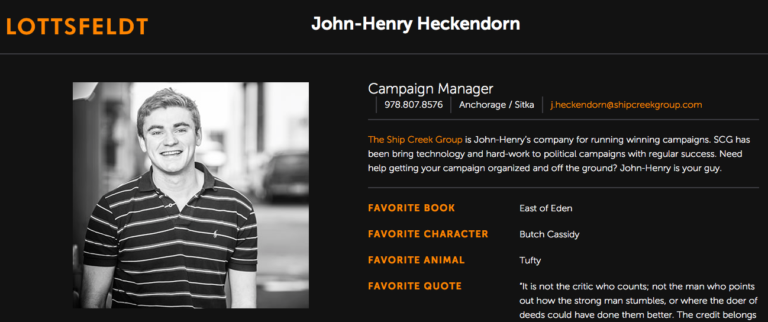
THE $100,000 MAN: We come to the pending employment of John-Henry Heckendorn, who is Exhibit A for a hiring freeze that does not exist.

Screen Shot 2017-01-21 at 10.43.21 AM

Heckendorn is the young man from Massachusetts who came to Alaska five years ago to work on a campaign for Rep. Andy Josephson, someone he met while attending Whitman College.

He found Alaska to his liking, so much so that he decided to start his own campaign company, Ship Creek Group, which gets Democrats elected. He’s good at it.

Heckendorn is associated with Jim Lottsfeldt Strategies, where he appeared on the Democrat operative’s web site as a team member until his profile was removed last week. Heckendorn has a talent for running effective campaigns. His alliance with Lottsfeldt gives him strong union chops, and a direct line to the Lottsfeldt political blog.

Heckendorn is a likable guy. But in fairness, he’s 100 percent campaign operative.

The governor has made Heckendorn an offer to come onboard his Administration, starting at the end of this month.

This is good for Heckendorn, because it’s an off-year for campaigns and money will be harder to come by with only municipal races in Anchorage to play in. He can put his company on auto-pilot while he goes to work for Walker, who has made him a handsome offer: $97,500.

Heckendorn is 26 years old.

That’s equivalent to nearly 100 Permanent Fund dividends. And that’s not including benefits.

What is Heckendorn’s job? From the paperwork, it’s unclear. There is no actual job description. He told the Alaska Dispatch News that “he will work with the Legislature and the state’s executive-branch agencies.”

Where did the governor come up with the position?

An analysis of the paperwork trail shows Walker has taken a position from the Governor’s Office of International Trade, which had been occupied by an associate director who the governor let go to trim the budget. The governor has slyly converted it into a special assistant position that is likely related to Walker’s re-election bid.

Heckendorn, according to the governor’s organization chart, is at the same reporting level as Communications Director Grace Jang. He will be a special assistant to the Chief of Staff and Governor, but technically reports to Marcia Davis, deputy chief of staff.

His handsome salary at the assigned Range 23, between a step E and F, indicates there has been a salary override. This is a salary step that Heckendorn might only see after working a few years, but he’s getting it right out of the gate.

The new position will be stationed in Anchorage, where the bulk of election strategy work is likely to take place:

Screen Shot 2017-01-21 at 11.21.54 AM

WHITAKER, ESSENTIAL TO LIFE AND SAFETY: The governor has also retained his former chief of staff, Jim Whitaker, keeping him at his very lucrative chief-of-staff salary of over $173,000, plus benefits.

Whitaker is around Range 29, Step Q, and adding in the benefits he receives, he pulls down the equivalent of 249 Permanent Fund dividends.

Whitaker’s job description is Special Projects Coordinator, a job created for him after Walker needed to get him out of the spotlight, since he is unpopular with legislators. Whitaker, readers recall, spoke in endorsement of Barack Obama at the Democratic National Convention in 2008.

How did Walker carve out that position vacancy? In the paperwork trail it appears that he took a constituent relations position, (PCN 01-405X) , that was in Fairbanks.

That position was vacant due to downsizing his staff. Now he is up-sizing the position from a Range 14 to a Range 29 in order to keep Whitaker close by.

Screen Shot 2017-01-21 at 11.51.26 AM

KENDALL, CAMPAIGN MAN AND CHIEF-OF-STAFF: Walker hired former Murkowski campaign operative Scott Kendall as his new chief of staff.

Kendall is in charge of signing off on the Heckendorn hire, and in fact may be looking forward to having the young man join the staff in just 10 days.

Kendall himself came in on a salary override, of nearly Range 29, Step O. With his benefit package, Kendall costs Alaska nearly 232 Permanent Fund dividends.

The world of Bill Walker’s own office salary overrides, layered on his previously announced hiring freezes, gets weirder by the day: This week he announced wage freezes for most non-union state workers.

While admirable, it’s not new.  Recall last year’s attempt at freezing wages, an effort by Republicans in the House, which ran into a concrete wall of Democrats. The bill would have kept wages steady until oil hit $90 a barrel.

Back then, Alaska AFL-CIO President Vince Beltrami called it a “ridiculous sideshow,” and said he was glad to see that Democrats in the House were blocking its passage.

The governor’s bill, SB 31, holds unions harmless and goes after non-union state workers instead.

“Until we enact a sustainable fiscal plan, we must make adjustments,” Governor Walker said in a Jan. 19 press release. “I believe in leading by example and have reduced my own salary by one-third. While it won’t close the fiscal gap, this legislation (SB 31) is a necessary part of the solution to Alaska’s fiscal crisis.”

His bill and transmittal letter are here.

The reality is that the Governor’s Office is in no way leading by example.

THE SALARY OVERRIDE GOVERNOR: This could get awkward for Gov. Walker. While freezing wages for many rank-and-file state workers, he is dramatically upgrading positions in his own office, creating new ones, and re-purposing trade promotion staff to serve as political operatives for his own re-election.

Andree McLeod, a citizen activist who requested the documents from the Governor’s Office that are cited in this story, had this to say:

“Walker’s actions do not match his rhetoric. His attempt to seem fiscally prudent is disingenuous at best and is three budgets too late. He campaigned on the promise to decrease high exempt salaries but has chosen to increase them year after year. Even his most recent exempt hires contained salary overrides (salaries over the required amount) to his newly hired chief of staff Scott Kendall and his former chief of staff Jim Whitaker who was kept on at the same rate.”
Look for the Senate Finance Committee — and other Alaskans — to have questions about the governor’s actions.

Toyko or bust: Fish office replaced by natural gas office in Japan

1

Screen Shot 2017-01-20 at 4.51.54 PM

The Alaska Gasline Development Corporation has opened an office in Tokyo, Japan to market the state’s wealth of natural gas.

And the State of Alaska has closed down another office — one that represented the trade interests of fishing families in Alaska.

While the Governor’s Office for many years had a seafood office in Japan’s capital, anyone who wants to talk fish now needs to go through the office devoted to talking nat-gas. The office being run by AGDC is a one-stop shop for any of Alaska’s resources, but the person in charge is a natural gas guy.

Oddly, the governor made no mention of the historic change in his State of the State Address on Wednesday, but an invitation to the opening of the new office was making its way around the small circle of media at the Capitol even while the governor spoke. It was dated January 12, six days before the governor’s speech.

Screen Shot 2017-01-18 at 8.47.28 PM

Similarly, no mention was made in the governor’s State of the State speech about the Houston office that AGDC announced it would open back in July.

That office never materialized, and no public discussion has taken place about why, or about the need for the Tokyo office.

On Jan. 11, AGDC President Keith Meyer spoke about the gasline project in Kenai to a group of business and industry leaders, and also made no note of the office he had opened in Japan that week.

And at the most recent board meeting of AGDC took place on January 12 — the same day the Toyko Office opening was quietly introduced to industry — no mention was made.

That meeting was almost entirely held behind closed doors in an executive session, with no written notification before or after the executive session about any topics discussed.

Alaska’s seafood industry is the fourth-largest supplier of seafood imports to Japan, and has been for decades.

Screen Shot 2017-01-20 at 4.30.24 PM
Masatoshi ‘Nick’ Shiratori 

Now, with the fish trade expert gone, a former employee of Mitsubishi Corp. will be Alaska’s representative on all trade matters. He will work with the administration to secure long-term contracts for gas, as well as financing for the gasline project that may cost $65 billion. Masatoshi “Nick” Shiratori is anchoring the new office.

AGDC officially became the sole owner of the giant gas export project on the last day of 2016 after its private partners – Transcanada, BP, ConocoPhillips, and ExxonMobil decided the massive project was not for them. AGDC is a public corporation owned by the State of Alaska.

Alaska seafood in Japan has been a declining market because of changing tastes among younger Japanese, according to the food blog Northwest Asian Weekly.

Not as many millennial Japanese are eating the kinds of seafood that come from Alaska waters, but instead are turning to chicken, pork and beef, the magazine said. Without a robust trade representative, Alaska’s Japanese market position could erode even more as the skills needed to handle and prepare seafood are lost.

The Alaska Seafood Marketing Institute has worked to counter that trend by actually teaching the Japanese in Tokyo various time-saving tips, such as its  “Cook It Frozen” campaign.

Read more by Nat Herz at the Alaska Dispatch News about the Tokyo office non-announcement.

A president underestimated from Day One

1

Screen Shot 2017-01-20 at 11.04.05 AM

It’s President Trump.

At 8 am Alaska time, The Donald became the most underestimated president in modern times. Even the parade this afternoon is sparsely attended, compared to the past few presidential parades.

Sometimes it’s nice to be underestimated. Half of the public doesn’t seem to expect much of Donald J. Trump. Maybe that’s going to work to his benefit.

By comparison, Barack Obama had been practically anointed as the Inevitable One, a process that started with his stunningly “on-message” keynote speech at the Democratic National Convention back in July of 2004, four years before he ran for the presidency.

If anything, the quite effective orator Obama had been overestimated, which led to the deep disappointment that many Americans felt during his presidency. As it turned out, he was not a unifier. He divided the nation bitterly.

Not Trump. His was an uphill battle all the way to the late hours of Election Night, 2016. He’s never been one to be “on message.” Half of his supporters cringed even while they backed him, because he is not a man used to crafting every turn of a phrase. He is not, as is evident, politically correct enough for half of the voters. Those who voted for Hillary are not coming over. Ever.

Trump fought this battle alone much of his journey to the White House. He had to clear a crowded field of usual suspects. He did so with a blustery and blistering style that scared many mainstream Republicans, who were convinced he was the one candidate who could not win against Hillary Clinton. They, too, underestimated him.

Eighteen months ago, the media could barely contain its disdain when Trump announced his candidacy. They thought it was a joke. From the outset, they made a winking sport of their coverage, using dismissive phrases and code language. One could almost see them laughing into their sleeves.

A reporter in 2015 asked him: “You are not a nice person. How are you going to get people to vote for you?”

Trump’s answer was “I think I’m nice…But I think people want competence.”

(Watch Trump’s speech announcing his candidacy on June 16, 2015).

That very day of his announced candidacy, the spokeswoman for the Democratic Party, Holly Schulman, poked fun at the entire Republican field: “Today, Donald Trump became the second major Republican candidate to announce for president in two days. He adds some much-needed seriousness that has previously been lacking from the GOP field, and we look forward to hearing more about his ideas for the nation.”

The Democrats were pulling for him back then. They didn’t think he had a chance against Mrs. Clinton. He was the Democratic establishment’s favorite candidate.

Dismissed by the liberal intelligentsia, and hammered by the media as temperamentally unequipped to lead the nation, Trump motored on, tweeted on, and never once apologized for who he is.

Today, Trump’s  inaugural address mirrored the remarks he made back on June 16, 2015.

He did not try to mend fences with the liberal establishment. He didn’t turn and throw a single compliment to his predecessor, but doubled down on his “take back our country” populist message.

It was the speech of a fighter who, for all his theatrics, is remarkably consistent in the platform that he ran on: American jobs, American schools, Americans’ safety and national security come first for him.

No more than one half hour after he became president, his Administration began to unwind some of 11th-hour moves of the Obama Administration:

He suspended a Department of Housing and Urban Development rule that Obama approved on Jan. 9, which lowered charges for borrows on risky mortgages backed by the the Federal Housing Administration. Conservatives have held that moving mortgage risk to the federal government and away from the private sector is bad policy; the federal government should not take over what the private sector should be doing.

 CONFIRMATIONS BEGIN: In the U.S. Senate, lawmakers are expected to take up the confirmation votes for two of Trump’s cabinet as early as today:
Retired Marine Corps Gen. James “Mad Dog” Mattis, Trump’s nominee for Defense secretary, and retired Marine Corps Gen. John Kelly, the president’s choice to lead the Department of Homeland Security are the first to be voted on.
Those two confirmation votes may be presided over by U.S. Sen. Dan Sullivan, Alaska, who is also a Marine.
RIOTERS AND PROTESTERS: A mass hysteria took hold among Trump opponents over the recent weeks since the election. The public grieving has devolved into violence as today, hundreds of lawless rioters are costing the nation millions of dollars as they break windows, start fights, and leave at least a few Trump supporters bloodied in the nation’s capital.
Tomorrow, women protestors take to the streets across the nation to express their displeasure with the president.
As they do so, Americans will watch football, attend basketball practices, go to work, pay bills, visit friends, and gather around the dinner tables of America from Nome to Nantucket.
In short, we will carry on with our lives, expressing love for family, love for country, and love for freedom that was expressed by this, the Most Underestimated president we have known.

The partying part of the transfer of power

0

Alaskans are making the most of the celebration under way in Washington, D.C., at events leading up to the swearing in of Donald J. Trump tomorrow. More photos from the Alaska celebration that continued late into the night. While much of Alaska is hunkered down for one of the coldest January’s in memory, ambassadors to the nation’s capital are having a cool time: The weather forecast for Friday in Washington is a high of 49 degrees and rainy.

Partying for a new president

0

The celebrating continues tonight in Washington, D.C., as Alaskans gather to ring in a new president who they hope will have a positive impact on the state and the nation. Some outtakes from the celebration under way, which included Alaska’s own mushing mortician, Scott Janssen, and a sled dog. The inauguration of Donald Trump as president is tomorrow, and tonight’s partiers will be lining up starting at 6 am to get good spots, if they don’t already have assigned seating. Come back for more photos.

Photos from Alaskans’ inaugural celebration

0

The Alaska-themed Inaugural Celebration is under way in Washington, D.C. We’re posting photos that participants send to Must Read Alaska.

The celebration, with honorary cohosts Sens. Lisa Murkowski and Dan Sullivan, is at the Washington Plaza Hotel. It’s an Alaska extravaganza with Native dancing and drumming, Hobo Jim, Alaska beers and seafood, and historic photos and artifacts on display.

More photos from Alaskans in DC:

Screen Shot 2017-01-19 at 4.11.13 PM

Screen Shot 2017-01-19 at 2.07.19 PM


Screen Shot 2017-01-19 at 4.00.00 PM
Bejean and Jay Page locate their seats for tomorrow’s swearing-in ceremony.

Screen Shot 2017-01-19 at 2.09.17 PM

Rep. Don Young photo-bombs a constituent for the family scrapbook.


Alaskans set loose on nation’s capital

0

Alaskans attending the swearing-in festivities in the nation’s capital this week are sending photos of themselves and their friends at various historic events. We’re posting them throughout the rest of the week, and captioning the photos as names are available:

Screen Shot 2017-01-19 at 2.13.45 PM
Kristie and Tuckerman Babock at the RNC meeting.
Screen Shot 2017-01-19 at 2.04.58 PM
Sen. Lisa Murkowski and constituents.
Screen Shot 2017-01-19 at 2.34.19 PM
Alaska Republican Party Treasurer Julie Tisdale and Sen. Dan Sullivan.
Screen Shot 2017-01-19 at 2.28.25 PM
Becky and former state Sen. Charlie Huggins 
Screen Shot 2017-01-19 at 2.06.36 PM
Rep. Don Young and Sen. Frank Murkowski (ret.)
Screen Shot 2017-01-19 at 2.06.46 PM
Rep. Don Young and former Lt. Gov. Mead Treadwell, with George Lamoreaux.
Screen Shot 2017-01-19 at 2.09.31 PM
Rep. Don Young greets constituent.
Screen Shot 2017-01-19 at 2.08.39 PM
Sen. Dan Sullivan and Alaskan.
Screen Shot 2017-01-19 at 2.06.56 PM
Randy Ruedrich, on the left, Rep. Don Young on the right.
Screen Shot 2017-01-19 at 3.33.15 PM
Ryan McKee and Lauren Cusack ready for the Alaska Inaugural Ball.
Screen Shot 2017-01-19 at 2.28.14 PM
Charlie Huggins and daughter Hallie Huggins.
Screen Shot 2017-01-19 at 2.11.20 PM
Protestors vowing to “BRING DC TO A HALT!”

State of the State: Signs of struggle

1

It was 50 minutes of oratorical mediocrity, but there have been worse in the history of State of the State Addresses.

Screen Shot 2017-01-18 at 9.24.10 PMAlaska Gov. Bill Walker tonight stammered his way through his Address to the people of Alaska — not tipsy, but with that lazy elocution that Alaskans have come to know as the Walker Dialect.
In the content department, however, it was like Gertrude Stein arriving in Oakland: When you get there, she said,”there is no there there.”

Walker struggled to read the teleprompter, rushing through the text and skipping over words, and there were many to skip over.

He was his most animated and endearing when he broke free from the script and told the story of his teenage years and a harrowing winter drive from Delta to Valdez in a car that only had a reverse gear and only made it part of the way home before giving up that gear too. It was reminiscent of a Jay Hammond moment. The crowd didn’t go wild, but at least returned to a waking state.

The moral of his story, he said, is to learn from the past. Another wag in Juneau noted: “Don’t get into a car with Walker. He’ll take you backwards and then it will break down.”

In the end, there really wasn’t anything that stood out in what was ultimately a nothing-burger, hold-the-relish performance, except his admonishment to the Legislature: If you don’t like my fiscal solution, bring one of your own, he said. But don’t bring it unless it balances.

“Gravest Fiscal Crisis in State History” was the title of Walker’s speech, and he spent at least some time reviewing the seriousness of the problem, which has not changed much since last year, except the options are clearly closing.

State revenues are down more than 80 percent from four years ago, he said. During that period, he said he has cut the budget 44 percent.

“But we still face a $3 billion fiscal gap,” he said.

Walker didn’t mention the spending cap that the Senate has proposed, nor the $750 million in cuts the Senate has also offered as a three-year plan. But he acknowledged that Alaskans said they want their government cut.

We learned that Walker is still pursuing the income tax: “In this vein, I maintain my support for a modest income tax and other revenue bills I introduced last year,” he said. “If all of these measures passed, with Alaskans receiving a PFD each year, we would still be the lowest taxed individuals in the nation.

“Before reintroducing those bills, I plan to work with you in this body to chart a path forward,” Walker said.

The translation is that he’s going to count votes before introducing any more taxes under his own name.

The governor also did not talk about how to stimulate the private sector economy, although he cheered the news that there are oil finds on the North Slope that will help the state. He’d like to see more of them, at least.

He revisited his request that all Alaskans shop at farmer’s markets in their area, as that circulates millions of dollars through communities: “If every Alaskan spent just $5 a week on Alaska-grown products, that would translate into $188 million circulating through the Alaska economy annually,” Walker said.

The governor said he would not pursue projects that “don’t pencil out,” referring to the cancellation of the Juneau Access project and Knik Arm Crossing. He said the gasline project “will be financed by long-term purchase commitments from LNG buyers, not from the Permanent Fund. It will not be pursued at all costs. It will only be pursued if it has long-term customers.”

Screen Shot 2017-01-18 at 8.47.28 PM

Walker spoke at length about the gasline project that he’s pursued most of his adult life, but did not mention the fact that the Alaska Gasline Development Corporation has just opened up a Tokyo office.

The best speaking of the night came in the prerecorded response from a casual and unrehearsed Senate President Pete Kelly of Fairbanks, who let it be known that the Senate’s proposed $750 million in budget cuts over three years and the proposed spending cap would be every bit as essential as looking at the Permanent Fund Earnings Reserve Account. Kelly was articulate, spoke with conviction, and was, well, chill.

Importantly, Sen. Kelly focused on getting oil production ramped up, which implies he will not be friendly to any bills coming from the House of Representatives that further hobble an already struggling oil industry.


Interior Secretary nominee: King Cove Road a priority

0

Screen Shot 2017-01-18 at 4.15.26 PM

A source connected to President-elect Donald Trump expressed optimism today that the road between King Cove and Cold Bay will be a top priority early in the Trump Administration.

The source, who spoke to Must Read Alaska on the condition of anonymity, has spoken directly with Rep. Ryan Zinke, the Interior Secretary nominee, and received assurances that the life-saving road is one of Zinke’s top priorities.

The confirmation hearing for Zinke are underway in Washington, D.C., where he was intensely grilled by Democratic members of the Senate Committee on Energy and Natural Resources, chaired by Sen. Lisa Murkowski of Alaska.

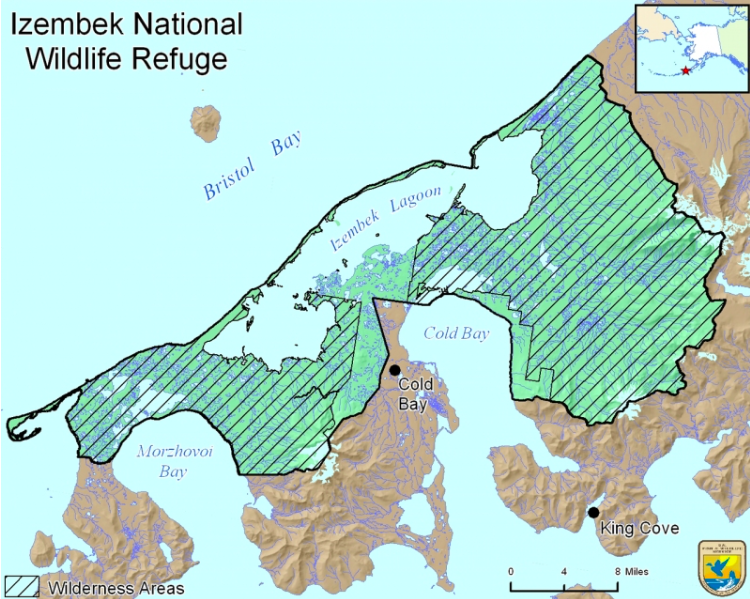
Three years ago, current Secretary Sally Jewell rejected the road that would connect King Cove residents with the all-weather airport in Cold Bay. Many Alaskans saw it as evidence that the Obama Administration cares more about the birds of the Izembek Refuge than it does for the lives at risk in windy and foggy King Cove community.

Zinke is being pressured by the Alaska DC delegation to commit to building the 11-mile emergency gravel road.

King Cove Mayor Henry Mack last month expressed hope for the Trump Administration coming to the aid of the community: “Unlike Secretary Jewell, we believe President-elect Donald Trump and Interior Secretary nominee Ryan Zinke value human lives as well as birds,” he told reporters. “We are confident they will take action because they understand that the lives of King Cove residents matter. We’re encouraged that we may finally get access to a small life-saving road corridor, and our dream of safe passage to the Cold Bay airport will become a reality.”

King Cove residents have lobbied for a road for two generations. But the U.S. Fish and Wildlife Service in 2013 decided the road could cause damage the wetlands and lagoons of the 150-square-mile Izembek Lagoon It is a seasonal home to various migratory birds.

Environmental groups remain opposed to the road, and Secretary Jewell agreed with them, and even refused a land swap that would have traded state land for federal land. The federal government would have received 97.5 square miles of state land and given up 3 square miles of federal land.

The environmentalists’ opposition remains.

“Check back for updates on this story.