WALKER SAYS IN RESPONSE: IT’S A ‘RACE TO 40 PERCENT’
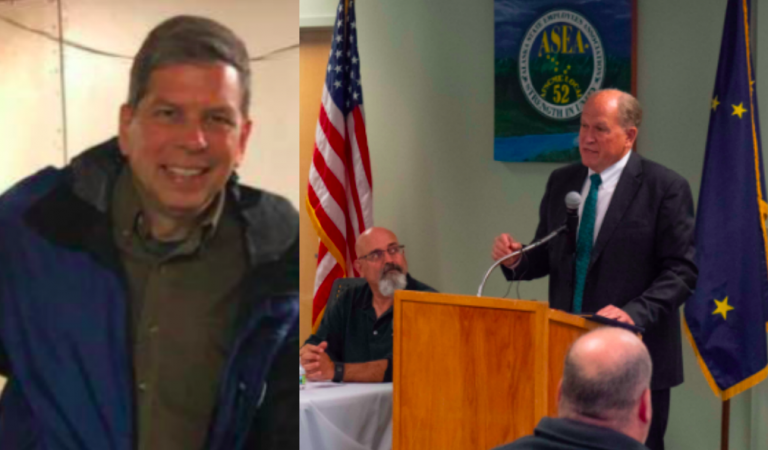
Mark Begich ended the suspense today, saying he is sticking with his race for governor. He made the announcement at his campaign headquarters in a strip mall at the corner of Benson Blvd. and Minnesota Blvd. Before he began speaking, the songs “Born to Run,” and Eye of the Tiger” were broadcast from the loudspeaker.
The room itself, which is diminutive to begin with for a campaign, was crammed with supporters who included many of the usual Democratic operatives and political figures: Assembly members Eric Croft, Chris Constant, senatorial candidate Elvi Gray-Jackson, Sen. Tom Begich and Bill Wielechowski, Rep. Chris Tuck, and even former Rep. Willie Hensley and former U.S. Senate candidate Steve Lindbeck. Bloggers Jeanne Devon (Mudflats) and Jeff Landfield (Landmine) joined the crew of media that included public broadcasting, KTUU, Anchorage Daily News and the Frontiersman/Anchorage Press.
Begich, in his typically jovial mood, was flanked by two dozen supporters holding signs that indicated why they were supporting their Democrat nominee: Crime, the PFD, abortion rights, and LGBT rights. They were pumped and resolute about their candidate.
Begich’s remarks were streamed on Facebook:
“For those who are wondering, I’m staying in this are for governor,” Begich said. “Let me make it very clear to the reporters and others. If you want to talk about the process talk to someone else. We are done with that. I’m in the race to win. It’s a three-way race, so get used to it. We are focusing on what this race is about: The people of Alaska. Alaskans will need to make their choice of who they will support, and vote accordingly. You cannot cut a deal on your values just to make sure one person or another becomes governor.”
That was the bad news for the candidacy of Gov. Bill Walker, who has the third spot in a race featuring someone who is a titan on the Democrat Party side, and another who is a force of nature for the Republicans — Mike Dunleavy.
For weeks, Walker has tried to muscle Begich out of the race, and as late as yesterday the two had met to discuss if there was a way for one of them to drop.
“This just goes to show you Walker still can’t make a deal come together,” said one supporter attending the rally at the Begich headquarters. “Maybe he can unilaterally keep Mark’s nameoff the ballot.”
But Walker took the announcement in stride, and within minutes had released this prepared statement on Facebook:
“Regardless of how many candidates are in the race, this election will come down to the decisions made on the Permanent Fund and the Fiscal Plan. Those decisions have been tough, but they have restored our credit rating, ended our unilateral dependence on oil, and protected the Permanent Fund for the future. A three-way race is a race to forty percent. Our challenge in the next two months is to make sure that at least forty percent of the electorate recognize that those decisions have put Alaska in control of our own future. Byron and I are ready to meet that challenge!”
The campaign for Mike Dunleavy issued a statement of its own:
“After months of closed door meetings with power brokers and special interests, the two candidates for big government – Bill Walker and Mark Begich – failed to pull off another scheme to disenfranchise Alaskan voters. Now the choice could not be more clear: Alaskans can vote either for the failed experiment of Walker/Mallott, career politician Mark Begich, or the bold new leadership of Mike Dunleavy, who has pledged to restore the PFD, take real steps to fight crime, and grow the economy. The Mike Dunleavy campaign is focused on addressing issues that matter most to Alaskans: record unemployment, out-of-control crime, a weak economy, and unsustainable government spending. Mike Dunleavy’s optimistic vision for Alaska has been, and will continue to be, the cornerstone of the campaign to send Mike to the governor’s office.”
Dunleavy today appeared on public broadcasting’s “Talk of Alaska” show and then was heading to Juneau to attend a town hall meeting focused on crime, to be held at the Mendenhall Public Library Wednesday at 5 pm, and a Juneau Chamber of Commerce forum on Thursday, where all three candidates are likely to appear.
Tim Fitzpatrick is the new vice president of external affairs and government relations for the Alaska Gasline Development Corporation.
Fitzpatrick replaces Rose Alcantra, who was released this summer by the agency, which is operating under close guidance from the Office of the Governor, with Deputy Chief of Staff Grace Jang keeping tabs on the agency’s every move. The construction of a gasline is Gov. Bill Walker’s primary focus and one of his main campaign promises when he ran in 2014.
Fitzpatrick is a communications strategist with more than 20 years of experience assisting business and policy organizations achieve their public relations objectives, the news release from AGDC says. He has consulted to BP Alaska, the Alaska Oil & Gas Association, and the Alaska Support Industry Alliance.
Fitzpatrick previously worked in Comcast Corporation’s corporate communications department, managing media relations for financial, merger and acquisition, regulatory and policy activities.
Prior to joining Comcast, he was a senior communications advisor to political and governmental organizations, including two presidential nominating conventions, national and local political campaigns, and on Capitol Hill.
In his role at AGDC, “Fitzpatrick will advance AGDC’s communications objectives with in-state, national, and international stakeholders.”
Although Rep. Gabrielle LeDoux won the Primary Election on Aug. 21, she’s not out of the woods yet in her quest for reelection to House District 15.
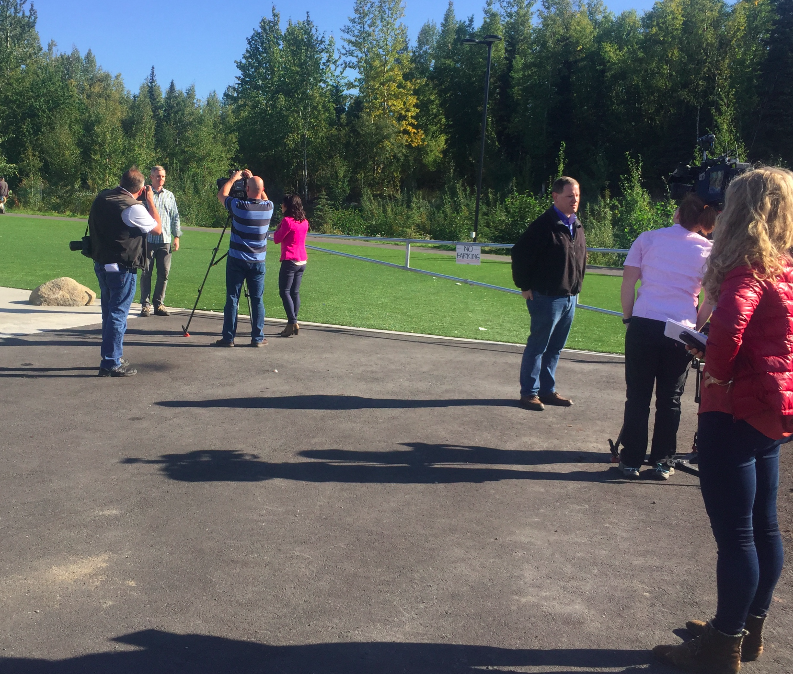
Jake Sloan this afternoon announced he is running as a write-in Republican candidate. He made the announcement at a park in Muldoon, while his children played on the equipment at the park.
Sloan is 39. He was born in Seattle, but spent his early formative years in Nepal, where his parents were serving as missionaries.
The family moved to Alaska and settled in Talkeetna, where Sloan continued his schooling.
Sloan graduated from Mat-Su Valley High in 1997, and works as a contractor. He and his family have lived in the East Anchorage district for five years. Married and the father of three children, Sloan has also served as a pastor and worked with ministries and churches in the area.
Jake Sloan is interviewed on the left by KTVA, while Aaron Weaver is interviewed on the right by KTUU, during today’s press availability at a Muldoon park at noon.
“I’m running because the people of Muldoon and East Anchorage deserve better — an honest candidate who will really represent the people of the district and not her own political ambitions or special interests,” he said, referring to LeDoux, whose primary win is under a cloud after many instances of fraudulent votes were discovered and linked to her.
LeDoux’s election to the General Election ballot is likely to be (MRAK will update) certified today with the rest of the 39 district certifications, but it is now under investigation. after the Division of Elections discovered that seven requests in the name of dead people had been made for absentee ballots, and that people submitting absentee ballots for LeDoux were not living in the district.
LeDoux left the state shortly after the election. Charlie Chang, the man whom she paid over $10,000 to work on her absentee ballots lives in California, where he is a Democrat.
Aaron Weaver, a videographer who lives in the district, had filed for the Primary Election against LeDoux. Although he never mounted an active campaign, he said today that his goal had always been to give people at least some kind of alternative to LeDoux on the Republican ballot. He was surprised on election night when he actually pulled ahead of LeDoux by three votes. She had, however, worked the absentee ballots hard, and pulled ahead after the absentees started coming in.
Lyn Franks, a hardline Democrat, is also in the race. Republican analysts told Must Read Alaska that without Jake Sloan in the race, Franks would win, even though she is on the steering committee of the radical group, March on Alaska, and is an active member and volunteer for the Alaska Center (for the Environment), which has endorsed Mark Begich for governor.
LeDoux has become so toxic to donors, volunteers, and voters, that her core supporters may find it hard to muster the support she needs to be a competitive candidate. She was also asked to leave the Alaska Republican Party last year, when the party voted to sanction her due to the role she has played in putting the Democrats in charge of the House.
Gov. Bill Walker and Mark Begich met early Monday afternoon in an undisclosed location in Anchorage. The two candidates for governor had tried all week to iron out who is going to stay in the race against Mike Dunleavy for governor, and who might find a way to gracefully bow out.
Gracefully is the operative word: A sitting governor doesn’t just step aside and a former U.S. senator doesn’t either, especially when he has the Democratic Party behind him.
They both know a three-way is trouble against a Republican candidate of the stature of Dunleavy; Begich and Walker both occupy the same space in the electorate — the progressive, Bernie Sanders Democrats and others on the political left. Dunleavy has the political right locked down.
Complicating the matter is the sitting lieutenant governor, Byron Mallott, who gave up his own aspirations to be governor in 2014, and accepted the understudy role, allowing Walker to win the election after the Alaska Democratic Party jettisoned two duly elected candidates — Walker’s running mate Craig Fleener and Mallott’s running mate Hollis French.
Mallott been a loyal soldier, rewarded by being allowed to basically run day-to-day operations in government to the extent he wishes to. And so to combine a Walker-Begich ticket would be an act of deep disloyalty to Walker’s most stalwart ally.
As of sundown on Labor Day, both Begich and Walker were still in the race — Begich as the top Democrat in the state, and Walker as whatever he wants to be on any given day.
Begich has been making the case for weeks that he, in fact, actually has an advantage over Dunleavy, while Walker is bumping along the bottom in third place as one of the least liked incumbent governors in the nation.
Walker brings recent baggage — lying about how he wouldn’t impose taxes and lying about how he wouldn’t take the Permanent Fund dividend from Alaskans.
His administration has been marred by scandal, from the $850,000 he gave to his consultant friends like Rigdon Boykin, which paid off unsettled debts from previous joint ventures, to appointing Roland Maw to the Board of Fisheries, only to then find him embroiled in the largest Permanent Fund dividend fraud lawsuit in Alaska history. The scandals have continued, crime has spun out of control, and the governor has been distracted by his enchantment with China.
But he has the endorsements of the unions, which is no small advantage.
Begich is the actual nominee of the Alaska Democratic Party — with 33,451 votes already from the August primary. That’s his baseline as he heads into November.
The Alaska Democrats, his base, have not had such a good candidate for governor in years, and they’re not likely to see a person of his caliber run for governor for a long time under their banner. If they let this one go, and allow a full eight years to pass without a candidate for governor, it damages their party’s brand.
Add to that is the prize of redistricting: The Alaska Democratic Party knows that the next governor has a great deal to say about how the redistricting board is shaped, and there will be new lines drawn across the state that will influence who has power: In Southeast, a diminishing population means Southeast Alaskans will lose at least one half a seat in the House, while the Mat-Su Valley will gain a seat. The way those lines get drawn will have a powerful impact on who controls both the House and Senate.
If Walker is elected again, he will owe no allegiance to the traditional Democratic constituency that brought him to the party. With term limits, he would never face reelection, and therefore Democrats would not be able to count on him for anything.
Ultimately, either Begich or Walker must announce their decision before the close of business on Tuesday, Sept 4th. That decision will have been reached, as it was in 2014, behind closed doors, far from the inquisitive eyes of the voters. If one of them drops, there will have been a price to pay by the other, and voters won’t know what that price is until the election is far behind us.
In which our senior contributor considers the eight-hour day and the three-day weekend that celebrates it, at least for white-collar workers.
By ART CHANCE SENIOR CONTRIBUTOR
The first Monday in September has been the Labor Day federal holiday since 1894, although many states had a labor day before that.
In labor and leftist circles, activists pushed for a May holiday to commemorate working people, but business interests and the government itself resisted a May labor day because of the association with the Haymarket Riots, in which several police officers and civilians were killed and for which several anarchists/socialists were hanged or imprisoned.
Largely because of the Haymarket Affair, the politically correct way to refer to the riot, May 1 has become Labor Day in many socialist and communist countries.
Since the US Labor Day was designated as the first Monday in September, Labor Day became the first of the three-day weekend holidays, at least for those who got Saturday and Sunday off, a small minority of workers, mostly white collar.
Labor Day weekend over time became the symbolic end of summer and the time to put away your white and seersucker clothing, though that standard has been relaxed in recent years.
Art Chance
Organized labor likes to brag that they’re the people who brought you the weekend; they aren’t. Even today the only unionized employees who routinely get every Saturday and Sunday off are white collar and professional public employees and in the non-union workforce only professionals and some white collar employees can routinely expect every Saturday and Sunday off.
In the 1890s, the standard for labor and trades workers was a work week of six 10-hour days, Monday through Saturday with Sunday off for those operations that weren’t 24/7. Most “inside” work, retail, office workers, etc. worked eight- or 10-hour days with either five and a half days or six days in the workweek.
Much of the retail industry and some service companies gave a half day off mid-week, usually Wednesday or Thursday afternoon, and then were closed on Sunday. Much manufacturing, railroading, mining, the most highly unionized sectors in those days ran 24/7 and workers had irregular days off.
In the late 19thCentury the big push from organized labor and their allies on the Left was for the eight-hour day. A demonstration in support of the eight-hour day is what led to the police shooting of workers at the McCormick farm machinery plant and a protest over that shooting led to a bombing and the Haymarket Riot.
For those who get a weekend, the traditional Saturday and Sunday, it can be attributed first to custom in the professional and managerial classes and second to the 1938 federal Fair Labor Standards Act (FLSA). While the FLSA didn’t formalize labor’s long-held desire for the eight-hour day, it did set the standard of the 40-hour week at straight time pay and “time and a half” for work over 40 hours in a week and an administrative work period, a work week, of seven consecutive days, usually Sunday through the next Saturday.
This led to five eight-hour days with two days off in the work period becoming the standard, though two consecutive days off even today is far from universal.
The real impetus behind the 40-hour week and overtime pay over 40 hours was to get more people employed. Benefits were a very minor part of payroll costs in the 1930s so putting a 50 percent premium on work over 40 hours was to incentivize employers to have more employees rather than work the employees more hours.
Today when putting out a “Help Wanted” sign is akin to putting out a “Please Sue Me” sign. Benefits and taxes can be well over 40 percent, so employers would often prefer to pay the overtime.
Only Alaska and a couple of other states have daily overtime, though the State of Alaska exempts itself from the State’s Wage and Hour Laws and the daily overtime requirement.
Most of the rest of the Fair Labor Standards Act was aimed at the abysmal working conditions in rural areas and particularly in the South and the racially motivated death spiral of wages in the South. Child labor, at least for those under 14, was outlawed altogether except for family businesses and on farms; most agricultural and small retail labor was exempt from the Fair Labor Standards Act anyway.
Whenever workers complained of working conditions or a union organizer showed up all the Southern employer had to do was threaten to hire black labor. Then the union organizer couldn’t find anyone who’d talk to him and the workers were told they should be happy with the wages and working conditions they had.
The minimum wage was instituted to stop the downward spiral in wages as southern employers would routinely cut wages and threaten to replace white workers with blacks if the white workers objected. The minimum wage had little if any effect on the more industrialized and unionized north and middle West, but had a significant effect on the agricultural areas of the Country, particularly the South.
Even today agricultural and fishing employers go to great lengths to avoid state and federal wage and hour laws, as do other employers in areas where the economy is dominated by agriculture and fishing.
In Alaska if you process fish in a cannery onshore, you’re subject to Alaska’s draconian wage and hour laws. Move it 12 miles offshore and you’re subject only to federal wage and hour laws, and many of the employees would be considered agricultural employees and exempt from most federal wage and hour laws. Move the processor outside 200 miles and you aren’t subject to any laws at all.
I spent much of my adult life across bargaining tables and in hearing rooms arguing with unions over wages, hours, and terms and conditions of employment. The unions, some of them anyway, like to accuse me of being anti-union, but I’m not anti-union in their role of representing employees in matters of wages, hours, and terms and conditions of employment.
But I am very anti-union when they assume the role of a Socialist workers’ party with the right to compel political contributions.
I grew up in The South and I’ve seen how employers will behave in a friendly legal environment and with a labor surplus. I wouldn’t want to be an hourly worker non-union, even in Alaska.
Today, much of America’s unskilled and semi-skilled workforce would love to have an 8-hour day rather than the 4- or 6- hour day and two jobs that Obamacare has sentenced them to.
This Labor Day is a good time to think about the deteriorating Alaska workforce and working conditions. Every time Pomp and Circumstance gets played, Alaska gets dumber. Our best and brightest go Outside to college and the only ones who come back for more than a visit are those with a family situation that they can step into. We are graduating kids who are at best semi-literate and who have zero work skills. Throw in the amount of drug use and we’re producing a workforce that lacks fundamental work habits and skills and because of drug use cannot be employed in any safety sensitive job.
Employers willing to put up with the low-quality workforce can hire at the minimum wage and those with some concern for workers compensation costs can pay a dollar or two more and require drug testing.
You cannot live on the minimum wage or even a dollar or two more anywhere in Alaska except in your parents’ house or piled in with a bunch of others similarly situated in an apartment in a bad part of town. And, no, the answer isn’t to raise the minimum wage.
At this time of celebrating those who labor, we should be concerned that the labor force participation rate in the US was last so low in the early 1970s before large numbers of women began to enter the workforce. I’ve never looked at Alaska-specific workforce participation rates, but it must be abysmal statewide and disastrous in rural Alaska.
And it isn’t going to get any better unless we take steps to produce a more skilled workforce. If you’re an entry level or low/semi-skill worker, only your personal pride causes you to take the jobs that are available to you in the private sector. If you can’t get an entry-level government job, and the competition is intense, you’re better off on welfare than working two or three lousy jobs to try to support yourself. Frankly, if you go to college and come out with some general studies/liberal arts degree, you’re still a entry level or low/semi-skilled applicant and they’re a dime a dozen, though the degree might give you a little advantage in getting a government job.
There really isn’t much to celebrate about labor in Alaska unless you are a high-skill worker or have a unionized government job. The unions, particularly the building trades unions that were once the most powerful force in Alaska politics, have all but abandoned doing anything other than protecting their niche. They should be desperately concerned about their diminishing ability to send a qualified employee when one of the few remaining unionized employers calls the hall.
Young people are trying to enter the workforce with no skills and no clue as to what is expected from an employee. Just as the University of Alaska has to provide remedial courses before Alaska’s high school graduates can even take college level classes, themselves dumbed down already.
Meanwhile, unions that have apprenticeship programs have to teach their apprentices what work is before they can teach them the actual skills of their trade.
Unions need to do something about it, but so far they seem content with the status quo of a poorly educated workforce. And they’re allied with the teachers’ unions in maintaining that status quo.
Art Chance is a retired Director of Labor Relations for the State of Alaska, formerly of Juneau and now living in Anchorage. He is the author of the book, “Red on Blue, Establishing a Republican Governance,” available at Amazon. He only writes for Must Read Alaska when he’s banned from posting on Facebook. Chance coined the phrase “hermaphrodite Administration” to describe a governor who is simultaneously a Republican and a Democrat. This was a grave insult to hermaphrodites, but he has not apologized.
As bona fide, card-carrying kibitzers in the upcoming November political silliness, we cannot help but wonder what Mark Begich must be feeling about unions right about now. With friends like them, he must be thinking, who needs enemies?
The AFL-CIO has decided it will hang onto its current meal ticket, Republican-cum-independent-cum-undeclared-cum-independent again Gov. Bill Walker in the upcoming general election and kick Begich to the curb. No money. No help. No Love.
IS THE BEAR SANPAKU OR JUST A VIDEO GAME KNOCKOFF?
Must Read Alaska has heard from several readers with opinions about the new Alaska State Trooper logo and branding.
One Asian scholar observed that the bear’s eyes are “sanpaku,” which a Japanese term describing an unhealthy condition where the whites of the eyes are visible below the iris as well as along the sides — three sides of white.
In some Asian medical interpretations, this is evidence of someone who attracts accidents and violence. Famous people who were sanpaku include former President John F. Kennedy and Princess Diana.
Several retired State Troopers are disapproving of the new logo, slogan and rebranding of the Alaska State Troopers for different reasons than a sanpaku bear.
The rebranding is, for now, limited to the recruiting office and confined to two recruiting vehicles.
Last week, a retired Trooper sent a letter to Gov. Bill Walker articulating the concerns of the retired law enforcement officers with whom he had been in touch.
The letter reads:
Dear Gov. Walker,
Very recently it was announced by the Director’s Office of the Alaska State Troopers that the patrol car door decals and motto was being changed. The motto: “Loyalty, Integrity, Courage” will now be “Guardians of the 49th”. The below image is one the Director’s Office chose for a new door decal:
We retired members of the Department object strenuously to this change for several reasons:
It is unnecessary, the present motto, “Loyalty, Integrity, Courage”, has been part of the Alaska State Troopers since the 1960’s; it is a cherished part of our history.
The present decal was new in early 2005; it then replaced the more popular blue diagonal slash with the image of a Trooper’s badge.
The current action is taken by a Commissioner and his Director without a clear reason for change other than their legacy.
The purported justification of increasing recruitment and retention defies the comments on the Department of Public Safety social media page. At last count there were 243 negative responses to 1 positive.
The Department has a high number of vacant trooper positions and asked the legislature for funding to fill them; spending dollars on decals is not fiscally responsible.
In a year the residents of Alaska were asked to take a cut in their PFD to help fund State operations this expenditure appears superfluous at best.
The new image the Director’s Office selected closely resembles one from “Titan Bear Gaming”, an online gaming group, hardly one would expect as a source for a professional law enforcement agency.
We assure you that present and past field personnel remain focused on the real public safety issues confronting the State. It is our objective to stop the nonsensical decal action and re-direct attention to traditional law enforcement activities.
I have sent this information out to over 250 members of the Fraternal Order of Alaska State Troopers and to date all the responses have expressed disappointment, frustration, anger, and disgust with this change. I suspect you were not aware of this action by the Commissioner of Public Safety; I hope you will rectify it. This is an issue that I will remember at the ballot box.
The letter to the governor is signed by Norm Carson of Pelican, Alaska, a retired Trooper lieutenant and Southeast Alaska Commander, who served from 1968 to 1990. It was forwarded to Must Read Alaska by one of Carson’s fellow troopers.
John McCain, who was presidential material and would have made a good president in 2008, was being victimized by the liberal media exactly 10 years ago this month.
But the news media waved the patriotic flag frenetically this week upon the announcement of the Arizona senator’s passing.
Those who shape the mainstream narrative have made him into a lion beyond reproach, someone who would fight the media bogey-man named Donald Trump until his last breath.
In 2008 the mainstream press rather enjoyed McCain as a primary candidate, at least initially, because the man was sympathetic toward the Democrats’ positions and could never be counted on by his party as a solid Republican. In fact, he seemed to fight his own party as much as he’d battle the opposing one.
But the moment he chose Alaska Gov. Sarah Palin as his running mate, the media turned its fire-breathing dragons on him.
The Pew Research Center found that McCain received four times as many negative stories as positive ones after his nomination.
Barack Obama, on the other hand, was the subject of twice as many laudatory stories as McCain.
Coverage of McCain was lopsidedly unfavorable, and became even more so over time, the research shows, as the nation prepared to vote in the General Election that November.
For Obama during this period, a third of the stories were clearly positive, a third neutral, and 29 percent were mixed.
Conversely, 75 percent of the stories about McCain were negative.
The media does the same savaging day after day to President Trump, and yet he seems to just keep on being himself, and being president.
McCain clearly never liked Donald Trump, and swiped at him at every opportunity; the president swiped back. McCain likely could not understand how the country could elect a man with a bad comb-over and a New York businessman’s brashness, while not allowing a true war hero like himself to lead the country.
Both men were alpha males, both full of themselves, both regarding their own talents as extraordinary.
Trump didn’t take lightly to the insults and said some regrettable things about McCain. The grudge stuck, on both sides, and it never seemed to ease.
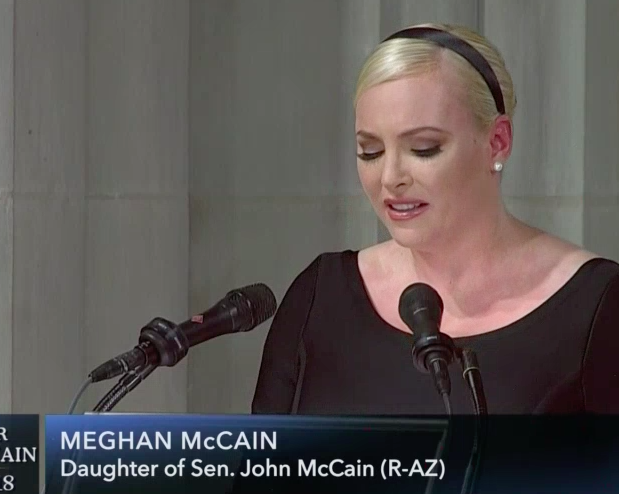
Today, the bitterness of the McCain family toward the sitting president spilled over to the ceremonies that featured a eulogy by his daughter, Meghan McCain, which carried the grudge match forward into the next generation, even while she mourned her beloved father:
“We gather here to mourn the passing of American greatness. The real thing, not cheap rhetoric from men who will never come near the sacrifice he gave so willingly,” she said, emotionally.
“The America of John McCain has no need to be made great again, because America was always great.” The crowd roared its approval.
“We live in an era where we knock down old American heroes for all their imperfections when no leader wants to admit to fault or failure. You were an exception and gave us an ideal to strive for.”
No one should speak ill of the dead, but this is the Hatfields and McCoys of the political realm. It was sad to see the family lose their loved one, but it was also sad to see the lack of restraint; instead, the McCains made it about Trump, who went to play golf and tweeted about Canada today. Trump had added to the drama earlier in the week by only lowering the flag over the White House for just a day to mark McCain’s passing. Public pressure finally prevailed and he ordered the flag back to half-staff until the senator is in his final resting place.
The remarks of former President Barack Obama during the memorial service were also pointed criticisms of Donald Trump, and spoke of McCain in ways that were entirely opposite to how he portrayed him in 2008, when he unleashed a series of attack ads that even the New York Times said were false.
At McCain’s apparent request, his former running mate Sarah Palin was disinvited to the memorial services, as were several members of his campaign staff from the 2008 failed presidential run. But the Obamas were there.
Families are entitled to bury their dead in the way they see fit, but this memorial week has devolved into a bit of theater that will make many Republicans glad when it’s all over. For many, McCain was a man they admired for many attributes, who they tolerated for other attributes, and who they wanted to like.
The late Sen. Ted Stevens understood these mixed feelings toward McCain better than most. He and McCain were often at odds on policy issues, especially Alaska spending programs, and their personal rapport was none too warm, either. It was Sen. McCain who popularized the “bridge to nowhere” description of the proposed Ketchikan bridge and, to the enduring dismay of the entire Alaska delegation, made it a rhetorical centerpiece of his 2008 presidential campaign.
Like Trump, McCain often made liking him a difficult task. His memorial service only scratched the scab on that dichotomy of the patriotic desire to honor the hero, yet wanting the drama between McCain and the president to — for the love of all things holy — be put to rest.
House Rep. Gabrielle LeDoux, in a reputation crisis over an alleged vote-buying scheme, now has 116 more votes than her primary challenger, Aaron Weaver.
In a matter that has been referred to the Department of Law for investigation of potential fraud in the LeDoux votes, the absentee ballots coming in late last week at the Division of Elections give LeDoux an easy win. Earlier absentees had her up by 87.
It’s a turnaround for the history books: On the first count after the polls closed, she was down by three votes.
LeDoux may have been stunned on election night by her opponent’s strength, but she already knew she had at least 100 absentee votes that had not been counted — those were the votes that a California man named Charlie Chang had acquired for her, and she’d paid him more than $10,000 for his services. These were her “insurance” votes, and now, it appears, many of them were fraudulent, perhaps criminally so.
It’s now been shown that even Chang voted in her district, although there’s little evidence he lives there. Chang is a Democrat operative in Fresno, California, where he serves on the Fresno County Democratic Party committee for Hmong voters.
It’s only one of dozens of irregularities, which include seven instances where dead people requested absentee ballots to vote in District 15.
In the counting of all the absentees, the Division of Elections set aside 26 for further review. There were just too many questions. And although the Department of Law will likely not pursue the matter, due to the Attorney General answering to Gov. Bill Walker first, this has become a federal criminal matter because there were federal candidates on the ballot in the U.S. House race.
That may have caught the attention of the U.S. Department of Justice and FBI, although neither has issued a statement.
It now appears that LeDoux will “win”, but will be busy for months answering the questions of investigators and reporters who will want to know what she knew and when she knew it, whom she directed to get votes and in what manner she directed them.
LeDoux is famous for keeping records on her district and every voter in it, and she has now told the media she has no idea who the voters are or why there are 17 voters registered with their listed address in one small trailer.
But her days of speaking to the media are coming to an end. LeDoux will clam up during an active investigation, and she’ll need to get a lawyer, too.
During an investigation, which would span California and Alaska, state and/or federal investigators would likely subpoena documents from her, Chang, and even her legislative staff who helped her during her campaign. Often legislative staff take official leave to help their bosses get re-elected.
That could sweep into an investigation of her long-time chief of staff, confidante and Juneau roommate Lisa Vaught, who may expect to have her phone records, emails and text messages to and from Rep. LeDoux and Chang scanned into the record. Vaught is handling LeDoux’s reporting to the Alaska Public Offices Commission of campaign income and expenditures.
It could also entangle Courtney Enright, her Rules Committee staff and Greg Smith, her legislative aide. All three of them have been paid by LeDoux to perform campaign work during the past few months.
The investigation could widen from there and sweep in close associates, such as lobbyists who advise her on a regular basis. It could extend as far as her donors.
And if there’s one thing about an investigation that includes the FBI it’s this: You don’t want to be telling agents anything that isn’t absolutely true.
The certification of the Primary Election is set for Tuesday, which is also the last day candidates can drop from the General Election ballot.
Election officials will likely be working through the weekend to prepare for Sept. 4, the day when the field for the General Election ballot will be set and the ballots can be printed.
But questions continue about how many illegitimate ballots were cast in the district.
After extensive reporting by news media, Alaska Republican Party Chairman Tuckerman Babcock wrote to the director of the Division of Elections Josie Bahnke and asked her to delay the certification of District 15 until an investigation is completed.
“They are grappling with pre-meditated corruption and have never faced that challenge before,” Babcock said. The fact that dead people requested absentee ballots is proof that the corruption was planned.
“Where is Byron Mallott?” Babcock said, referring to the silent lieutenant governor, whose job it is to oversee elections in Alaska.
Assuming the state moves ahead to certify the District 15 results on Tuesday, this will be the second flawed primary election in two years blessed by the Alaska Division of Elections. The first was the blatantly erroneous House District 40 election in 2016 that ended up ousting Rep. Ben Nageak in favor of the now disgraced Dean Westlake.
Coincidentally or not, both of these tainted races will have been decided in a manner that favors the political fortunes of the Walker-Mallott Administration.
THE GENERAL ELECTION
All of this bodes well for LeDoux’s Democratic opponent, Lyn D. Franks, who won 45 percent of the Democrat ballots cast and now proceeds to the General Election.
The Alaska Democratic Party will likely recalculate its plans for the district and see that seat as a “pick up” for Democrats, leaving LeDoux without any party at all, since the Alaska Republican Party has sanctioned her as unacceptable.
Raising money for LeDoux’s General Election effort will be tough under the current circumstances, with donors unlikely to want to write a check to someone who may ultimately face corruption charges.
The Democrats have pounced already. Franks wasted no time in putting out an invitation for a fundraiser for her campaign, in which she identified LeDoux as “vulnerable,” as shown below: