Thursday, December 25, 2025
Home Blog Page 1478

Sen. Lora Reinbold, ghost buster, makes national news

GHOST HUNTER GETS HUNTED BY SENATOR

Eagle River Republican Sen. Lora Reinbold has made national news for challenging one of Gov. Michael Dunleavy’s appointees, focusing on his ghost-hunting hobby.

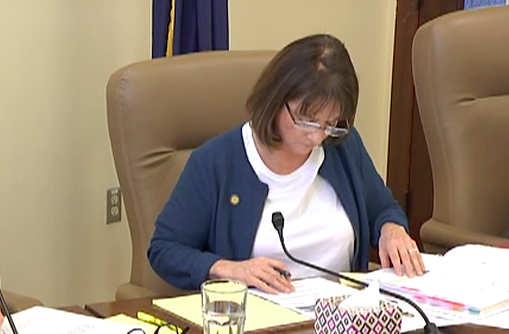
John Francis’ ghost hunting activities came across Reinbold’s radar, and she asked him about it in Senate Judiciary Committee on Wednesday as he was being interviewed for his nomination to the Violent Crimes Compensation Board.

Was he serious about the paranormal or was it a hobby?

“If it’s just for fun and all make believe, tell me that. If you’re serious and there’s investigative process and you believe this is real, I want to know that,” Reinbold said. “I really don’t want you to glaze over this because I think this is a real serious concern.”

Reinbold said tonight that victims of violent crime are emotionally fragile and she’s simply concerned about someone being on the compensation board who could take advantage of them, or influence them about their loved ones being ghosts.

Francis’s Alaska Ghost Hunting website says the team “never asks to be paid for an investigation. Every member of the AKGH team is passionate about what they do.”

John Francis

But the business also presents itself as a group of serious-minded paranormal investigators that specialize in haunted locations, rather than UFOs, aliens, or mythical creatures. Francis has appeared on television shows on the topic, but said that his group hasn’t been very active recently.

Reinbold said she thought Francis had been less than candid in his answers and she does not plan to vote for him.

[Francis’ resume can be read here]

Francis is an active member on social media sites such as Stolen in Alaska, and Mat-Valley Crime Discussion, for which he is an administrator. He is dedicated to the repeal of SB 91, the liberal crime bill that many believe led to an uptick in crime across the state and his Facebook pages dedicated to crime-stopping have thousands of followers.

The Associated Press story about the interview of Francis has made it as far as the New York Times.

The hearing can be watched here, starting at 1.26 and ending about 1:39.

Wild: Mat-Su School Board meeting disintegrates into shouting

OLE AND DONNA AT EACH OTHER’S THROATS

The March 6 regular meeting of the Matanuska-Susitna School Board devolved into a shouting match after the school board president and a board member got into a disagreement about whether a board member can be forced to serve on a board committee. They also disagreed about whether the complaint by the school board president about another member should be made in public or in executive session.

The meeting started out ordinarily, with Board President Donna Dearman asking board member Ole Larson to read the goals of the school district aloud. Which he did. The board then stood for the Pledge of Allegiance.

The clerk was then asked to read the rules for public comment, which included a stipulation that complaints about individual employees should be avoided in the public setting, and that disruptive persistence by an individual or group “shall be grounds for the chair to terminate the privilege of addressing the meeting. The board may remove disruptive individuals, and have the room cleared if necessary.”

About 45 minutes into the meeting, after going over a report by the superintendent on implications of state budget cuts, the disruptions began.

Board President Dearman needed to get something off her chest. She referenced a conversation she had had with board member Ole Larson prior to the November board meeting, in which Larson had asked to be excused from board committee work and said she had excused him.

“That conversation never took place,” Dearman said to the room. “There was no ask and there was no granting of excusing from committee work.

“I want the board to know that on Nov. 7, when we chose board committees, had I granted such an allowance to any board member, I would have stated at the beginning of that selection process that a board member had asked to be excused,” she explained. It is board policy that members serve on committees, and she said she would have been transparent about it if she had excused him.

Larson sat listening, as she described her version of events, including details about a heated conversation the two had had prior to the November meeting.

At this point in the meeting, Larson leaned into his microphone and interrupted her with “Point of order,” and the two of them began talking over each other loudly.

“Mr. Larson! Mr. Larson! Mr. Larson! Mr. Larson!” Dearman pounded the gavel three times as she yelled. “I have the microphone! Mr. Larson you impugned me in open session and I am clarifying the record in open session.” He continued to argue.

At this point Dearman had reached over to cut Larson’s microphone, and it’s not clear what he was saying, but it appeared to be about moving the dispute into an executive session.

The two were talking simultaneously and the meeting was overheating. Dearman finally called for an at-ease.

When they returned, the arguing and yelling continued, and the clerk tried to explain Roberts Rules of Order as they pertained to someone calling for a “point of order.” There is no debate or vote on a point of order, she said “we are to hear the point of order and the chair has the determination to accept and reject.”

Dearman decided to decline to hear his point of order, and said she would finish her statement.

But Larson persisted and even though his microphone was no longer working, he spoke for a minute about wanting to take the matter into executive session and he objected to her calling him a liar.

Dearman responded that since he opened it up in open session, she was “going to finish it in open session.”

“This could have been resolved in executive session. To bring it up in public is bad, bad form,” Larson said before being subjected to the remainder of her remarks.

(The drama continued and can be watched on the district’s livestream, starting at about the 42.45 minute mark. It’s good, clean family entertainment.)


Ryan McKee is new head of AFP-Alaska

1

Americans for Prosperity has promoted Ryan McKee to state director for Alaska. McKee was grassroots director of the organization since its inception in Alaska in 2014. Jeremy Price, the former state director, has taken a post with the Dunleavy Administration.

In his new role, McKee will be responsible for leading the state’s grassroots network, as well as promoting policies across the state that lift government burdens and improve the lives of those in the Last Frontier.

McKee was born in El Salvador and at the age of 18 months joined his adoptive family in Fairbanks. His family’s business and political roots in Alaska go back to the 1940’s with various family members serving Alaska in local and state government since the early 1990’s.

Raised in Wasilla, Ryan graduated from Colony High School, where he competed in wrestling, rodeo, and soccer. He graduated from the University of Alaska Anchorage in 2011 with a bachelor’s degree in Political Science. McKee joined the staff of Rep. Bill Stoltze, Co-Chair of the House Finance Committee in the Alaska State Legislature. In 2014 he helped start the State chapter of Americans for Prosperity. He lives in Wasilla.

The organization has been involved in several initiatives, most recently working to move the local voting date in the Mat-Su Borough to align with November General Elections, in order to increase voter turnout.

Tlingit code talkers chalk up another honor

3

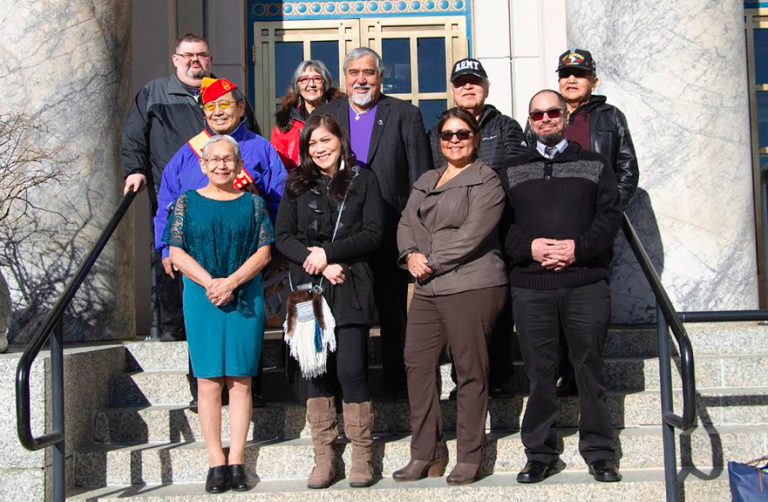
The Alaska State Legislature on Wednesday honored Alaska’s Tlingit code talkers for their exemplary military service and the crucial role they played in helping to end World War II.

Although the Tlingit code talkers have been recognized by Congress, this is the first official State recognition for their secret service in defeating Imperial Japanese Army and bringing the war to a close.

The citation passed by the House and Senate posthumously honored Tlingit code talkers Robert Jeff David, Sr., Richard Bean, Sr., George Lewis, Jr., and brothers Harvey Jacobs and Mark Jacobs, Jr.

Several family members of the late code talkers watched from the House and Senate galleries.

“Their story is a testament to the ingenuity, nobility and bravery of Alaska Native people and highlights the importance of preserving the Tlingit language,” said Senate Majority Leader Mia Costello.

The term “code talker” is usually associated with the better known Navajos, but Comanches, Hopis, Meskwakis, and Tlingits — far away in Territorial Alaska — also were recruited into the program. Code talking for military uses goes back at least as far as World War I with Cherokee and Choctaw peoples.

The Tlingit families never knew about their men’s specialized service to the country, according to former House Rep. Bill Thomas, who initiated the effort for the citation. At the time, of course, Alaska was not only a territory of the United States, but was also a war zone when the Japanese invaded Attu and Kiska Islands in the Aleutians.

“I knew Jeff (David) all my life and he took it right to the grave,” said Thomas, who is a Tlingit elder and U.S. Army veteran (Vietnam, 1968). Thomas said though David often spoke proudly of his accomplishments as a hall-of-fame basketball player and fishing highliner, his amazing achievements as a code talker were never shared. “George Lewis too, he was a storyteller. He would sit there and tell you stories, but he never told one about that.”

Thomas said he was told by families of the code talkers that they theorized the men were told their families would be killed by the enemy combatants, if the secret ever got out.

Lewis spent 52 years working for the Salvation Army, and was carver, boat builder, and silversmith, and David was one of the first directors of the Sealaska Corporation, was a commercial fisherman and a Hall of Fame basketball player for the Gold Medal Tournament, said Thomas.

“They took their orders seriously, to never talk about it,” said Southeast Alaska Native Veterans Commander Ozzie Sheakley, who attended the House and Senate sessions.

“He took it to his grave,” said Krissy Bean, granddaughter of Tlingit code talker Richard Bean of Hoonah. “My Grandma Bean (Richard’s wife) did not even know he was a code talker.”

“I remember asking (Tlingit Code Talker Jeff David) what he did when he was in the service and he would just smile and say ‘Oh, it was the best time of my life. I played basketball, I played in a band,’ ” said his stepdaughter Jodi Mitchell after the event. “He never talked about what he actually did.”

Other family members at the legislative event honoring the code talkers included Verna Adams, daughter of George Lewis, and John David, son of Jeff David.

GOLD MEDAL HONOR

The code talker program was eventually declassified by the government, and the Code Talkers Recognition Act of 2008 honored all Native American code talker who served during WWI or WWII. President George W. Bush authorized the making of a Congressional Gold Medal of individual design for each tribe and a silver medal duplicate for each code talker.

In November 2013, Congress awarded the silver medals posthumously to the Tlingit code talkers, and Southeast Alaska Native Veterans Commander Ozzie Sheakley received the Congressional Gold Medal, the nation’s highest civilian honor, on behalf of the Tlingit tribe.

On the reverse side of the coin is an homage to the Killer Whale Clan. The medal’s design was created by noted U.S. Mint coin designer Susan G. Gamble, and it was the last coin she ever designed for the Mint, before she passed unexpectedly in 2015. Sheakley had a hand in advising the design.

To order your own commemorative coin honoring the code talkers, follow this link the U.S. Mint.

 

Anchorage climate plan filled with code words

THE ANCHORAGE DAILY PLANET

The city apparently does not have enough on its plate. Now, it turns out, Anchorage has a new draft Climate Action Plan.

Mayor Ethan Berkowitz announced Anchorage has joined with something called the Global Covenant of Mayors for Climate and Energy – a European group – to reduce greenhouse emissions in Anchorage by “80 percent from 2008 levels by 2050, with an interim goal of 40 percent by 2030.”

More important, we suppose, it “places equity and inclusion at the heart of our social, environmental, and economic policies and practices.” How in the world can you have a Climate Action Plan without equity and inclusion?

The city teamed up with the University of Alaska and myriad other entities and individuals to come up with the plan and, until March 31, is taking public comments.

The draft document is a “guiding document that provides a framework for policies that reduce emissions and a pathway to achieve long-term outcomes that reflect the values of Anchorage as an equitable and resilient community.”

Read the rest of this commentary at:

http://www.anchoragedailyplanet.com/150355/climate-action-plan/

Lynn Gattis joining staff of Rep. Tammie Wilson

8

Former Rep. Lynn Gattis, who has served in the Mat-Su Office of the Governor, is returning to the Capitol Building in Juneau next week as an aide to Rep. Tammie Wilson of North Pole.

Wilson is co-chair of Finance, in charge of the capital budget, in the Democrat-led bipartisan majority.

Gattis served as a House member for District 7 (formerly District 9) from 2012 to 2017.

She served on the House Finance Committee and chaired the subcommittee on administration. She ran for the Senate Seat D post that was being vacated by Sen. Charlie Huggins in 2016, but lost in the primary to Sen. David Wilson. In 2018, she ran for lieutenant governor.

Earlier this year, Gattis took a temporary job with the Governor’s Office as his representative in the Mat-Su. She is a lifelong Alaskan who was raised in rural Alaska and had a career in aviation before becoming involved in politics.

Democrats call for nine-month comment period on Pebble

TRYING TO PUSH ENVIRONMENTAL PROCESS INTO POST-TRUMP

Twenty members of the Alaska House of Representatives have asked the U.S. Army Corps of Engineers for an extension of the public comment period for the Pebble Project Draft Environmental Impact Statement. They want nine months to comment. That’s after Thanksgiving.

The 20 who are opposed to the project say 90 days is just not enough. All the legislators who signed the letter were Democrats (including Indie-Democrat Dan Ortiz), except for Fairbanks Republican Steve Thompson, whose name on the letter surprised Republicans in the Capitol. Thompson left the Republican majority and now caucuses with the Democrats, where he is their Majority leader. Two other putative Republicans who have long caucused with the Democrats also signed the letter — Gabrielle LeDoux and Louise Stutes.

Other signers were House Speaker Bryce Edgmon, and Reps. Andy Josephson, Harriet Drummond, Matt Claman, Grier Hopkins, Jonathan Kreiss-Tomkins, Zack Fields, Sara Hannan, John Lincoln, Dan Ortiz, Ivy Spohnholz, Andi Story, Geran Tarr, Adam Wool, Chris Tuck, Neal Foster, and Tiffany Zulkosky.

“The Pebble Project would have far-reaching impacts on both the commercial and the subsistence economies of the region,” the letter-writers state. “It is, arguably, the most important proposed Alaska project of our time. Alaskans deserve a fair chance to weigh in on it.”

What the letter writers hope for is that the nine-month comment period will allow national groups such as the Natural Resources Defense Council and the Sierra Club to mount intense public pressure campaigns, as well as fundraising efforts to oppose the proposed mine in Western Alaska.

That timeframe would then coincide with a presidential election, and if environmentalists have their way, a new president who would squash the project, as occurred under the Obama Administration. The record of decision would come in the middle of the presidential election cycle, and also during the election cycle for Sen. Dan Sullivan.

The normal comment window for projects under review by the U.S. Army Corps of Engineers is 45 days.

Bristol Bay Native Corporation has also asked for a 270-day extension, although several years ago the Native Corporation was on record saying that a 60-day comment period was adequate for the much-larger project that was proposed before Pebble scaled down its plans. The Native Corporation is one of the local leaders of the opposition to the Pebble Project.

If the Corps capitulates to the request for a nine-month comment period, resource development advocates fear that the environmental impact statements for other projects would also suffer the same delay tactics.

Other major Alaska projects have had much shorter comment periods:

  • ANWR Coastal Plain oil and gas leasing: 45 days, with a 30-day extension
  • ConocoPhillips Greater Moose’s Tooth: 45 days, with a 10-day extension
  • Hilcorp Liberty Project: 90 days, with a 22-day extension
  • Donlin gold, 155 days, with a 31-day extension.
  • Chukchi Sea Outer Continental Shelf Oil and Gas Lease: 45 days, no extension

Notably, the Bristol Bay Watershed Assessment in 2013, used by the Obama Administration to shut down the environmental impact statement process for Pebble, had just a 32-day public comment period, with a six-day extension.

The final environmental impact statement for Pebble is due in early 2020, with a “record of decision” to be published in mid-2020, according to the Army Corps of Engineers.

Public hearings, which are likely to attract many protesters and meeting disrupters, are scheduled for the coming weeks according to the published schedule:

Keith Miller, Alaska’s pipeline governor, dies at 94

8

HE WAS THE THIRD GOVERNOR OF ALASKA

Keith Miller, Alaska’s third governor, has died in Anchorage at age 94, after suffering from pancreatic cancer.

Miller, a Republican, was secretary of state for Alaska under Gov. Walter J. Hickel. When President Richard Nixon appointed Hickel to be Secretary of the Interior, Miller became governor.

Miller was born March 1, 1925, in Seattle. As a young man, he moved to Alaska in 1946 and settled in Talkeetna, where he and his wife, who was an artist, homesteaded a cabin with a magnificent view of what was then called Mt. McKinley.

A TWIST OF POLITICAL FATE

Miller was sworn in as Alaska’s Secretary of State on Dec. 5, 1966. When Gov. Wally Hickel was selected by President Richard Nixon to be the secretary of the U.S. Interior, Miller was next in line and became governor. Alaska didn’t have a lieutenant governor position then.

Miller remained governor for two years, and filed for the office in 1970. This writer’s father was recruited to be Miller’s campaign press secretary, and the family fate was wrapped up in that campaign.

However, Bill Egan, who had served as governor at Statehood and was very popular across Alaska, won that election.

In 1974, Miller ran again, but lost in the primary to Jay Hammond, who was able to best Egan, 47.67 percent to 47.37 percent to become governor.

In the Miller era, oil wealth began to flow as Alaska completed leases in Prudhoe Bay, worth a sudden $900 million to the State coffers. At that time, the new money was seven times the State budget. Spending ballooned.

Keith Miller, visiting Sen. Ted Stevens in his Washington, D.C. office

Miller had been a tireless advocate for building the the Trans-Alaska Pipeline, traveling to Washington, D.C. to push for its approval, in spite of objections of federal judge George Hart, who had, in 1970, ordered the Interior Department to not issue a construction permit. Two weeks later, he issued an injunction against the Interior Department permitting and, for a while, stopped the project.

By 1970, as he sought to win re-election, Miller’s popularity was fading. Hickel, who was by then the Interior Secretary, delayed the permits for the pipeline, which made Miller look ineffective. Frustrated voters gave the win to Egan.

It wasn’t until the 1973 oil crisis did Congress pass the law that Miller had fought for:  The Trans-Alaska Pipeline Authorization Act.

Gov. Michael Dunleavy ordered the flags to fly at half staff through Sunday in honor of the late Gov. Miller.

“While Governor Miller’s time in office was brief, the “Prudhoe Bay Governor” as he became widely known, successfully managed the historic $900 million-dollar Prudhoe Bay lease sale that led to the construction of the Trans-Alaska Oil Pipeline and the modernization of Alaska’s economy,” said Gov. Dunleavy. “That’s a remarkable legacy and I ask all Alaskans to remember that significant contribution Governor Miller made to our great state.”

Do you have a memory of Gov. Keith Miller? Add it in the comment section below.

Rep. Fields now accuses commissioner of slandering him

DEMOCRAT’S WAR ON CHRISTIANS CONTINUES

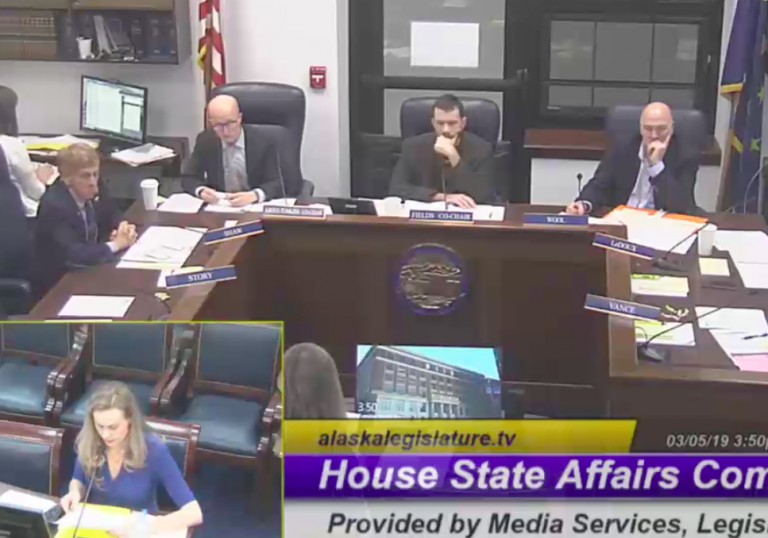
Rep. Zack Fields, an Anchorage Democrat, sent a note to all 59 other legislators today accusing Commissioner of Administration Kelly Tshibaka of slandering him.

His letter was in response to Tshibaka’s testimony in front of the committee that Fields leads, House State Affairs. Tshibaka announced to the committee that Fields had, in her earlier conversation with him, told her to prepare to discuss in front of the committee how her religious beliefs would impact her work as a department head.

[Read the original story here]

[Read the transcript of what Tshibaka actually said here]

Field’s letter follows:

“I was surprised yesterday when Commissioner Tshibaka slandered me in her opening statement, by suggesting that I imposed some sort of religious “test” for her appointment.

Here are the facts: Commissioner Tshibaka had requested to meet with me prior to the State Affairs Committee meeting, and I met with her per her request. We discussed several questions that I thought might come up in the committee, based on discussions of her record in the media. One of the questions I asked her was if she could separate her personal opposition to LGBTQ equality (which appears linked to her religious views) from her role as a manager of Alaska’s workforce, which is really the most fundamental job of a DOA Commissioner. I actually thought her answer to my question was reasonable, and I left that meeting planning on voting for Ms. Tshibaka’s confirmation when it comes to the House floor.  I could not care less what religious views nominees hold, so long as they are fair administrators.

Ms. Tshibaka’s opening statement in yesterday’s meeting raises all sorts of questions, including about her integrity and temperament.  I’m going to continue to do my job as a legislator and State Affairs Co-Chair, and that includes making sure the DOA Commissioner will treat Alaska state employees fairly, and without discrimination. It is sad and ironic Ms. Tshibaka had convinced me should could be fair, only to turn around and engage in baseless personal attacks of a manner that are entirely inappropriate when addressing any legislator.

His letter was signed “Zack.”

The legal element of defamation include whether something is false and defamatory, and it is done orally, with malice. However,  what Tshibaka accused Fields of does not meet the definition of slander, since she simply accused him of violating her civil rights.

Fields has now raised the ante, by questioning Tshibaka’s integrity and temperament and by accusing her of engaging in a personal attack “entirely inappropriate when addressing any legislator.”

Tshibaka used to work for the CIA and had top secret clearance. Her integrity and temperament has never before been in question.

Slander and libel are behaviors Fields should understand well, since it was his stock and trade when he was a political operative for the Alaska Democratic Party for years, during which time he, on numerous occasions, sent out flyers and letters filled with lies about Republican candidates and lawmakers.

PRUITT CALLS FOR INQUIRY

Rep. Lance Pruitt, who leads the House Republicans, on the floor of the House today asked Speaker Bryce Edgmon to open up an inquiry about whether Tshibaka’s civil rights were violated.

Rep. Jonathan Kreiss-Tomkins, a Democrat, then spoke against Pruitt, saying that as the co-chair of the committee, Kreiss-Tomkins had not known anything about it, but thought a couple of bloggers in the room knew something was up.  He indicated this was a plot.

Must Read Alaska was not in the building at the time of the committee meeting.

Kreiss-Tompkins said the whole thing needs to be “nipped in the bud.” He told the Speaker that this kind of thing should be handled behind closed doors. No members of the Democrat-led bipartisan majority spoke to the problem.

Although Fields has moved the nomination of other commissioners out of his committee, he held Tshibaka’s back.

There’s no evidence that Speaker Edgmon was planning to open up an inquiry. However, now that one of his caucus members (Fields) has accused a commissioner of an illegal act (slander), he may be forced to do so.