The House Judiciary Committee released an interim report detailing evidence of a “climate cartel” consisting of leftwing activists and major financial institutions.
“Climate Control: Exposing The Decarbonization Collusion in Environmental, Social, and Governance (ESG) Investing” tells the story of how collusion is taking place to impose radical environmental, social, and governance (ESG) goals on American companies.
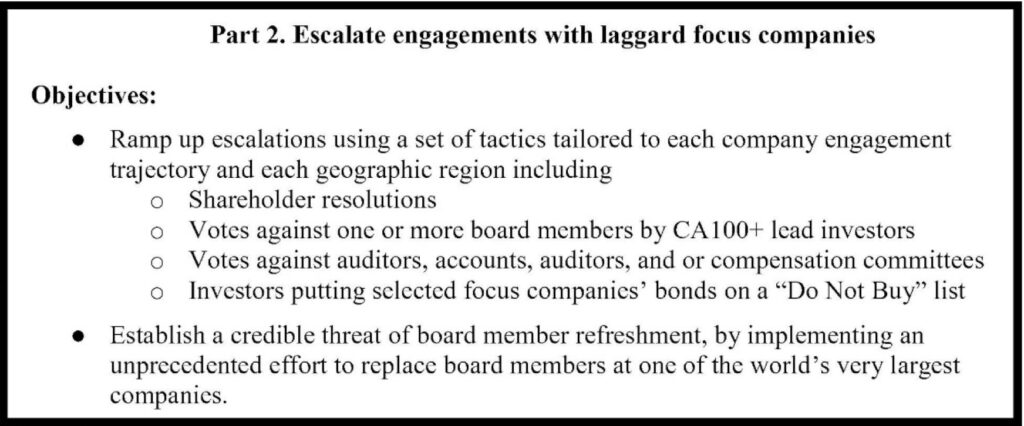
The climate cartel colludes to decarbonize companies by leveraging negotiations with management, shareholder resolutions, and board of director votes, the report said. The cartel forces companies to disclose their carbon emissions, reduce their carbon emissions, and enforce their disclosure and reduction commitments by handcuffing and restricting company management. This “decarbonization” collusion causes reduced output and higher prices, including in the critical fossil fuel, aviation, and agriculture industries, posing a significant threat to the economy and to the well-being of American consumers, the summary of the report said.
“Through their commitments to groups such as Climate Action 100+, the members of the climate cartel expressly have agreed to decarbonize the American economy by forcing corporations to disclose their carbon emissions, to reduce their carbon emissions, and to enforce (and reinforce) their disclosure and reduction commitments by handcuffing company leadership and muzzling corporate free speech and petitioning. The climate cartel imposes these radical policies by weaponizing ever-escalating pressure tactics that start with negotiations with corporate management, continue to filing and ‘flagging’ stockholder proxy resolutions, and culminate with taking out the boards of directors at ‘recalcitrant companies,” the report said.

Members of the cartel include the Net Zero Asset Managers initiative, the Glasgow Financial Alliance for Net Zero and eight blue-state pension funds led by heavies such as the California Public Employees Retirement System (CalPERS), which is one of the founders of Climate Action 100+, along with Arjuna Capital.
“Based upon the evidence obtained by the Committee, the members of the climate cartel are colluding toward a common goal: the ‘decarbonization’ of American industry, which necessarily reduces output and increases prices for American consumers. Thus far, the investigation has revealed how the climate cartel has escalated its attacks on American companies and is forcing companies to slash output of products and services that are critical to Americans’ daily lives,” the report said.
The committee’s investigation has succeeded in prompting several major asset managers to withdraw from Climate Action 100+.
One company the Climate Action 100+ group targeted was Exxon.
“In particular, CalPERS doggedly has pursued ExxonMobil, the United States’ largest oil and gas company. CalPERS has served as a lead investor for Climate Action 100+’s ExxonMobil engagement. As illustrated in the CalPERS ‘Case Study’ graphic below,
CalPERS escalated its engagement with ExxonMobil from filing shareholder proposals, to voting against ExxonMobil directors, to supporting Climate Action 100+’s efforts to replace the incumbent board with directors of the climate cartel’s choosing,” the report said on Page 15.
In 2021, Climate Action 100 member Arjuna filed a shareholder proposal to convert Chevron into a “public benefit corporation,” that would eschew profit and pursue the radical goals of the cartel.
Climate Action 100+ said in response that it is feeling misunderstood.
“Recent political discourse, including today’s U.S. House subcommittee hearing and a letter from 17 U.S. state attorney generals to US-based asset managers, has misunderstood and misrepresented elements of Climate Action 100+ – this includes the basics of what it is and its core activities,” the organization said. “Climate risk is a material financial risk. Institutional investors are well-served by acting on these risks and the resulting investment opportunities. If left unchecked, these risks threaten investors’ long-term ability to sustain value and generate ongoing returns for their beneficiaries.”
The committee said the investigation underscores the importance of enforcing longstanding antitrust law prohibiting anticompetitive collusion.
Read the full Judiciary report here.