
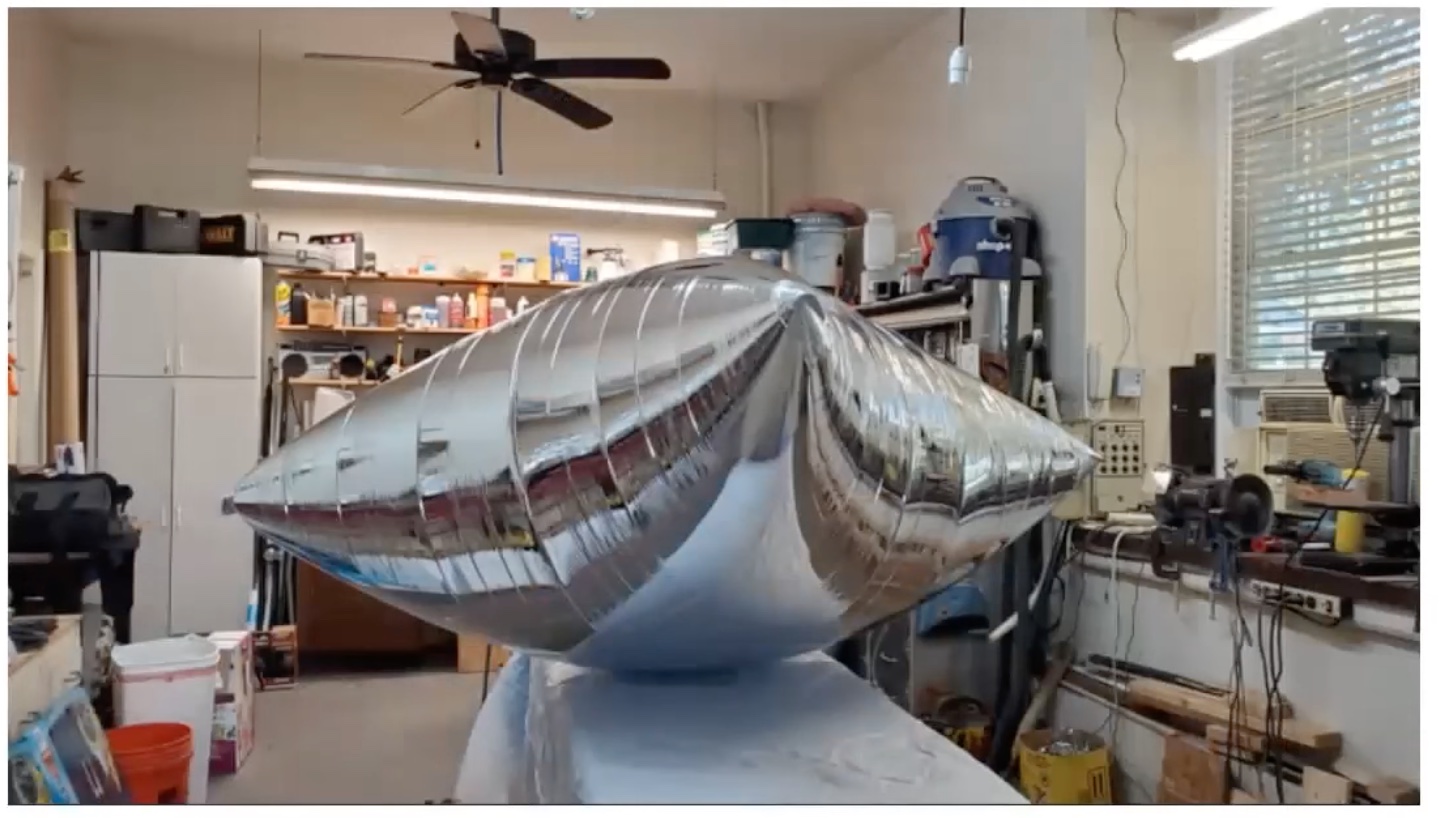
Balloon clubs are saying they have a couple of missing balloons that they think may have been shot down by the U.S. Air Force.
Late on Friday night, the Department of Defense said it ended its search for an airborne object shot down over the Arctic Sea ice north of Deadhorse, Alaska on Feb. 10. The military also ended its search for airborne object shot down over Lake Huron on Feb. 12. Canadian military called off its search for an item shot down by the U.S. Air Force at the request of Prime Minister Justin Trudeau.
The announcement came a day after a hobby group said it was missing one of its balloons. Aviation Week reported the day before that the Northern Illinois Bottlecap Balloon Brigade is missing one of its party-style “pico” (metallic or mylar) balloons that had last pinged on Feb. 10, at about 38,910 feet in altitude off the western coast of Alaska near Hagemeister Island, on the north shore of Bristol Bay near the mouth of Togiak Bay.

In the joint statement released at 10 pm on Friday, the start of a three-day holiday weekend when many newsrooms were running with skeleton crews (including this one), the North American Aerospace Defense Command and the U.S. Northern Command said the agencies had advised the search be called off because the objects were in difficult terrain. U.S. Secretary of Defense Lloyd Austin approved the Defense agencies’ recommendation.
“Search operations conclude today near Deadhorse, Alaska, and on Lake Huron, as search activities have discovered no debris from airborne objects shot down on” on Feb. 10 and 12 after “a variety of capabilities, including airborne imagery and sensors, surface sensors and inspections, and subsurface scans” had found no debris.
“The U.S. military, federal agencies, and Canadian partners concluded systematic searches of each area using a variety of capabilities, including airborne imagery and sensors, surface sensors and inspections, and surface scans, and did not locate debris,” NORAD wrote in a statement released on Facebook, but not on its own website. “The Secretary of Defense concurred with the recommendations.”
Northern Command worked closely with the Alaska National Guard, Federal Bureau of Investigation, and U.S. Indo-Pacific Command to position teams to expedite recovery should searches locate debris, the agency said.
“Arctic conditions and sea ice instability informed decisions to conclude search operations in this location,” NORAD said.
As for searching for the object that fell over the Yukon in Canada, the Canadian military said snowfall had probably covered the debris and the search was called off.
On Lake Huron, the Unified Command Group consisting of capabilities from U.S. Coast Guard District 9, the FBI, Canadian Coast Guard, and the Royal Canadian Mounted Police hare not identified debris from the airborne object after multiple days of surface searches and subsurface scans. That unidentified object is believed by officials to have fallen into the water on the Canadian side of the lake.
According to Aviation Week, all three unidentified objects shot down Feb. 10-12 “match the shapes, altitudes and payloads of the small pico balloons, which can usually be purchased for $12-180 each, depending on the type.”
The balloon shot down over the Yukon may have been an amateur radio pico balloon called K9YO-15, which launched from Independence Grove Forest Preserve in Libertyville, Illinois, north of Chicago, reported Space.com, adding that “K9YO-15 was apparently on its seventh circumnavigation of the globe after being aloft for 123 days.”
Pico balloons used by hobbyists and scientists are sometimes called a “poor man’s space program.”
Cary Willis of the Northern Illinois Bottlecap Balloon Brigade (NIBBB), told Space.com that there are about three million amateur radio operators around the globe and the NIBBB is a subset of the group, using pico balloons that travel the globe.
“Our balloons are very small, 32-inch [81 centimeters] diameter, 100-inch [254 cm] circumference, pre-stretched and carry a payload of around 10 grams [0.35 ounces] including the tracker, solar panel and 33-foot [10 meters] antenna wire,” Willis explained to Inside Outer Space.
“Our pico balloon K9YO had been flying for 123 days preparing for the seventh time around the world when it went missing over Canada,” Willis said. “That wasn’t the first time K9YO went missing. After the fifth time around the world in 77 days, K9YO went missing for 30 days, reported on the 106th day over Mongolia and continued the sixth circumnavigation at 112 days.”
Aviation Week contacted a host of government agencies, including the FBI, NORAD, the National Security Council, and the Office of the Secretary of Defense for comment about the possibility of pico balloons. The NSC did not respond to repeated requests from the publication. The FBI and OSD did not acknowledge that harmless pico balloons are being considered as possible identities for the mystery objects shot down by the Air Force, the publication said.
Pico balloons can be 3 feet in diameter on the ground before they are launched. As they ascend to altitudes of 20,000-50,000 ft, they expand under pressure. Learn more about pico balloons and the hobbyists who use them in this video:
Meanwhile, pilots have reported the FAA notifying them of a large white ballon between 40,000 and 50,000 feet that was about 600 miles east of the Hawaiian Islands over the weekend. Messages sent on the Aircraft Communications, Addressing and Reporting System show pilots acknowledging the alert, which has a request to report back if they spot any such object. INDOPACOM is reporting, “U.S. Indo-Pacific Command is aware of the reports of a large white balloon by civilian aircraft. We are looking into the reports and have nothing additional at this time.”


