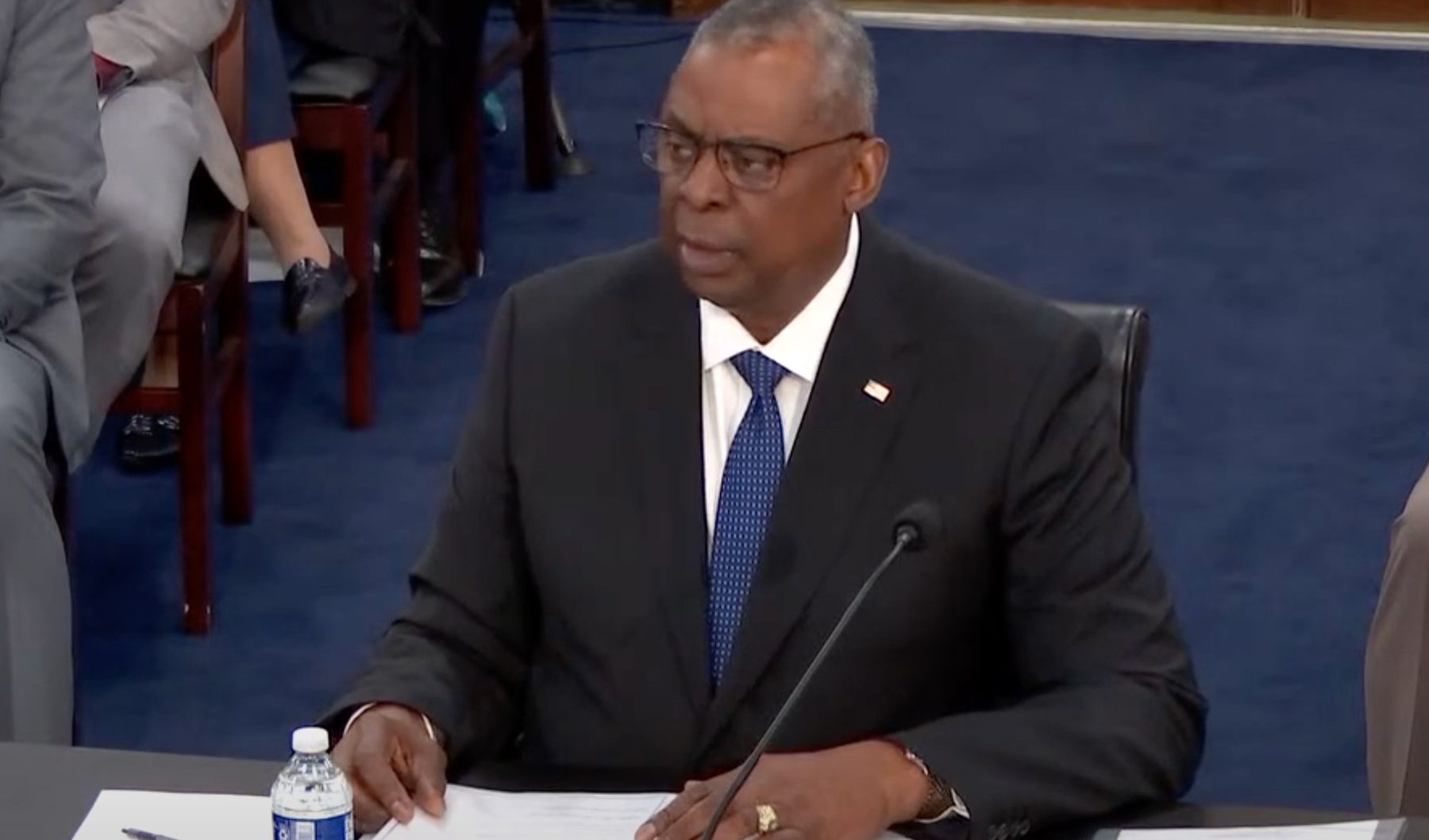
Defense Secretary Lloyd Austin told the House Appropriations Subcommittee on Defense that the budget for the military needs to be prepared for a possible confrontation with China.
Austin was asking for the approval of the Defense Department’s $842 billion budget.
“This is a strategy-driven budget, and one driven by the seriousness of our strategic competition with the People’s Republic of China,” Austin said in his testimony. The budget has $9.1 billion to build up military capabilities in the Pacific, a 40% increase.
“This is a budget aimed squarely at keeping America secure in the world of the 21st century. At $842 billion, it’s a 3.2% increase over Fiscal Year 23 enacted and and it is 13.4% higher than Fiscal Year 22 enacted,” he said during Thursday morning’s testimony.
The People’s Republic of China is “our pacing challenge. And we’re driving hard to meet it. Our budget builds on our previous investments to deter aggression by increasing our edge,” Austin said.

“We’re investing in a more resilient force posture in the Indo-Pacific and increasing the scale and scope of our exercises with our partners. And this budget includes a 40% increase over last year’s for the Pacific Deterrence Initiative—it’s an all-time high of $9.1 billion. That will fund a stronger force posture, better defenses for Hawaii and Guam, and deeper cooperation with our allies and partners,” he said.
Austin also is requesting $61 billion to sustain air dominance, including funding for fighters and the new B-21 strategic bomber, unveiled in December.
He seeks $48 billion for sea power, including the construction of nine battle force ships.
“And we’re boosting capacity at America’s shipyards to build the ships that our strategy demands. We’re investing a total of $1.2 billion in the submarine industrial base. And we’re buying two Virginia-class attack submarines and one Columbia-class ballistic-missile submarine,” Austin said.
He described investments to counter drones and the Pentagon’s investing in hypersonics and space.
“We’ve put forward the largest space budget in Pentagon history. We’ve requested $33.3 billion to improve our capabilities, our resilience, and our command and control in space,” he said.
“This budget also moves us away from aging capabilities that aren’t relevant to future conflicts so we can focus on the advances that warfighters will need going forward,” Austin said.
Austin called out Russia President Vladimir Putin and said that Russia continues to be an “acute threat,” and that the U.S. will support the defense of Ukraine “for as long as it takes.” He also mentioned other persistent threats, such as Iran, North Korea, and global terrorist groups.