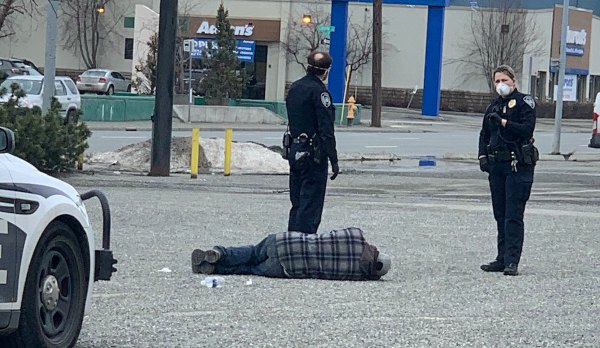
In the one year since a new “pedestrian equity” law went into effect in Anchorage that effectively made jaywalking allowed in most situations, 12 people have died by being struck by cars in Anchorage while they wandered into the streets and roads. It’s record-setting death and injury, never seen in Alaska history. The record for pedestrian deaths statewide was set in 2022, with 13.
The dozen deaths doubled the number of pedestrian fatalities from the year before the Assembly passed new ordinance that gave pedestrians the run of the streets. Under the new laws, pedestrians can cross pretty much wherever they feel it’s safe to cross, regardless of traffic lights or crosswalks, which have been made into merely suggestions.
Now, the Assembly wants to penalize the drivers by reducing the speed limits throughout Anchorage by at least 10 miles per hour.
Three Assembly members will hold a press conference Tuesday to outline their resolution, which also demands more light pollution in Anchorage by having more lights installed, ignoring the fact that only one of the fatalities this year took place in the dark of winter, and most of the pedestrians were struck during the summer months, when there is an abundance of natural light. The members also ignore the reality that most of the deaths occurred in well-lit locations, such as Northern Lights and Minnesota Blvd., Minnesota and Benson Blvd., Tudor Road and Seward Highway, and C Street and Fireweed Lane.

Assembly members Daniel Volland, Karen Bronga, and Meg Zaletel don’t believe their actions in passing the ordinance that went into effect last Oct. 7 have anything to do with the doubling of pedestrian deaths. They also want to make October into “Pedestrian Safety Month” and pay for an information campaign to impress upon people the impact that cars have on humans.
“Acknowledging that pedestrian deaths are 100% preventable, the resolution declares October as Pedestrian Safety Month and calls for the Municipality of Anchorage and the State of Alaska to take the following actions in corridors where pedestrian deaths have occurred: Immediately install improved lighting as used by the HSIP program; Lower speed limits by at least 10mph, not to exceed 35 mph; Produce a public education campaign about the impact of speed on pedestrian safety,” the three wrote in a press release.
After the AO No. 2023-65(S) was introduced in May of 2023 by Assembly members Karen Bronga, Daniel Volland, and Anna Brawley, the then-Anchorage chief of police pointed out to the Assembly that they did not consult the police department on the ordinance prior to introducing it. Police had opposed it, but the Assembly went ahead.
The Assembly majority thinks that the pedestrian laws are racist and are disproportionately enforced against minorities, especially “Black and “Latine/x” and low income people.
The law they passed allows some types of jaywalking and looser laws for bike riders, scooters, and others who are now allowed to ignore traffic signals, not wear helmets, or have lamp equipment when using roadways.
The 12 pedestrian deaths in the one year since the relaxed jaywalking law went into effect (not counting bicycle rider deaths) were:
- Jan. 30 – C and Fireweed Way
- March 3 – Old Seward and Industry Way
- March 8 – New Seward and Dowling Road
- April 8 – 11th and Karluk
- April 20 – Tudor Road and Seward Highway
- May 20 – Fireweed and 16th
- August 21 – East Tudor and McLean (nonfatal)
- September 8 – Muldoon and 6th
- September 8 – Debarr and 34th
- September 13 – Minnesota and Benson
- September 21 – Northern Lights and Minnesota
An additional death occurred in a parking lot when a woman lying on the pavement was run over. There were several car-bike incidents in the year as well.
The same consequence happened in Los Angeles after that city relaxed its jaywalking laws. Must Read Alaska reported on that over a year ago at this link:
The Assembly’s press conference is scheduled for Sept. 24 at 1 p.m., in Suite 155, City Hall, 632 West 6th Avenue, Anchorage. The trio intends to bring the resolution to the regular Assembly meeting that starts at 5 p.m. and put it on the agenda as a last-minute item.