

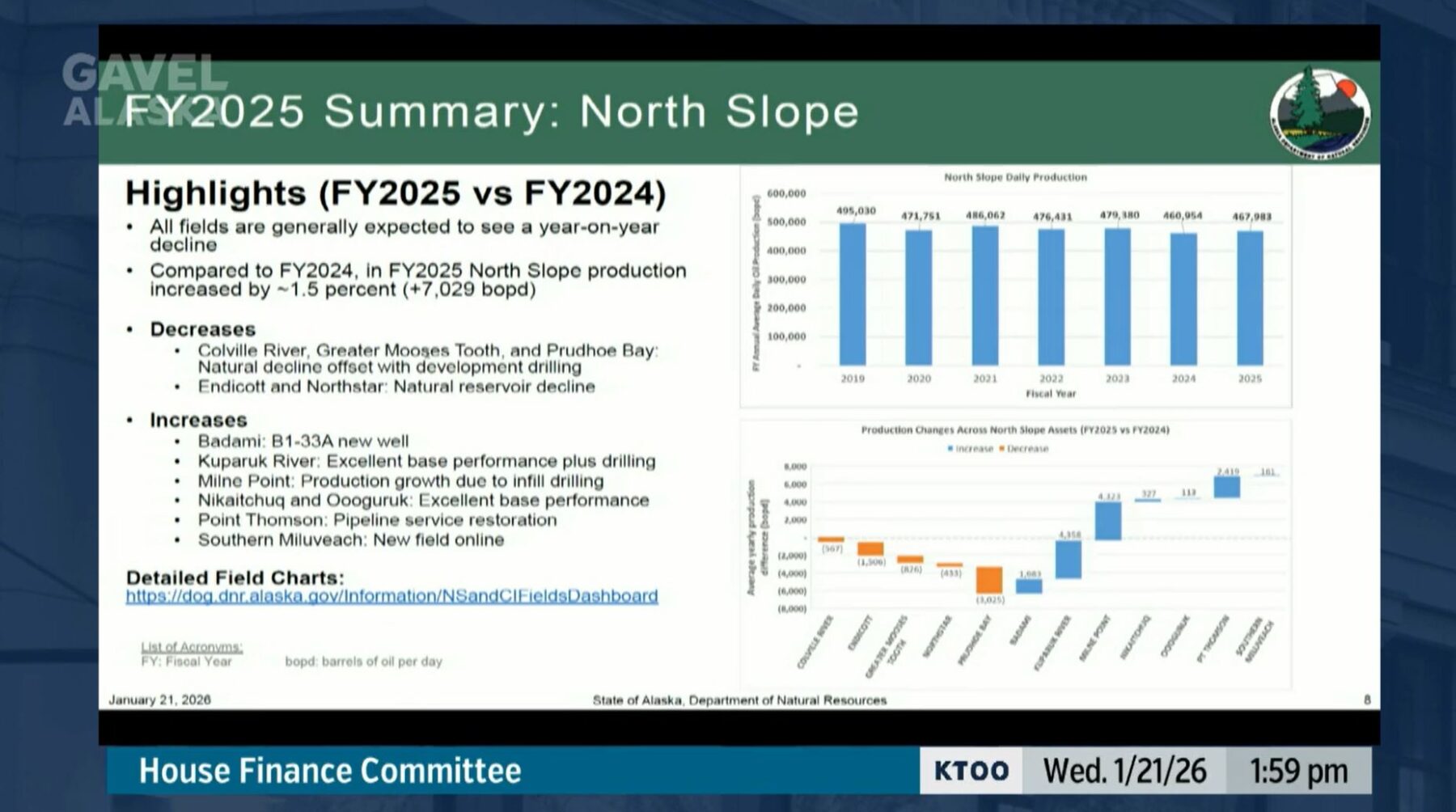
On January 21, 2026, the Alaska House Finance Committee convened a teleconference that buzzed with unprecedented optimism about the state’s oil industry. Co-chaired by Representatives Andy Jospehson and Neal Foster along with the Department of Natural Resources (DNR), the meeting painted a vivid picture of resurgence on the North Slope. Director Derek Nottingham set an enthusiastic tone, declaring, “This is the year we’ve been waiting for.” With construction underway, facilities being installed, and drilling in full swing, the discussion centered on the FY2026 production forecast, ongoing projects, and the remarkable turnaround at Milne Point—a testament to innovation in a mature field.
The FY2026 forecast emerged as a beacon of hope, projecting Alaska’s oil output at 465,000 barrels per day (bopd). Reservoir Engineer Travis Peltier presented forecast charts underscoring this figure, noting it stems from DNR’s independent analysis of production among the oil fields. Notable among the discussion was that between FY2024 and FY2025, a 1.5% production increase was realized, equating to about 7,000 bopd, with Kuparuk and Milne Point averaging the largest production increases.
Legislators probed the forecast’s reliability. Representative Stapp asked when Alaska last saw such volumes, prompting Nottingham to highlight tangible progress: “The difference this year is that there are boots on the ground, facilities are being installed—this is reality rather than concept.” He pointed to projects like Pikka, now at a “point of no return,” with commissioning underway for first oil. Stapp echoed the excitement, exclaiming, “This is the first time in my lifetime Alaska will see this big of a production increase—we should recognize this!” The forecast’s optimism is further fueled by federal opportunities under the Trump Administration, including four planned wells in the National Petroleum Reserve-Alaska (NPR-A). Peltier noted these developments on federal lands signal broader investment potential.
Current projects amplified the positive vibe, with discussions revealing active advancements across the North Slope. When asked how Alaska compared to other Lower 48 states, Peltier stated higher costs and inflation but stressed the need for a competitive environment. When Stapp inquired about legislative actions, Peltier advised, “Maintaining a competitive environment for investment because there are other places around the country and the world for companies to develop.” Despite global volatility—Representative Bynum raised concerns about Northern Hemisphere impacts like Venezuela or the Middle East disruptions—Peltier reassured that legacy fields remain resilient. Even during 2014’s $100/bbl highs or 2020’s COVID lows, production persisted to maximize volumes.
The highlight, however, was Milne Point’s success story, a narrative of revival that captivated the committee. Acquired by Hilcorp in 2014 when production languished near 19,000 bopd, the field has been transformed through relentless reworking. Hilcorp’s strategies—continued drilling and polymer flooding—propelled output back to near-peak levels, defying expectations for a mature reservoir with heavy, viscous oil. Nottingham elaborated on page 9 of the presentation: “Revitalization of a mature field to replicate peak production is almost unheard of.” The existing facilities, ill-equipped for the oil’s viscosity, were upgraded alongside innovative drilling methods. This not only boosted volumes but exemplified how mature fields can be rejuvenated, contributing significantly to the recent statewide production increase.
Representative Josephson wrapped up optimistically, noting “good things for future legislatures.”
Alaska’s oil sector, long challenged by declines, now stands on the cusp of growth. With forecasts grounded in real progress, projects advancing, and Milne Point as proof of ingenuity, the meeting left attendees hopeful. As Nottingham put it, this isn’t just projection—it’s happening now, promising economic vitality for the Last Frontier.
Milne Point: That’s the way it’s done. Great to hear some positive news coming out of DNR and the North Slope. The Sierra Club, Trustees for Alaska and the rest of the Communist Eco-Cabal must be weeping and gnashing their teeth.