
By BRENDA JOSEPHSON
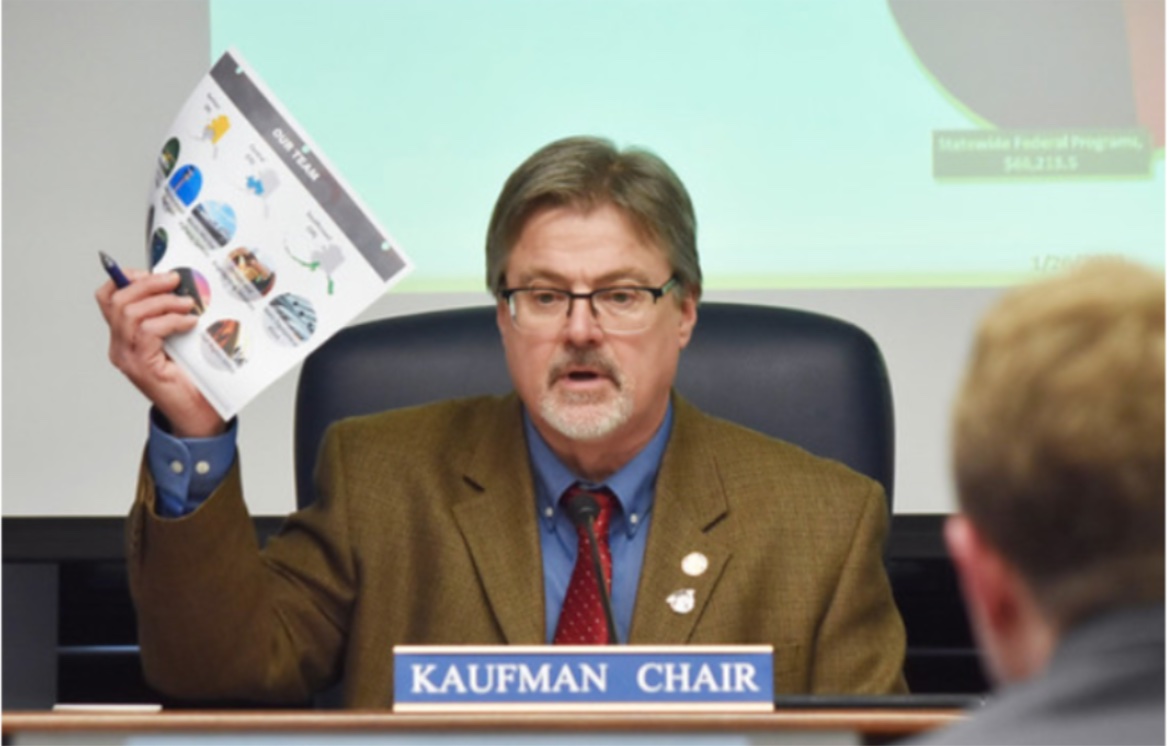
James Kaufman served a term in the State House before winning election in 2022 to represent Anchorage District F as a Senator. When he arrived in Juneau, he brought his vision of “a limited, accountable, efficient, and transparent government that provides opportunities and respects personal freedoms.” With 25 years of experience managing large and complex projects, he was prepared to lead the charge for Alaska’s stability, security, and innovation through common-sense budgeting at the state level.
Before holding an elective office, Kaufman worked as a quality manager and team leader in his professional career, helping management teams improve the quality and efficiency of their projects on the North Slope. As a new legislator, he quickly leveraged his team-building expertise to organize the 24 legislators representing Anchorage, Eagle River, and Girdwood into the Anchorage Delegation. The delegation focuses on bipartisan issues affecting residents in the Anchorage region, including infrastructure, homelessness, food security, housing, and education. Kaufman served as the delegation’s House co-chair from 2021-2022 and Senate co-chair since 2023.
Senator Kaufman was the 17th member to join the Senate Majority Caucus, ensuring that sensible conservatism had a greater voice in the 33rd Legislature. He expressed to me that “it was a tough decision, but one that I made to fight for conservative values from the inside and to make sure we weren’t left out of the critical decisions that will shape Alaska’s future.” He applied this approach to his responsibilities as Chair of the Senate Transportation Committee and Vice Chair of the Senate Health & Social Services Committee. He also served on the Legislative Budget & Audit, Judiciary, and Resources Senate committees. Furthermore, he served in four Senate Finance Subcommittees, including Natural Resources, Health, Revenue, and Family & Community Services.
Serving on the committees positioned Kaufman favorably to advance his legislative objectives, which center around three areas aimed at improving the lives of Alaskans. The Senator outlines his focus areas as follows:
- Stability: “Stability means fixing Alaska’s broken systems—whether it’s the budget, education, or transportation infrastructure. By stabilizing these critical areas, we can create a foundation for long-term growth and sustainability.”
- Security: “Security means protecting our infrastructure, ensuring energy and food security, and supporting first responders. By investing in these areas, we’re building a safer, more resilient future for all Alaskans.”
- Innovation: “Innovation is the key to Alaska’s future prosperity. By removing obstacles, promoting new technologies, and allowing our universities to lead in research and development, we can drive economic diversification and create a thriving, competitive economy.”
Senator Kaufman has walked his talk for the last four years, advancing each of his objectives by successfully passing 10 pieces of legislation into law and advocating for his district with many other initiatives. Here are a few highlights:
He aimed to increase government efficiency and reduce costs with two of his first bills. Kaufman sponsored HB187 and SB25, both of which became law unanimously. HB187 repealed several outdated and redundant publications. SB25, another measure to enhance governmental efficiency, closed several long-dormant funds, saving significant administrative costs. Both acts established a process that identifies outdated publications and inactive funds and recommends their repeal to the legislature, thereby saving money in future budgets.
To address infrastructure security needs, the Anchorage Delegation collaborated with Mayor Bronson and the Anchorage Assembly. These efforts secured $200 million for the Don Young Port of Alaska in Anchorage, ensuring the port’s continued ability to import 60% of the state’s food. The delegation also secured funding for homelessness response and advocated for the renewal of a $45 million annual federal grant to maintain UAA’s Arctic Domain and Awareness Center.
In response to the specific security needs of Abbott Loop, Huffman/O’Malley, and the Lower Hillside, the collaborative efforts resulted in $2 million in direct funding for his district, the first significant district-level funding in a decade. The project list represents over half of Kaufman’s district’s top priorities, including projects to build safe routes to schools and parks, necessary drainage for several neighborhoods, and evacuation routes for Hillside.
Senator Kaufman took action to protect the public from cybersecurity threats by sponsoring and passing SB134, which requires insurance companies to secure Alaskans’ sensitive health and financial information. The law, which requires insurance companies to establish data security requirements to protect the public from data breaches, received broad bipartisan support.
In an effort to seek better innovation across Alaska, Kaufman has been a steadfast advocate for an “all of the above” approach to energy. He fought for our ability to responsibly develop our resources, joining the successful push to see the Willow project. He was the catalyst for the passage of HB62, the companion bill to Kaufman’s SB33, which extended the Renewable Energy Grant Fund, supporting efforts to lower energy costs for families. He advocated for passage of this legislation in order to further energy independence in more of Alaska’s communities.
As chair of the Senate Transportation Committee, Kaufman introduced SB123, an act removing unnecessary requirements for individuals applying for a commercial driver’s license. This bill was a practical solution to alleviate a shortage of truck drivers and keep commerce moving in the state. The Teamsters Local 959, Alaska Trucking Association, Alaska Technical Center, and Northern Industrial Training all supported the legislation. The governor signed the law, and it became effective on July 30, 2023.
The passage of legislation to restore the Citizens’ Advisory Commission on Federal Management Areas (or CACFA) in Alaska was another win for the people. Kaufman sponsored SB34 to ensure Alaskan representation in federal government decisions that affect Alaska’s land access. The commission monitors federal government actions, holds hearings on federal land decisions, and posts information regarding historical and new regulations. A wide range of federal land users will comprise the commission, which aims to offer independent, unbiased information and assistance to individuals. According to Senator Kaufman, “CACFA provides people a way to navigate federal land use issues and improves Alaska’s interface with the federal government by allowing Alaskans to collectively voice their concerns to government officials making policy decisions.”
Finally, with the introduction of SB147, Kaufman demonstrated his commitment to effective governance. Alaska’s Workers’ Compensation program has long been a cost to both the state and its employees, without delivering results. Less than half of the injured workers who applied were eligible for the system’s rehabilitation plan several years ago, and only an average of 13 out of 140 eligible workers successfully completed the program. Kaufman’s bill passed, fixing this disparity and shifting the program’s focus from training workers for a new profession to helping them return as soon as possible to their current job. This was a positive step forward for using state dollars efficiently to protect injured workers.
These accomplishments are noteworthy, but Senator Kaufman told me that he looks forward to returning to Juneau for the next legislative session so that he can continue to work on making the State of Alaska more efficient and effective at delivering core services. He specifically focuses on establishing appropriation limits, strategic planning, and promoting innovation and economic development, for which he has already introduced legislation.
His plan for appropriation limits, outlined in SJR4 and SB20, seeks to create a statutory and constitutional framework that ties government spending to the health of our state’s economy. The current limit came into existence in 1982, as the oil industry was approaching its peak output. Kaufman’s plan includes a constitutional upper limit to cover unexpected needs. It sets a functional ceiling based on the average of the private sector’s economic performance over the last five years, calculated as real GDP minus government spending. Linking the state’s expenditure cap to the state’s private economy would encourage the government to adopt policies that promote the expansion of the private sector while maintaining a right-sized government.
In SB21, Senator Kaufman has proposed an approach to bringing strategic planning to the State of Alaska. SB 21 would better integrate the state’s planning with our budgeting processes by requiring that our annual budgets align with a four-year strategic plan. Those leading and conducting the work in each department set the goals, objectives, and key performance measures for each budget cycle. This will allow the legislature to consider department budgets based on those strategic and performance-based department plans. This method aims to assist the state in improving efficiency and performance in critical services that facilitate commerce and promote public well-being.
Additionally, technological advancement and new ideas are key to ensuring Alaska’s future prosperity. Kaufman intends to foster innovation in Alaska by establishing a “regulatory sandbox program” in SB251. This forward-looking bill aims to establish an Office of Innovation & Economic Development and an Alaska Innovation Council to make recommendations to the governor and legislature on how Alaska can better encourage innovation and economic competitiveness. The Innovation Council will identify and promote innovation-based businesses, encourage seed and start-up capital investment, and foster entrepreneurial capacity to promote innovation-based economic development. The plan establishes the state’s authority to issue innovation permits and provide regulatory and technical assistance to innovators in order to enable commerce that benefits all Alaskans.
Senator James Kaufman is a visionary leader who understands the value of collaboration and teamwork. He has demonstrated his commitment to promoting the state’s prosperity through balanced policies that assist citizens in overcoming challenges that make living in our communities difficult, all while safeguarding what makes Alaska special. In short, Senator Kaufman delivers for us.
Visit James Kaufman’s website, Kaufman 4 Alaska, for more information about his legislative achievements, vision for Alaska, and to donate to his campaign.
Brenda Josephson is a Haines resident. She co-authored the white paper Restoring Public Trust: Legislative recommendations for Alaska’s Property Tax Assessment Process.


