Monday, June 8, 2026
Home Blog Page 1024

Bob Maier: Chugach Electric, now owning ML&P, is in trouble with revenue shortfall

By BOB MAIER

That did not take long: 253 days after closing the sale for the purchase of Municipal Light and Power by Chugach Electric Association, Chugach has filed with the Regulatory Commission of Alaska for a … well … I am just not sure what they have filed for.

In Chugach’s July 1, 2021 submittal with the RCA – (Docket U-21-059) – Chugach requested to reopen the stipulated purchase and sales agreement with ML&P.  

Chugach’s reason was not for a rate increase but for assistance to help them address a deficiency in their ‘margin performance’. 

The only two reasons given were “(1) an economic downturn in the local economy caused, in part, by the Covid 19 pandemic and (2) customer efforts to manage energy usage more efficiently” with ‘the primary impact being seen in the North District (former ML&P service area territory)’.

During the pandemic those darn old ML&P ratepayers have not been using their toasters and washing machines as much as the ratepayers in Chugach Electric’s South District, which is the historic Chugach territory.  

On July 30, the RCA denied Chugach Electric’s request to reopen the ML&P purchase and sales agreement and instead opened a separate Docket – (U-21-059) – to address Chugach’s projected 2021 margin shortfall.

Anchorage Ordinance 2018-1(S) placed Proposition 10 on the April 3, 2018 Municipal ballot, which presented the sale of ML&P to voters.  Prop 10 passed by a 65% to 35% margin. 

Included in the Prop 10 Ballot language was the provision “No Increase in Base Rates.  Base rates for existing ML&P and Chugach Electric ratepayers would not increase as a result of the transaction.” 

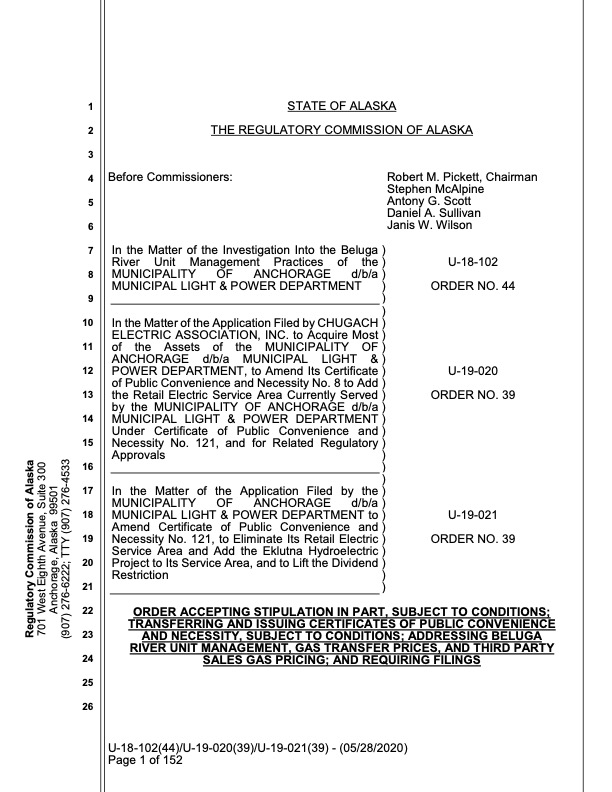
So let us take a look at a few excerpts from the final 152-page RCA decision concerning the sale of ML&P to Chugach Electric dated May 28, 2020 which is attached. (Dockets U-19-020, U-19-021 and U-18-102).

Page 2 – “The transaction as conceived by ML&P and Chugach was not straightforward.”

Page 10 – “Chugach will have only 13% equity after closing the transaction”

Page 41 – “One basic premise of the transaction is that base rates for ML&P and Chugach ratepayers will not increase as a direct result of Chugach’s acquisition of most ML&P assets.  For the reasons discussed below we cannot, and do not, accept that premise as limiting our rate setting authority or obligations under law.” 

Page 44 – “We note that this transaction was approved by the MOA Assembly and voters based in part on a public representation by Chugach that base rates for ML&P and Chugach ratepayers would not increase as a result of Chugach’s acquisition of most ML&P assets.  That public representation is not expressly included in any of the documents that we have been asked to approve …”

Page 48 – “We inform Chugach, the MOA, and ML&P, that closing this transaction under the terms and conditions we require in this order is an express waiver of any claims for remedies under the language of Ballot Measure 10 or any municipal ordinances if Chugach’s base rates are increased by us as a result of the costs incurred buy Chugach to acquire most of ML&P’s assets.” 

Page 106 – “To be clear, we declare under our authority in AS 42.05.141(a)(3) that any covenant by Chugach to comply with the rate provisions of Ordinance No. 2018-1(S) or Proposition 10 quoted above is an unreasonable practice that is void and unenforceable.”

What we see here is the RCA deeming itself a higher authority over ballot language and a vote of the people. 

With their hands tied by State statute, the RCA should have sent the sale of ML&P back to Chugach, the Municipality and the Anchorage Assembly with instructions to fix the ballot language and hold another vote of the people.  For reasons only the commissioners know they decided to approve the sale instead.

Clearly many were aware that due to Chugach’s fiscal situation, Chugach would inevitably need rate increases in order to purchase ML&P.  By utilizing Covid as an excuse is Chugach utilizing the adage ‘never let a crisis go to waste’?    

Which all brings us back to Chugach’s July 1 filing, where it claimed Covid and energy efficiencies are responsible for their ‘margin performance’.  Clearly this is not the whole story.  

Is Chugach Electric being honest with all of us? Are they not aware of their 13% equity rating since closing on the sale of ML&P as documented by the RCA?  Again, this was discussed numerous times during the 14-month process which, by the way, was pre-Covid.

Where does this leave the Chugach Electric ratepayers?  As members of a ‘membership owned cooperative,’ perhaps everyone should ask a few questions. A good place to start would be for the member owners to ask both Chugach and the RCA, in the spirit of fiscal transparency, for the release of an itemized listing of all vendors and costs incurred by Chugach concerning the purchase of ML&P.  This should include a copy of former Anchorage Mayor Mark Begich’s contract concerning the sale of ML&P to Chugach Electric. He was the one who brokered the deal, after all.

Since the start in 2017 of this advertised $1,000,000,000.00 sale of ML&P, the truth about this whole mess is beginning to emerge.  I encourage all to review the attached 152-page RCA decision allowing the sale of ML&P to Chugach Electric for further perspective on Chugach’s current request.

The Regulatory Commission’s Mission Statement mandates that they are to assure viable utility and pipeline service is provided at just and reasonable rates to consumers in Alaska.  For the RCA to have approved the sale of ML&P to an entity that will result in a 13% equity rating is neither just or reasonable.  

We should be asking if the RCA is assuring just and reasonable rates because of their actions and decisions in Dockets U-19-020, U-19-021 and U-18-102. 

These Dockets, dealing with the sale of ML&P, were decided by a three Commissioner seating rather than the full body.  Why the decision to approve the sale was made, only those three know.  Chugach’s current request is being held before all five currently seated Commissioners.  

With the final RCA decision on this due no later than July 29, 2022 this will certainly be an interesting Docket to follow.

Bob Maier is an Anchorage utility ratepayer.

Read: April fools joke is on the ratepayers

Win Gruening: Vote-by-mail voter’s remorse, buyer’s remorse, or perhaps both

By WIN GRUENING

A curious thing happened leading up to the recent Juneau vote-by-mail municipal election. City Clerk Beth McEwen reported that many people who mailed in a ballot contacted the city wanting to change their vote. She didn’t speculate on the cause, but a KTOO news story attributed this to late-breaking developments after ballots were sent to voters. 

I think it’s likely that this explains the anomaly and underscores one of the unintended consequences of mail-in voting.

Under Juneau’s new municipal vote-by-mail system, ballots were sent to 27,684 registered Juneau voters on Sept. 14. Assuming voters returned ballots as early as they did in 2020, about 3,000 ballots would have been mailed back in the first week or so. This means many voters submitted their ballot a full two weeks early, well ahead of the official “election day” deadline of October 5.

Yet, during that same week, Will Muldoon launched a write-in campaign for school board. His candidacy was heavily supported as evidenced by a well-orchestrated letters-to-the-editor campaign.

Additionally, several news stories surfaced about two other school board candidates – both of whom had protective orders filed against them and one whose record included significant tax liens and foreclosures. 

The 3,000 plus voters who had already voted didn’t have the benefit of this vital information. Some regretted their choices and wanted a do-over. Voters, however, are not allowed to change their ballot once submitted. 

Paul Gronke , director of the Early Voting Information Center, believes early voting is not a panacea. If used, he says, “The period for casting ballots should not be too long.” Why? Campaigns don’t really ramp up until the final two weeks and voters rarely pay serious attention until the days just  prior to the election. 

With a “rolling election” that began three weeks early, it’s important to ask if the process is fair to the candidates, fair to the electorate, or actually beneficial to democracy.

There are other reasons to question the wisdom of vote-by-mail.

Voter fraud is a serious subject and, while it has been used too often to justify electoral losses in other states (by both political parties), it should not be dismissed out of hand. There is little documented election fraud in this country, but the irregularities that do exist are often associated with unsolicited mail-in ballots.

In Juneau this year, anecdotal evidence suggests numerous voters received multiple ballots for other people. It’s clear that voter rolls are full of names of people who have moved or are deceased.

Even with an uptick in voter turnout, fewer than half of Juneau’s vote-by-mail ballots will be returned in any election year. That leaves over 14,000 ballots floating around Juneau post office lobbies and waste baskets and residential garbage cans. 

Presumably, voter verification processes are in place. But after Alaska’s Online Voter Registration System was hacked last December, allowing personal information for 100,000 voters to be exposed, how difficult would it be to defeat that system?

At a time when elections can be decided by a few votes and election integrity is critical, why tinker with our voting procedures? Especially when doing so makes it easier to send in fraudulent ballots or for special interests to “harvest ballots,” thereby giving voters even less reason to trust the results.

By the city’s own estimates, the first-year costs for vote-by-mail (including new equipment and renovation costs) could approach $1 million. The ongoing operational costs of conducting the election could exceed $200,000 per year, triple the cost of a conventional election where voters can choose to vote in person or request an absentee ballot.

When Juneau’s elected leaders decreed that local elections would forevermore be conducted via “vote by mail” instead of in-person at local precinct locations, the electorate was denied a complete informed discussion. Copycatting the vote-by-mail plan adopted in Anchorage was easier than engaging the public in a full debate that evaluated the merits and pitfalls of vote-by-mail.

The Juneau Assembly, it seems, has no problem busting the budget once more on a questionable expenditure. Now, whether Juneau’s taxpayers want it or not, they will be stuck with the extra costs of vote-by-mail. 

After retiring as the senior vice president in charge of business banking for Key Bank in Alaska, Win Gruening began writing op-eds for local and statewide media. He was born and raised in Juneau and graduated from the U.S. Air Force Academy in 1970. He is involved in various local and statewide organizations and currently serves on the board of the Alaska Policy Forum.

Read: Ranked choice voting is not that simple

Read: Population, population, population

Read: What will it take to get reliable ferry service?

Theater of the absurd: Man creates new religion, invites all of Anchorage to join to stay exempt from Assembly mask ordinance

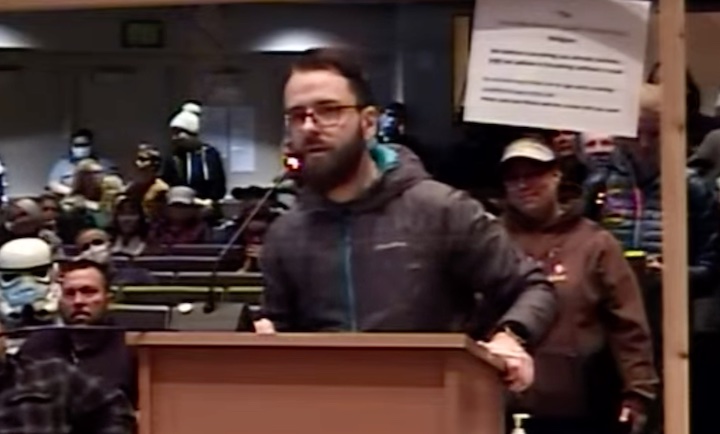
Immediately after the Anchorage Assembly voted to override the mayor’s veto of the Assembly’s mask ordinance, a man stepped to the podium to address the body. He said he has created a new religion, and all who sign his roster can be part of that religion, and thus, since religious assemblies are exempted from having to adhere to the emergency ordinance mask mandate, all could be exempted from the law.

Jordan (we could not catch his last name) said the new religion is “The Assembly Doesn’t Speak for Anchorage” religion.

“One of our tenets is our church is the entire city. And you’ve made exceptions for religious assemblies. Anyone who wants to sign up can. I am the president of this new religion. Your masks are now moot.”

Directly after his remarks, Assemblywoman Jamie Allard moved to extend public testimony until 7:30 pm, since the Assembly majority had only set aside a half hour for the meeting. But that vote failed, with Pete Person, Felix Rivera, Chris Constant, Meg Zaletel, Forrest Dunbar, Austin Quinn-Davidson, and Kameron Perez-Verdia voting to curtail the public comment period.

Four members were present in the Assembly chambers during the half-hour meeting. Allard and Crystal Kennedy were quarantining, and several others rarely attend meetings in person anymore. Someone had placed numerous roses on the desk where Allard sits.

One of the final comments made by the public was from a woman who stood before the Assembly and showed people how to vote to recall Meg Zaletel, the Assembly member who gave birth to the mask ordinance last month during a semi-secretive Assembly meeting.

Mayor Dave Bronson issued a statement after his veto was overridden 9-2:

“The Assembly’s override of my veto on their misleading mask mandate that was done without public notice or testimony is deceitful and wrong. The nine members who voted for this mask mandate ignored the public process, shut down public testimony, shut out the people, and decided that they (not you or your healthcare provider) will make decisions about your personal health. It’s just another effort by our Assembly to force the citizens of Anchorage to do their will and silence those who desire to exercise their right to petition their government. The Anchorage Assembly continues to break the public’s trust.”

Jamie Allard: This emergency ordinance is a gross abuse of Assembly authority

By ANCHORAGE ASSEMBLYWOMAN JAMIE ALLARD

I oppose Anchorage Emergency Ordinance 3, the mask ordinance. It is a gross overreach of this Assembly not only into the lives of our constituents, but also into the executive branch.

We have a duty to safeguard the separation of powers and to work with the mayor that the people elected. As intended and defined in the charter, the authority to make decisions in an emergency lies with the mayor.

The mayor has clearly communicated the multifaceted steps the Administration is taking to protect public health and address this endemic.

There is no emergency declaration at the state or city levels.

After this Assembly spent millions of Covid disaster relief money on issues not even remotely related to protecting public health, it is an embarrassment that our healthcare system is so fragile as to not be able to handle an inevitable Covid surge.

Where did that money go if not to prepare our hospitals for an increase in patients? Why are qualified healthcare workers being terminated for refusing a shot if we are in crisis mode?

Like those poor policy decisions, this mask ordinance is mixing politics with medicine, setting a dangerous precedent for medical totalitarianism, robbing the people of bodily autonomy, and turning our constituents against each other.

Furthermore, it is not even based on sound science, but rather on a false sense of security that you are “doing something” about Covid. But what the Assembly is doing is ignoring the will of the people, their right to informed consent to wear a medical device on their face, parental rights to make medical decisions for their children, and ignoring science that shows mandates are ineffective at best, and harmful at worst, not only to Covid outcomes in a community, but to overall physical, mental, and emotional health.

Mask mandates do not work, or else Covid would be a thing of the past. But what a mask mandate does do is tear our community apart. The evidence of that has been apparent the last two weeks, as we have listened to testimony after testimony about the real-world consequences these sweeping mandates cause.

It’s wielding a sledgehammer to kill a fly. It shreds the fabric of individual freedom upon which this country was built. As we have clearly seen, there are people in our community who cannot and will not comply with this ordinance. Which means it will require force. Force and coercion are the opposite of public health. It will not move anyone to kindness, will not inspire personal responsibility, and will not heal a very divided city.  It won’t even stop Covid.

And let me remind the Assembly that when it was politically convenient this Assembly voted to remove all emergency powers and orders (May, 2021, prior to the mayoral runoff).

This is not science. This is politics. And half of the community sees right through it.
 
This ordinance is nonsensical, unenforceable, unrealistic, and divisive. It violates my rights as a hearing-impaired American, forcing me to live in a world where I cannot read lips and cannot communicate effectively.

It robs our children of critical developmental processes such as learning to talk, building emotional intelligence and empathy, and socializing.

It creates embarrassing situations for our exempted neighbors with special needs or medical conditions, forcing them to explain themselves to strangers.

This ordinance places unfair and unenforceable pressure on businesses to police their patrons, and to provide masks for their employees. Will the assembly foot that bill? It welcomes discrimination and creates hostile work environments. It fails to acknowledge natural immunity in those who have recovered from Covid-19. And most egregiously, it fails to acknowledge that we are a free people, with inalienable rights that shall not be infringed.
 
As a veteran and a public servant, I am dedicated to fighting for the rights of my constituents. We are a diverse people, with different beliefs and opinions, and that makes us the vibrant community we all love. This ordinance turns that diversity against each other.

It is not our duty to micromanage the daily lives of our constituents. It is our duty to create policy that safeguards liberty, and the right to informed consent. If we really wanted to protect the public health, we would emphasize the importance of a healthy lifestyle and its significant impact on Covid-19 outcomes.

Our best strategy to minimize the Covid threat is public education on immunity and healthy bodies, vaccines, hand washing, staying home when symptomatic, and providing early treatment.

There is no emergency. Covid is here to stay. We cannot mask it away. We must live with it. This ordinance is a violation of our most valued American beliefs, and a pathetic political power move to usurp authority from a mayor who opposes the leftist nine.

It is a distraction from the homeless crisis, the border crisis, the Afghanistan crisis, and a recall election. I stand for individual responsibility and liberty first and foremost, as the foundation of our nation, the pillar of our policy, and the heritage for our children. 

Jamie Allard, a veteran, is one of two Assembly members representing Chugiak and Eagle River.

Alaska’s Covid daily positivity drops: 964

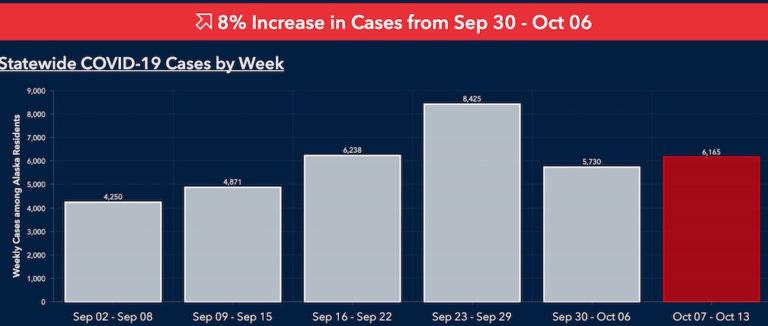
The latest count of positive Covid cases has dropped back to 964 after one day when it popped over 1,200 in Alaska. 421 of those positive cases were diagnosed in Anchorage, and 194 were in the Mat-Su Valley.

The positive cases are how many Alaskans have tested positive for Covid in the most recent 24 period, which lags by a day in reporting.

There have been 4,489 positive tests in the past seven days in Alaska. An unknown number of those are repeat tests. 10.7 percent of the Covid tests are coming back positive. In Anchorage, 5 percent of the tests are coming back positive, while in the Mat-Su Borough 9 percent are coming back positive.

The high number from the day before popped the overall increase week over week to 8 percent.

Hospitals are still under stress with not enough staffed beds, in spite of healthcare workers being brought in from Outside. Providence and Alaska Native Medical Center have open ICU beds, as does Joint Base Elmendorf-Richardson. All hospitals in the Southcentral region have openings in non-ICU beds.

There are 21 ICU beds open and available out of a total of 125 beds across the state.

208 Alaskans are currently hospitalized with Covid, but the number of those on ventilators has dropped to 25. Last week, there were 38 Alaskans on ventilators. The number of hospitalized patients who have Covid has remained stable at 19.6 percent.

Since Oct. 1, there have been 73 new Covid hospitalizations and 30 deaths. At this rate, October may see over 60 Covid deaths for the month.

A total of 592 Alaskans have died with Covid since March of 2020, about one per day.

That time when Assemblywomen Austin Quinn-Davidson and Meg Zaletel said only the mayor could enact a mask mandate…

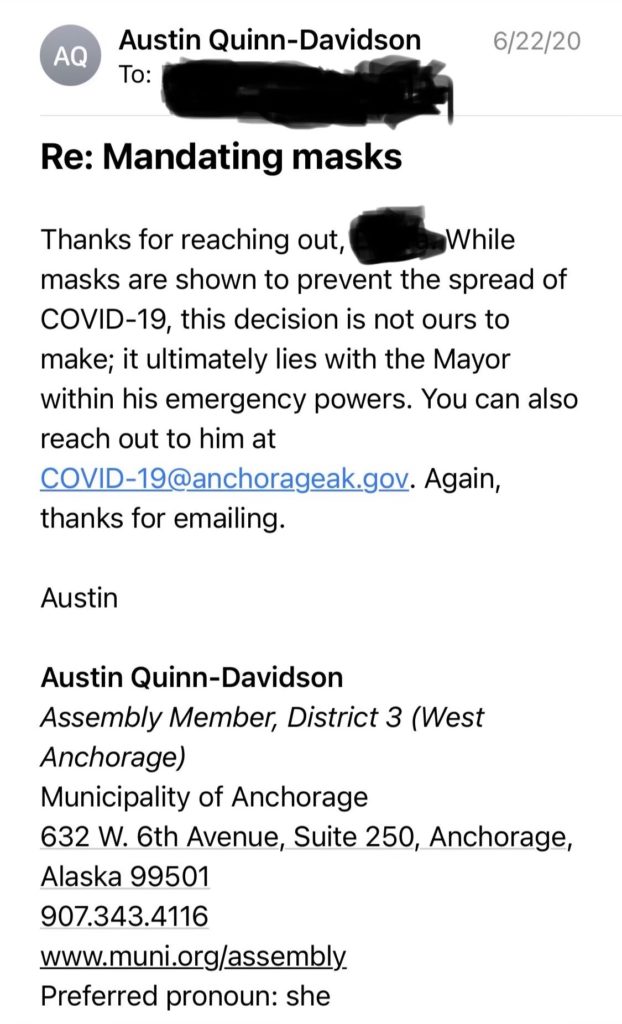
Assemblywoman Austin Quinn-Davidson hasn’t shown up in the Assembly chamber for months. She has participated by phone in the proceedings, and has stated that she is appalled and horrified at the people attending the meetings, who oppose the Assembly’s actions to forcibly mask everyone in Anchorage. She supports the emergency order passed by the Assembly on Tuesday.

But Quinn-Davidson didn’t always support Assembly power in this regard. In a note to a constituent in June of 2020, she wrote “While masks are shown to prevent the spread of COVID-19, this decision is not ours to make; it ultimately lies with the Mayor within his emergency powers.”

But evidently that only applied to a Democrat mayor. Ethan Berkowitz was in charge of the city back then. Now that there is a Republican mayor, Dave Bronson, Quinn-Davidson voted for the Assembly to pass an emergency ordinance making masks mandatory in Anchorage.

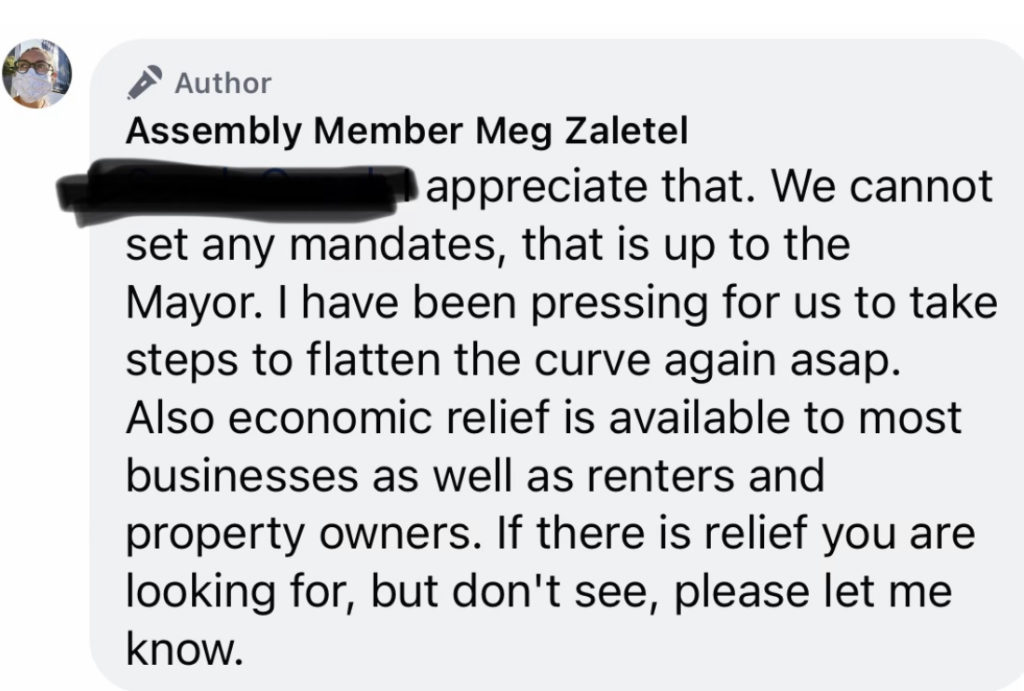
She wasn’t the only one who last year declared that only the mayor had that power.

Assemblywoman Meg Zaletel, in a similar note, wrote to a constituent: “We cannot set any mandates, that is up to the mayor. I have been pressing for us to take steps to flatten the curve again asap.” Her note was written last November.

Jab or no job XIII: Anchorage woman questions why local hospitals, with nearly two years to prepare, are doing so poorly

This is the 13th in a series of stories of people being fired from their jobs because they have declined to take the required Covid-19 vaccination. The identities of these workers are being kept confidential because they fear reprisal. In this edition, the story of a woman with Covid is told from her perspective. More stories will be included in future editions of this series as it continues. Previous interviews in this series are listed and linked at the bottom of this story. Send your story to [email protected].

By COVID POSITIVE / FIRST PERSON

I’m Covid-19 positive.

I started having a dry cough Friday. Since my family includes my elderly father and my husband, who just had open heart surgery in June, I decided to get tested as soon as possible. Oh, and yes, I’m fully vaccinated.

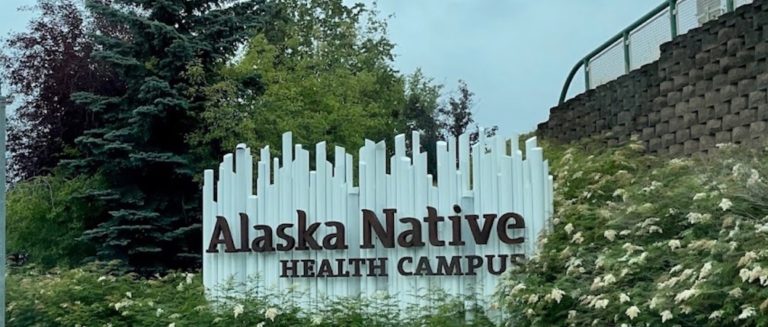
I pulled up to the Alaska Native Medical Center testing site only to find that is it closed on Saturday morning. Really? All I see on the news is pandemic, pandemic, pandemic and a testing site is closed one day a week?  I looked on the internet from my cell phone and find the next closest site was in the UAA parking lot. I pulled my car in and found no signs to the testing site.

There were signs for a CDL test, but nothing for COVID testing. But I saw a line of cars forming in the back east side parking lot, so I pulled over. There was one sign that stated I would need to preregister. I did. It took me about 40 minutes to get through the line with only 10 cars in front of me.

Two attendants were struggling in the pouring down rain to serve those of us who are now worried about our status. One worker finally got into his car and draped his now wet rain cape in his window to drive down the line of cars waiting.

Swabs up nostrils. Done. Now I waited.

And I waited some more. On Sunday, after 24 hours had passed, I decided to send an email off to Capstone, which had performed the test. I received an email back that an “error” occurred when running my test. The responder continued stating that my test would be rerun, and I’d receive the results that night.

By now, I wasn’t feeling confident about the test or my chances of it coming in that night. Predictably, the results didn’t come in. I went to bed that evening feeling like I was getting a bad head cold with the flu symptoms of achy joints. I took a generic over-the-counter cold medicine.

Monday morning I awakened to a text message and logged into my account: Large red letters announce that I’ve tested positive for Covid.

I was upset. I was angry. I was scared. I’ve been vaccinated. I’ve been wearing masks. I’ve been sanitizing my hands constantly. In short, I’ve been doing everything right! I worry about myself, my husband, and my dad.

Here’s my anecdotal evidence about the virus: The only people I know who’ve contracted it are people who’ve been vaccinated. One even had the third jab. In the last month I know of two who have died. 

Not knowing what to do, I called my doctor. Oh, I forgot. It was Columbus/Indigenous People’s Day. Nothing was open. I looked at my test result email there were no instructions. I called the Alaska Native Medical Center emergency room. The person answering there said they do not give advice over the phone. She would not even tell me if I should visit the emergency room.

I’m at high risk of a spontaneous pneumothorax, which is a fancy way of saying my lungs collapse. Since my five episodes a few years back, I’ve been careful with any respiratory issues. I’ve gotten the flu shot annually. I take vitamins.

I decided to visit the Alaska Native Medical Center ER. That was a mistake. The nurse there tersely stated to me when I told her I tested positive for COVID, “What are you doing here? You need to go home and treat it like a cold.”

I continued: “But I have extra risk factors….” The nurse would not let me finish. So I leave. By the way, there were only three people in line to visit the emergency room when I was there, including me.

Fortunately for me, a friend who has had the virus told me about the monoclonal antibody Covid-19 treatment offered by the State of Alaska. I was able to get in that afternoon since there’s a place you can go without a doctor’s note. That was a good thing, since apparently all medical offices have a day off during the pandemic.

The treatment takes about and hour and a half. The private contractor who operates the site has skilled medical personnel in hazmat suits like you see on TV treating up to 11 people at a time. Antibodies are input into your body via an IV. I feltl very safe and comfortable.

It’s now been four days. I feel like I have a head cold. I’m treating that with drug store medicine. I’m convinced that the antibody treatment saved me and my lungs from having a terrible experience. I received a call on Tuesday from Capstone asking me if I received my results and told me to expect a call from another entity to do “contract tracing.” I’m still waiting for that one call today, Wednesday. Given how fast the virus spreads I’ve already called everyone that I was in contact with the previous week to inform them of my status.

With all the money that’s been dished out to municipalities, hospitals and clinics, why are testing sites closed one day a week?

Why can’t the medical professionals give a simple set of instructions with options when test results are sent out?

It seems to me that a person who is positive should go directly to a Covid treatment site set up in each community. Our Anchorage Assembly should have directed the money to development treatment centers instead of diverting funds to buy properties for homeless shelters.

Anchorage hospitals have had a year and a half and they still don’t have a treatment plan in place. Instead of telling me to go home and treat my Covid like a cold, medical officials should have sent me directly to a treatment site. We need treatment centers, not mask mandates.

The author is a successful Anchorage businesswoman and Alaska Native, now home recovering from Covid. Her name is being kept anonymous because she, like others in this series, have everything to lose by criticizing the medical establishment.

Read: Part 1: Nurse losing job, after her medical exemption refused

Read: Part II: Pharmacist losing job

Part III: Southcentral Foundation employee losing job Oct. 15 over shot refusal

Part IV: Dozens of Alaskans come forward to tell their stories of being fired for not getting the shot

Part V: Military man getting discharged in Alaska for not taking jab

Part VI: Nurse says she sees too many blood clotting cases associated with jab, so she’s not taking it

Part VII: Bethel police investigator gets put on leave, won’t be returning to the force

Part VIII: Alaska Native man says unvaccinated patients are getting the shaft

Part IX: Sophies choice, between Moderna vaccine or childbearing?

Part X: Respiratory therapist describes growing underground of workers

Part XI: Supervisor says employees facing few options

Part XII: Founder of medical underground speaks about workers

Part XIII: Covid positive patient says Alaska Native Medical Center treated her with indifference

Read: ICU Nurse: Let’s stop demeaning the unvaccinated

Read: Doctor says hospitals are not in crisis, not rationing care

Read: My doctor fired me because I won’t take the vaccine

Details of the Anchorage mask law: To whom and when does it apply? Know the law

The Anchorage mask law will go into effect if and when the Anchorage Assembly votes to override the veto of Mayor Dave Bronson. This is not AO 2021-91, but a sneak look-alike “emergency ordinance” that required no public testimony.

When it does go into effect Thursday evening, with the presumed veto override, all who are in Anchorage must wear masks over their nose and mouth when indoors in a public place, or when gathering with people who are not members of one’s household.

The ordinance requires:

  • Medical grade masks or cloth, polypropylene, paper or other face coverings.
  • Masks or face coverings should rest snugly above the nose, below the mouth, and on the sides of the face; N95 masks are recommended.
  • The following are not face coverings because they allow droplets to be released: a covering that incorporates a valve that is designed to facilitate easy exhalation, mesh masks, lace masks or other coverings with openings, holes, visible gaps in the design or material, or vents.
  • The mask law does not specifically ban neck gaiter-style masks. The “should” portion of the ordinance leaves wide latitude for interpretation by the public for how to properly wear a mask.

Who must wear the mask

All individuals must wear masks or face coverings over their noses and mouths when they are indoors in areas which are open to the public or which are communal spaces shared with other individuals not from one’s household.

Exemptions exist for cases such as children under the age of five, individuals who cannot tolerate a mask due to a physical or mental disability, and religious assemblies. See below for the full list.

Businesses may choose to allow individuals who request an accommodation under the ADA to wear a face shield or accommodate these individuals through alternate means, such as curbside, delivery, or telephonic service.

Face shields may be permitted for the following individuals, who must wear a face shield whenever a face covering would be required unless it is impossible to do so:

Any individual who cannot tolerate a mask due to a physical or mental disability; the individual’s or guardian’s statement that they are exempt is sufficient evidence;

Also exempt are individuals who are communicating with someone who is deaf or hard of hearing; Individuals performing an activity that cannot be conducted or safely conducted while wearing a mask (for example, a driver experiencing foggy glasses, a dental patient receiving care, an equipment operator where there is a risk of dangerous entanglement).

The ordinance does not apply to the following categories of businesses, people, or activities:

Any child under the age of 5 years but face coverings are recommended for children over 2 years of age.
Individuals who are incarcerated, in police custody, or inside a courtroom; these individuals should follow guidance particular to their location or institution. Presenters, musicians, others communicating to an audience or being recorded, if they are 10 feet from the audience and all members of the audience are wearing face coverings.

Individuals may remove their face coverings to eat, drink, or “briefly scratch an itch.” Employees within their own fully enclosed office or workspace or within an unenclosed workspace if they are totally alone are allowed to remove their masks.

Fully vaccinated employees working in a separate room from the public and unvaccinated coworkers. Employees wishing to utilize this exception must be able to show a “vaccine passport” to their employer. All employees in the separate room that are vaccinated in a manner can be separated from other workers, “consistent with workplace anti-discrimination laws.”

Individuals performing an activity that cannot be conducted or safely conducted while wearing a face covering are exempt.

Individuals who cannot tolerate a face covering due to physical or mental disability are exempt. The individual’s or a guardian’s statement that they are exempted is sufficient evidence.

All athletic activities when a person is actively engaged in that activity are exempt. Indoor gyms, fitness centers, boutique fitness clubs, and other businesses or entities, including the school district, may require face coverings regardless of this exemption. This exemption does not apply to spectators not engaged in athletic activity.

Religious assemblies are exempt.

The Mayor and his executive team are exempt, but not the employees of the municipality, evidently.

Read the full text of the emergency ordinance EO-3 at: www.Muni.org/Assembly

“Businesses, employers, and building owners shall deny admittance to any individual who fails to comply with this Emergency Ordinance, as long as the regulation is applied in a manner consistent with the federal Americans with Disabilities Act (ADA) and any other applicable provision of law,” the ordinance states.

Employers must make sure employees who are present in the workplace have access to and wear masks or face coverings when required.

The Municipality reserves the right to use all available enforcement options to assure compliance with this Emergency Ordinance. Violation of this Ordinance does not create grounds for residents to harass individuals who do not comply with it, the ordinance states.

How long will it last?

The Emergency Order goes into effect immediately and expires when Anchorage has reached a point of sufficient medical capacity or no later than 60 days without further action by the Assembly.

The public health emergency does not end until either (1) crisis standards of care are ended at two of three local hospitals for 14 consecutive days; or (2) there is no longer substantial or high community transmission per the CDC for 14 consecutive days.

“When the Municipality of Anchorage is experiencing a public health emergency, the requirements of this ordinance shall be in effect,” the ordinance states.

The municipality is not experiencing a public health emergency, except that this ordinance falls under the national emergency declared by President Biden, which stays in effect through February 2022, which effectively means the mask ordinance can continue until the president changes the emergency order.

Could be crowded: Leftists to occupy Assembly chambers, as mayor also invites people to watch Assembly override his veto

Mayor Dave Bronson encouraged people to attend the 5 pm Thursday meeting of the Anchorage Assembly to witness the Assembly override his veto of the emergency ordinance forcing all in Anchorage to wear masks.

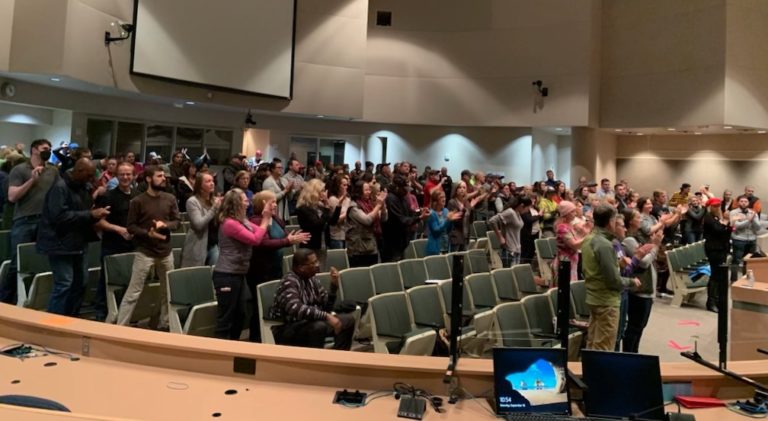
But a group of Democrats has called for their masked brethren to show up in force, double-masked, and occupy the front of the Assembly chambers to push out the pro-freedom activists who have spent dozens of hours expressing their opposition to the law, which is not in effect until the override vote.

The Democrats will be arriving early, and in force, according to the organizer, Elstun Lauesen, who is the husband of Rep. Harriet Drummond, an Anchorage Democrat.

“We need 200 people in the assembly chambers tomorrow to support our Assembly. Occupy the front of the room and form a barrier between the Assembly and the mob. Be there when they open at 5:00.
DOUBLE-MASK! [NOTE: Several folks mentioned that “if it opens at 5, be there by 4:15 to get in]” Lauesen wrote.

The Assembly Chamber doesn’t hold 200 people but the group appears ready to ignore the six-foot distancing guidelines, protected by their double masks. The Assembly majority has set 100 as the limit for the room, which can hold up to 180.

In his response to a question from one of his Facebook friends, Lauesen called Bronson a “fascist Mayor.”

“The fascist Mayor vacated security for the assembly before, he may do it again,”

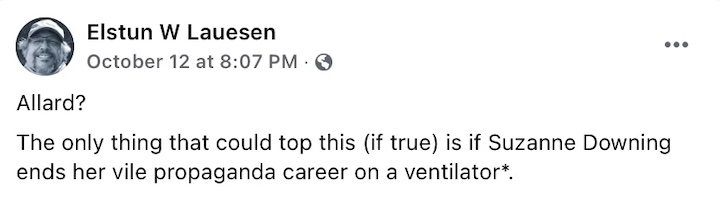
Lauesen, the organizer of the occupy Democrats, also wrote that he hopes author Suzanne Downing of Must Read Alaska ends up on a ventilator to end her career:

In the past, Lauesen has incited violence, calling for pitchforks and tar and feathers to be used against public officials in the Dunleavy Administration. The mainstream media has ignored his threats.

Read: Elstun Lauesen calls for pitchforks, tar and feathers for Kelly Tshibaka

Mayor Bronson has continued to oppose the compulsory mask ordinance in a statement on Wednesday on Facebook:

“The Assembly didn’t even have the conviction, courtesy, or courage to take those actions in front of the people. Instead, they waited to introduce and pass this measure without public notice and after 10pm at night. They have made their agenda clear: shut down the people, shut down the public process, and shove the heavy hand of government mandates into your personal health decisions,” Bronson said.

Bronson wrote of the ordinance, “It’s also un-Alaskan, to force a mask and take away someone’s right to make their own choices for their health. Please come out and respectfully express your right to be part of the public process.”

The Assembly is sure to override his veto of the mandatory masks for Anchorage, as nine of the Assembly members voted in favor of what they are deeming an emergency ordinance.

The Assembly majority lied to the public, telling them they would be able to give testimony about the ordinance on Wednesday, and then at the end of Tuesday’s meeting, passed a look-alike ordinance without public testimony, making the Wednesday meeting for a hearing unnecessary.